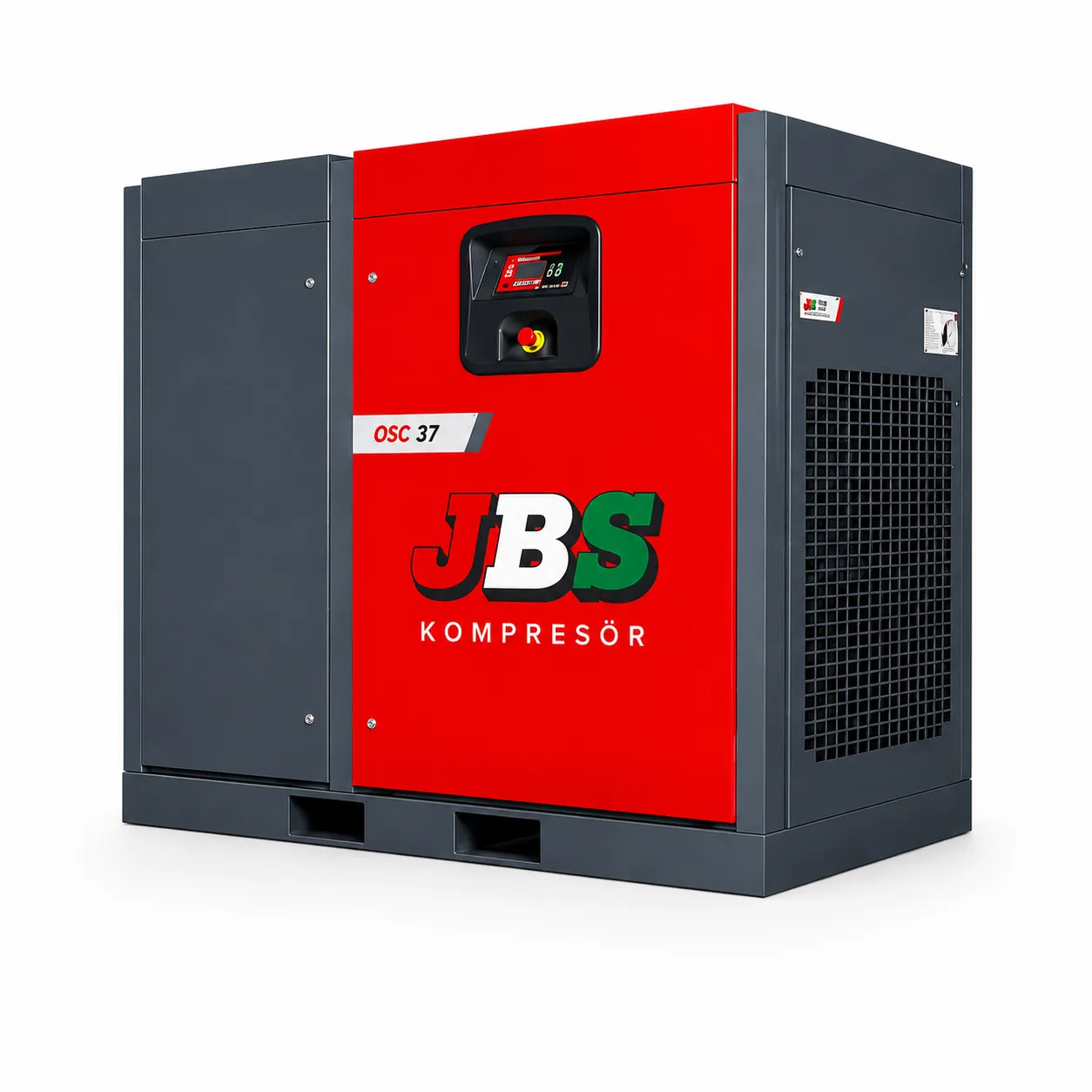
What Is a Rotary Screw Air Compressor?
Rotary screw air compressors are industrial systems that produce compressed air using two intermeshing screw rotors.
Unlike reciprocating compressors, they provide a more consistent and continuous compressed-air supply. They can therefore be preferred by businesses that operate for extended periods, use multiple pneumatic tools simultaneously, or experience frequently changing air demand.
Rotary screw compressors can supply the compressed air required by production machinery, pneumatic tools, assembly lines, painting operations, packaging systems, and automation equipment.
A compressor should not be selected according to motor power alone. The facility’s total air consumption, required working pressure, simultaneous usage, air-quality requirements, and daily operating time should be evaluated together.
OSC-V Series Variable-Speed Screw Air Compressors
OSC-V Series Variable-Speed Screw Air Compressors automatically adjust motor speed according to the facility’s changing compressed-air demand.
The series offers motor-power options from 3 to 132 kW for different operating capacities. Its premium-efficiency motor, air end, Poly-V belt-drive system, advanced cooling structure, and control panel support reliable and consistent compressed-air production.
| Series / example model |
Motor power |
Air delivery |
Working pressure |
Control system |
Recommended use |
| OSC-V Series |
Model options from 3 to 132 kW |
Varies by selected model |
Varies by selected model |
Variable-speed drive |
Businesses with variable and long-duration air demand |
| OSC V-55 |
55 kW |
9.5 m³/min |
7–13 bar |
Variable-speed drive |
Manufacturing facilities and intensive industrial compressed-air applications |
The OSC V-55 values shown in the table represent one example model within the series. Motor power, air delivery, working pressure, dimensions, and weight vary according to the selected model.
How Does a Variable-Speed Screw Compressor Work?
The variable-speed drive monitors the facility’s current compressed-air demand and adjusts the compressor motor speed accordingly.
When air consumption decreases, the motor runs at a lower speed. When demand increases, the system raises its output to maintain the required pressure. This operating method helps prevent the compressor from continuously running at full capacity and may reduce unnecessary energy consumption.
The variable-speed system also supports controlled motor starting, helping reduce sudden electrical loads and mechanical stress.
Energy savings depend on the facility’s consumption profile, compressor capacity, working pressure, air leaks, and daily operating pattern. An oversized variable-speed compressor may also operate inefficiently.
Applications of Rotary Screw Air Compressors
| Application |
Operations that may use compressed air |
| Industrial and manufacturing facilities |
Production lines, automation, and pneumatic machinery |
| Automotive service centers |
Air blow guns, pneumatic tools, and paint preparation |
| Metalworking facilities |
Cutting, assembly, grinding, and pneumatic equipment |
| Textile businesses |
Weaving, yarn processing, packaging, and production machinery |
| Plastics and packaging industry |
Production, molding, conveying, and packaging systems |
| Furniture manufacturing |
Pneumatic guns, presses, and production equipment |
| Glass and machinery manufacturing |
Automation, assembly, and controlled-air applications |
| Food and beverage facilities |
Packaging and pneumatic-control systems with suitable filtration |
| Pharmaceutical and precision manufacturing |
Production equipment with appropriate drying, filtration, and air-quality controls |
In food, beverage, pharmaceutical, and product-contact applications, air from a standard oil-injected compressor should not be used directly. An oil-free compressor, suitable dryer, and filtration system should be evaluated according to the required compressed-air quality class.
Advantages of Rotary Screw Air Compressors
Depending on the operating conditions, rotary screw air compressors may provide the following advantages:
- Compressed-air production suitable for long operating periods
- More consistent and continuous airflow
- High air-delivery options
- Ability to supply multiple pneumatic tools simultaneously
- Different motor-power and capacity options
- Adaptation to variable air demand with variable-speed models
- Controlled motor starting
- Compact cabinet construction
- Lower-vibration operation
- Operating and maintenance monitoring through the control panel
- Configuration with an air receiver, dryer, and filters
To benefit from these advantages, compressor capacity must be calculated correctly, the air system must be installed properly, and periodic maintenance must be completed on time.
What Is the Difference Between a Rotary Screw Compressor and a Reciprocating Compressor?
Reciprocating compressors may provide an economical solution for small businesses with intermittent and lower compressed-air demand. Rotary screw compressors are designed for businesses requiring longer operating periods, higher air delivery, and a regular compressed-air supply.
| Evaluation |
Reciprocating compressor |
Rotary screw compressor |
| Operating pattern |
Intermittent use |
Long-duration and regular use |
| Air delivery |
May be pulsating and variable |
More continuous and consistent |
| Capacity |
Low and medium air demand |
Medium and high air demand |
| Initial investment |
Generally lower |
Generally higher |
| Intensive use |
May be limited depending on the model |
More suitable for intensive use |
| Application |
Small workshops and service work |
Manufacturing facilities and industrial applications |
A reciprocating compressor may be sufficient for a few pneumatic tools used for short periods each day. A rotary screw compressor should be considered when production continues throughout the day and compressed-air demand is high.
Which Rotary Screw Air Compressor Should You Choose?
To determine the correct capacity, calculate the air consumption of all equipment that will operate simultaneously in m³/min or L/min.
The following information should be included in the calculation:
- Air delivery required by each piece of equipment
- Required working pressure
- Number of tools or machines operating simultaneously
- Operating and standby times of the equipment
- Pressure losses in the piping system
- Existing and potential air leaks
- Machinery that may be added in the future
- Total daily operating time
- Ambient temperature and ventilation conditions
The variable-speed OSC-V Series can be considered for businesses where compressed-air consumption changes significantly throughout the day. For applications with continuous and stable demand, a technical comparison should be made based on capacity calculations and total energy cost.
An undersized compressor may operate continuously at full capacity without providing sufficient pressure. An oversized compressor may increase initial investment, maintenance, and energy costs.
What Should You Consider When Buying a Rotary Screw Air Compressor?
The following features should be checked before purchasing:
- Motor power
- Actual free-air delivery
- Required working pressure
- Fixed-speed or variable-speed control
- Air-end and drive construction
- Motor-efficiency class
- Cooling system
- Sound level
- Control-panel features
- Accessibility of maintenance points
- Oil and separator system
- Air-receiver requirement
- Dryer and line-filter requirements
- Piping diameter and pressure loss
- Compressor-room ventilation
- Technical service and spare-parts support
The maximum air-delivery value stated in a catalog is not sufficient by itself. The actual air delivery at the required working pressure should be used as the main selection criterion.
Are an Air Receiver, Dryer, and Filters Required?
An air receiver stores the compressed air produced by the compressor, helping meet sudden changes in demand and stabilize system pressure.
A refrigerated air dryer helps remove moisture generated during compression from the compressed-air line. Moisture can cause corrosion in pneumatic equipment, surface defects in painting applications, and failures in production processes.
Line filters are used to reduce particles, oil, and other contaminants according to the application’s requirements. The required receiver, dryer, and filter capacities should be determined according to the compressor’s actual air delivery and the required air quality.
What Should You Consider During Installation and Maintenance?
The compressor should be installed in an area that provides clean intake air, adequate ventilation, and sufficient access for maintenance. Hot discharge air must not be allowed to circulate back into the compressor intake.
The main components requiring regular inspection include:
- Air and oil filters
- Compressor oil
- Oil separator
- Belts and connections
- Cooler and radiator surfaces
- Air leaks
- Electrical connections
- Condensate-drain system
- Dryer and line filters
Maintenance intervals should be followed according to the manufacturer’s instructions and operating hours. Delayed maintenance may reduce air delivery, increase energy consumption, and cause unexpected downtime.
Rotary Screw Air Compressor Prices
Rotary screw air compressor prices vary according to motor power, air-production capacity, working pressure, variable-speed drive, air end, control system, air receiver, dryer, filters, and installation scope.
The total investment calculation should include not only the compressor price but also the electrical infrastructure, compressed-air piping, ventilation, receiver, dryer, filters, condensate drainage, installation, and periodic maintenance costs.
Share the equipment you will operate, required working pressure, daily operating time, and available electrical infrastructure with JBS Makina to receive a technical assessment and current quotation for the most suitable OSC-V model.
To explore the available products, visit the rotary screw air compressors category.