JBS Makina
Menu
Language

Air Compressors Compressed Air Dryers

Compressed Air Dryers

JBS Makina compressed-air dryers help reduce moisture in air supplied by compressors, supporting the protection of air lines, pneumatic equipment, and production processes.

Category Guide

Product Selection Guide and Technical Information

What Is a Compressed-Air Dryer?

Compressed-air dryers are auxiliary systems used to reduce water vapor and moisture in air produced by a compressor.

Moisture in the atmospheric air drawn into the compressor can condense inside the air line after compression and cooling. The resulting water may cause pipe corrosion, pneumatic-equipment failures, surface defects during painting, and performance loss in production processes.

An air dryer is not a compressor and does not produce compressed air. It processes the air supplied by the compressor to provide a drier and more stable air supply.

JBS Compressed-Air Dryer Model

Model Air capacity Working pressure Pressure dew point Power consumption Refrigerant
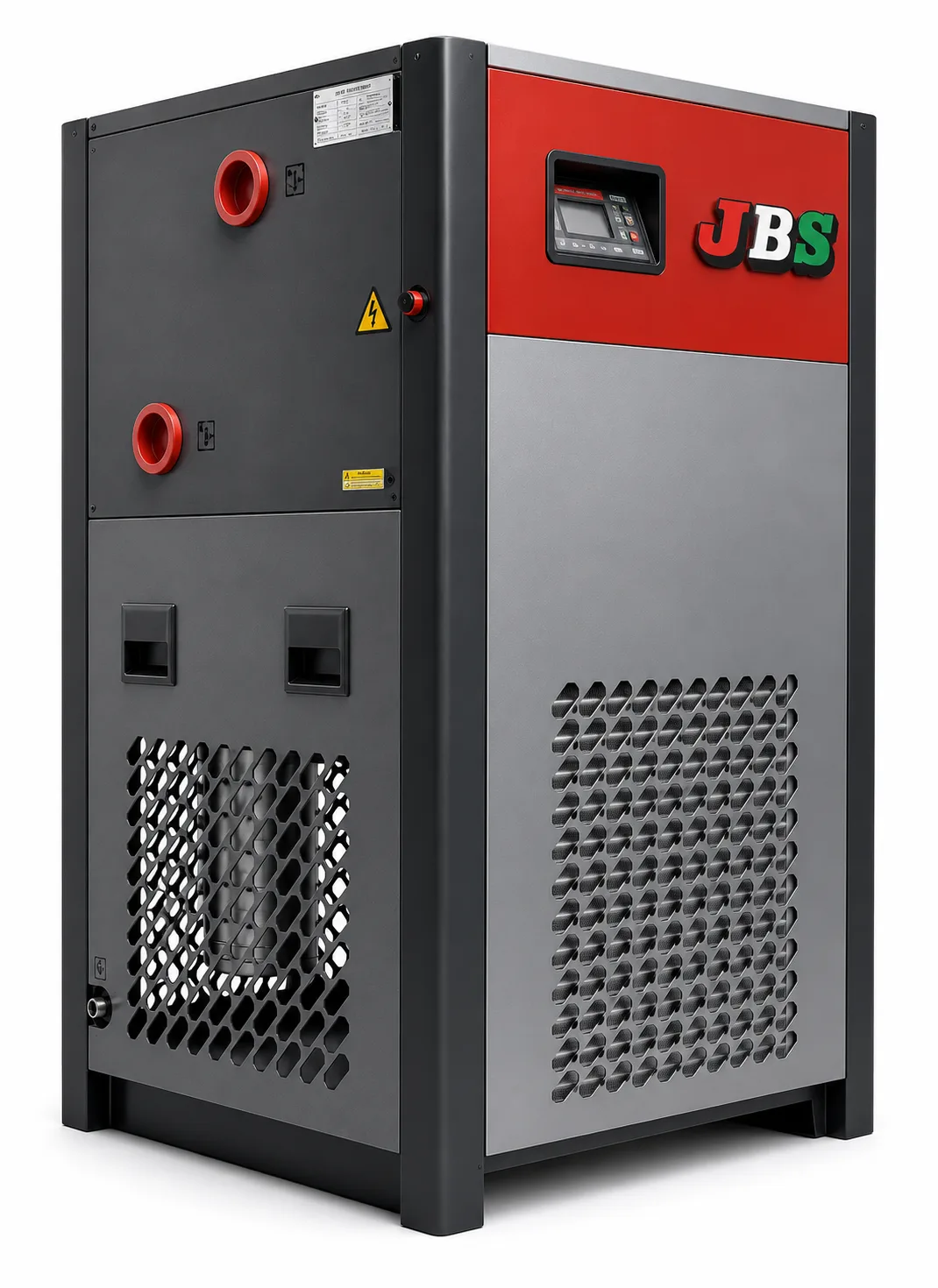
ODR-300 Refrigerated Air Dryer 30 m³/min 7–16 bar +3 °C 5.80 kW R-410A

The stated capacity of the ODR-300 may vary according to operating conditions. Compressor flow rate, inlet temperature, ambient temperature, and working pressure should be evaluated before ordering.

How Does a Compressed-Air Dryer Work?

A refrigerated air dryer cools the warm, moisture-laden air supplied by the compressor under controlled conditions. During cooling, water vapor condenses into liquid.

The separated water is removed from the air line through a condensate-drain system. The dried air is then brought back to an appropriate temperature before entering the compressed-air network.

For efficient operation, prefilters, after-filters, condensate drainage, ventilation space, and connecting pipework should be planned correctly.

Applications

Compressed-air dryers can be used in:

  • Factories and production facilities

  • CNC and automation systems

  • Pneumatic machinery and hand tools

  • Automotive service centers and tire shops

  • Paint and coating workshops

  • Packaging and filling lines

  • Metal- and woodworking businesses

  • Industrial systems powered by compressed air

A standard refrigerated dryer alone may not be sufficient for food, pharmaceutical, or sensitive production processes. The required air-quality and filtration classes should be determined according to the process requirements.

Why Use a Compressed-Air Dryer?

Using an air dryer helps reduce water accumulation and moisture-related failures in compressed-air lines. It supports the protection of pipework, air receivers, valves, cylinders, and pneumatic equipment.

It can contribute to more stable air quality in painting and coating applications while helping reduce production interruptions caused by moisture.

An air dryer does not remove oil or all particles on its own. Suitable line filters should also be used to achieve the required compressed-air quality.

What Should You Consider When Buying a Compressed-Air Dryer?

The following factors should be evaluated before purchasing:

  • Actual compressor air flow

  • Working pressure

  • Dryer inlet-air temperature

  • Ambient temperature

  • Required pressure dew point

  • Daily operating time

  • Compressed-air connection size

  • Power consumption and electrical infrastructure

  • Prefilter and after-filter requirements

  • Condensate-drain system

  • Installation and ventilation space

  • Technical service and spare-parts support

The dryer should not be selected according to compressor motor power alone. Actual air consumption and peak flow demand must be considered.

An undersized dryer may not achieve the required dew point. An unnecessarily large model may increase both purchase and energy costs.

Compressed-Air Dryer Prices

Compressed-air dryer prices vary according to air capacity, working pressure, dew point, power consumption, connection size, filters, and installation scope.

Share your compressor capacity, working pressure, inlet temperature, and application with JBS Makina to receive a technical assessment and current quotation for the appropriate ODR model.

To review the available products, visit compressed-air dryers.
Compressed Air Dryers Use Cases

  • Compressor Air Lines - Compressed-air dryers reduce moisture in air leaving the compressor, helping prevent water accumulation, corrosion, equipment faults and performance loss in the air line.
  • Industrial and Production Facilities - Provides drier air for pneumatic machines, production lines, assembly systems, presses, automation equipment and other air-powered machinery.
  • Automotive Service and Vehicle Care Areas - Supports blow guns, pneumatic equipment, tire inflation and detailing work in service centers, car wash businesses and tire shops. Drier air helps protect equipment and stabilize operation.
  • Paint and Coating Applications - Moisture can negatively affect surface finish. Air dryers support cleaner, drier air for painting, varnishing and coating applications.
  • Food and Packaging Facilities - Controlled air quality is important in food production, filling, packaging and pneumatic conveying. Dryers help reduce moisture-related problems and support more stable production.

Compressed Air Dryers Advantages

  • Reduces Moisture in the Air Line - Helps remove moisture from compressed air, reducing condensation that can cause water accumulation, corrosion, equipment faults and lower air quality.
  • Helps Protect Equipment and Piping - By reducing moisture, dryers help protect pipework and connected equipment from condensation, rust, corrosion and water-related failures.
  • More Stable Air Quality - Drier air helps reduce water accumulation, blockages, painting defects and irregular operation in pneumatic systems.
  • Integrated Operation with the Compressor System - Compressed air passes through the dryer before reaching the receiver, filters, regulators and downstream equipment, supporting a healthier complete air system.
  • Different Capacity Options - Capacity can be selected according to compressor airflow, operating pressure and duty cycle, from smaller workshops to continuously operating industrial systems.

Buying Guide

Compressed Air Dryer Buying Guide

When selecting a compressed air dryer, the actual air flow rate should be considered instead of the compressor’s motor power. Operating pressure, the temperature of the air entering the dryer, ambient temperature, and the required dew point must all be evaluated together.

Before purchasing, the following features should be checked:

  • Maximum air flow rate of the compressor
  • Operating pressure of the air line
  • Compressed air inlet temperature
  • Ambient temperature and ventilation conditions
  • Required pressure dew point
  • Inlet and outlet connection sizes
  • Power consumption and electrical connection
  • Pre- and post-filtration requirements
  • Automatic condensate drainage system
  • Technical service and spare parts support

If the dryer capacity is insufficient, moisture in the air line may not be reduced to the desired level. On the other hand, selecting an oversized model increases both purchase and energy costs.

ODR-300 Refrigerated Type Air Dryer offers a 30 m³/min capacity, 7–16 bar operating pressure, and a +3 °C dew point. Before ordering, it is important to verify that these values are compatible with the existing compressor system and operating conditions.

For sensitive processes requiring very low dew points, alternative drying technologies may need to be considered instead of standard refrigerated dryers.

Related Links

Frequently Asked Questions

Is an Air Dryer a Compressor?

No. A compressor produces compressed air, while a dryer helps reduce moisture in the produced air.

How Is Air Dryer Capacity Selected?

The compressor's actual air flow rate, operating pressure, inlet temperature, and ambient conditions should be considered.

Is an Air Dryer Required in Every System?

The requirement depends on air-quality and moisture sensitivity. The pneumatic equipment and process conditions should be evaluated.

Plan Your Compressed-Air Quality

Share your compressor flow rate and application to receive technical selection support for the appropriate air dryer.

Request a Quote

Request a Quote

Request a quote for Compressed Air Dryers

Tell us what you need and our sales team will recommend the right model, capacity and equipment for your application.