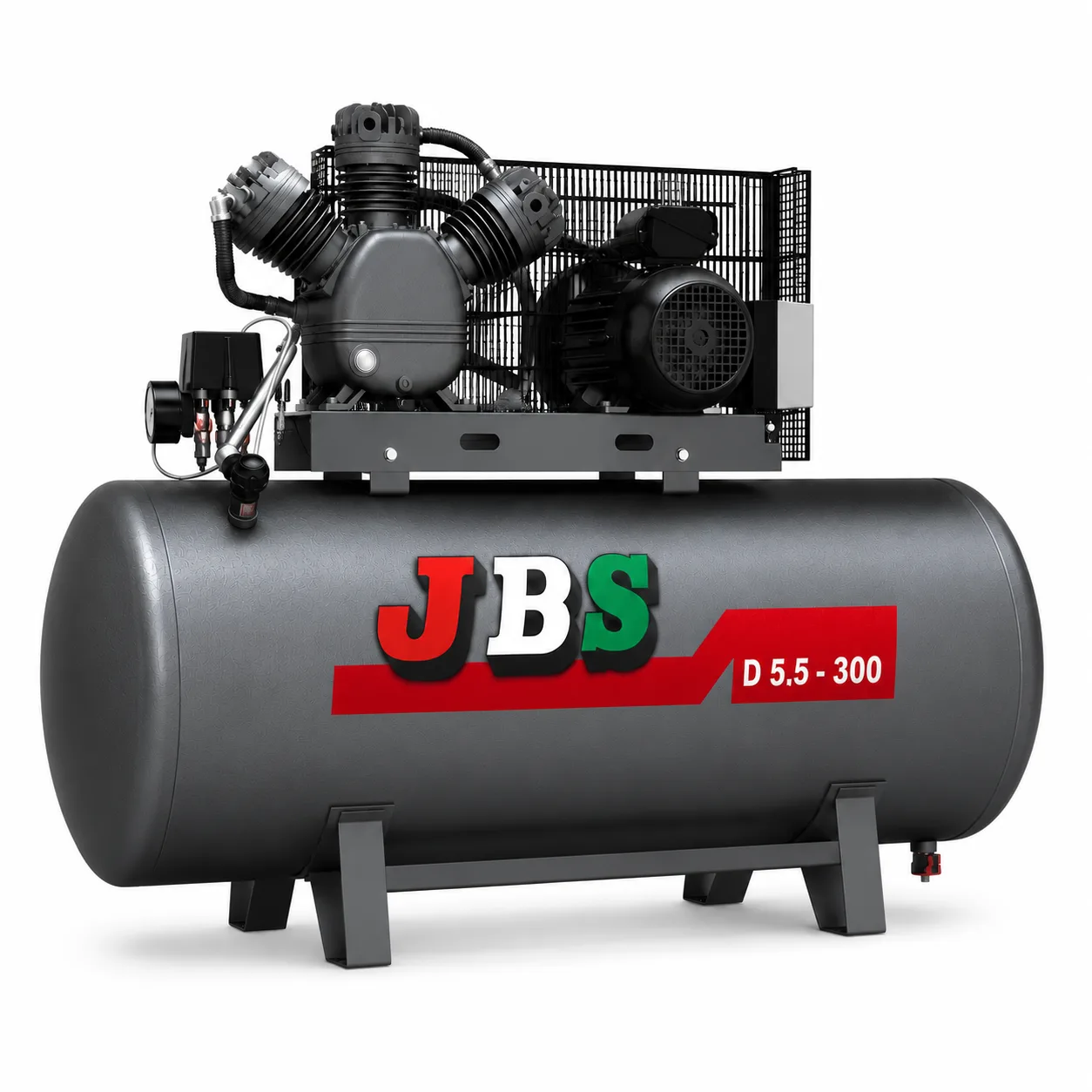
What Is a Reciprocating Air Compressor?
Reciprocating air compressors use piston movement to compress atmospheric air and store it in an air receiver.
They can supply pneumatic tools, tire-inflation equipment, spray guns, and other air-powered machinery. Their economical initial cost and practical maintenance make them particularly suitable for intermittent compressed-air demand.
For continuous operation and applications requiring a high air flow rate, rotary screw air compressors should be considered.
JBS Reciprocating Air Compressor Models
| Model |
Pressure |
Intake capacity |
Motor |
Receiver volume |
Recommended use |
| D-5.5-300 Piston Air Compressor |
7 bar |
649 L/min |
4 kW / 5.5 HP |
250 L |
Workshops, automotive services, and intermittent use |
| D-5.5-500 Piston Air Compressor |
7 bar |
649 L/min |
4 kW / 5.5 HP |
500 L |
Businesses requiring a larger compressed-air reserve |
The receiver volume of the D-5.5-300 is listed as 250 liters in the current technical specifications. Updated technical details should be confirmed before ordering.
How Does a Reciprocating Air Compressor Work?
An electric motor operates the compressor pump. Air drawn into the cylinder is compressed by the piston and transferred to the air receiver.
The motor stops when the receiver reaches the specified pressure. It starts again when pressure falls during use.
The receiver provides a temporary air reserve during sudden demand. A larger receiver does not increase the compressor’s air output; it only affects storage capacity and operating balance.
Applications
Reciprocating air compressors can be used in:
- Automotive service centers and tire shops
- Bodywork and paint workshops
- Furniture and woodworking businesses
- Small production facilities
- Maintenance and assembly workshops
- Agricultural businesses
- Work areas using pneumatic tools
The operating pressure and air consumption of connected equipment must be compatible with the compressor’s capacity.
Which Model Should You Choose?
The D-5.5-300 can be considered by businesses with limited installation space and intermittent compressed-air demand.
The D-5.5-500 offers the same motor and air-output capacity with a larger receiver. It can provide a greater air reserve for frequently repeated periods of short-term consumption.
Both models have the same intake capacity and motor power. Selection should therefore be based mainly on receiver volume, installation space, and operating frequency.
What Should You Consider When Buying a Reciprocating Air Compressor?
The following features should be checked before purchasing:
- Required working pressure
- Intake capacity and free air delivery
- Total air consumption of the equipment
- Motor power and electrical connection
- Air-receiver volume
- Daily operating time
- Oil-lubricated or oil-free construction
- Noise level
- Need for an air dryer and filters
- Technical service and spare-parts support
The intake capacity shown in product tables may differ from the actual usable air output. Selection should be based on the free air delivery available at the required working pressure.
Suitable filters and an air dryer may be required to remove moisture, oil, and particles from compressed air used for painting and sensitive pneumatic applications.
Reciprocating Air Compressor Prices
Reciprocating air compressor prices vary according to motor power, air capacity, working pressure, receiver volume, pump construction, and included equipment.
Share the equipment you intend to use, the number of machines that will operate simultaneously, and the required daily operating time with JBS Makina to receive a current quotation for the appropriate model.
To compare the available models, explore all reciprocating air compressors.