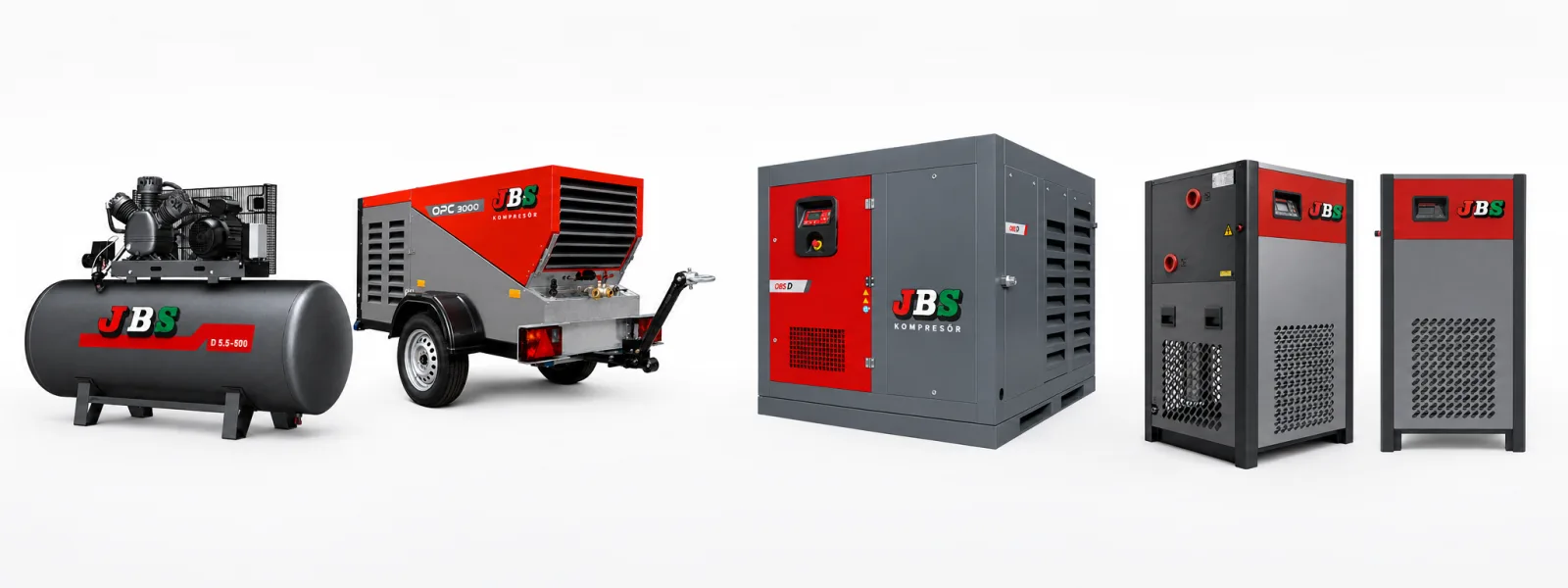
What Are the Different Types of Air Compressors?
Air compressors are used to supply compressed air for pneumatic tools, automotive workshops, manufacturing equipment, painting systems and industrial production.
There are several compressor technologies, but for most workshops and industrial businesses the main choice is between reciprocating air compressors and rotary screw air compressors. Other applications may require booster or portable compressors.
Reciprocating Air Compressors
A reciprocating or piston air compressor compresses air through piston movement inside a cylinder.
They are particularly suitable for businesses with intermittent compressed-air demand, including:
- Automotive workshops
- Tyre shops
- Car wash businesses
- Small workshops
- Pneumatic tools
- Spray equipment
Their relatively simple construction and practical maintenance make them a common choice for small and medium-sized businesses.
JBS Machines Reciprocating Air Compressors
Rotary Screw Air Compressors
Rotary screw compressors use rotating screw elements to produce a more continuous compressed-air supply.
They are generally more suitable for businesses requiring compressed air for long operating periods or throughout the working day.
Typical applications include manufacturing plants, large workshops, automotive businesses, production lines and pneumatic automation.
JBS Machines Rotary Screw Air Compressors
Booster Compressors
A booster compressor increases the pressure of an existing compressed-air supply.
These systems are used when standard compressor pressure is not sufficient for applications such as high-pressure industrial processes, PET production or specialised pneumatic equipment.
JBS Machines Booster Compressors
Portable Air Compressors
Portable compressors are designed for applications where compressed air is required away from a fixed installation.
They can be used for construction sites, roadworks, drilling, sandblasting and mobile service operations.
JBS Machines Portable Compressors
Reciprocating or Rotary Screw Compressor?
There is no single compressor that is best for every business.
For intermittent air demand, a reciprocating compressor may be more practical. For continuous and higher-volume air consumption, a rotary screw compressor is generally more appropriate.
The correct choice should be based on:
Airflow + working pressure + duty cycle + air quality + operating time
Conclusion
When choosing an air compressor, do not select a machine based only on horsepower, tank size or maximum pressure.
The best compressor is the system capable of supplying the required airflow at the required pressure for your actual operating conditions.
Recommended Solutions
Related Products and Categories
Common Questions
Frequently Asked Questions
When Should a Screw Compressor Be Preferred?
It should be considered for businesses with regular, long-duration, and high compressed-air demand.
What Does a Tank-Mounted Screw Compressor Provide?
It enables the compressor, air receiver tank, and, in some configurations, components such as an air dryer to be installed as a compact unit.
What Is the Difference Between a Piston Compressor and a Screw Compressor?
They differ in operating duration, capacity, operating cycle, and investment structure, so the choice should be based on the business's needs.
Is a Piston Compressor Sufficient for Intensive Use?
A screw compressor may be more suitable for continuous operation or applications requiring a high air flow rate.
How Many kW Should a Screw Compressor Be?
Motor power should not be selected in isolation. The total air consumption of the machines in the facility, required pressure, simultaneous usage rate, and possible future capacity increase should be calculated. Compressor selection should be based on the required m³/min flow rate.
What Is a Screw Compressor?
A screw compressor produces compressed air by reducing the volume of air trapped between two intermeshing helical rotors. It is widely used in businesses that require a continuous and stable compressed-air supply.
What Is the Difference Between a Screw Compressor and a Piston Compressor?
Piston compressors are generally suitable for intermittent and lower air demand, while screw compressors are better suited to intensive, long-duration, and consistent air demand. Screw models provide a more continuous airflow and generally lower vibration.