How Many Bar for a 500 Litre Air Compressor?
One of the most common questions when buying a 500 litre air compressor is how much pressure it should provide.
The important point is that 500 litres refers to receiver tank capacity, while bar refers to working pressure.
A 500 L air compressor can therefore be designed for different pressure levels. The correct pressure must always follow the technical specifications of the compressor and air receiver.
What Does a 500 Litre Air Tank Mean?
A larger receiver stores more compressed air, but it does not automatically produce higher pressure or greater airflow.
When choosing a compressor, consider:
Tank capacity + working pressure + airflow + motor power
For professional businesses, airflow in L/min or CFM is especially important.
Is a 500 Litre Compressor Suitable for a Car Wash?
Yes. A 500 litre compressor can be used in professional car wash and vehicle service operations depending on air demand.
Typical applications include:
- Foam tanks
- Blow guns
- Tyre inflation
- Vehicle detailing
- Pneumatic tools
If several pieces of equipment operate simultaneously, their total air consumption should be calculated before selecting the compressor.
Is 8 Bar or 12 Bar Better?
More pressure does not automatically mean better performance.
If your equipment requires around 7–8 bar, purchasing a 12 bar system may not provide an operational advantage. Higher-pressure equipment should only be selected when the application actually requires it.
The connected equipment's required working pressure and airflow should determine the compressor selection.
Can You Increase the Pressure of a 500 Litre Compressor?
The compressor must not be operated above the manufacturer's specified maximum pressure.
Pressure switches, safety valves or other safety components should never be modified simply to obtain more pressure.
JBS 500 Litre Air Compressor
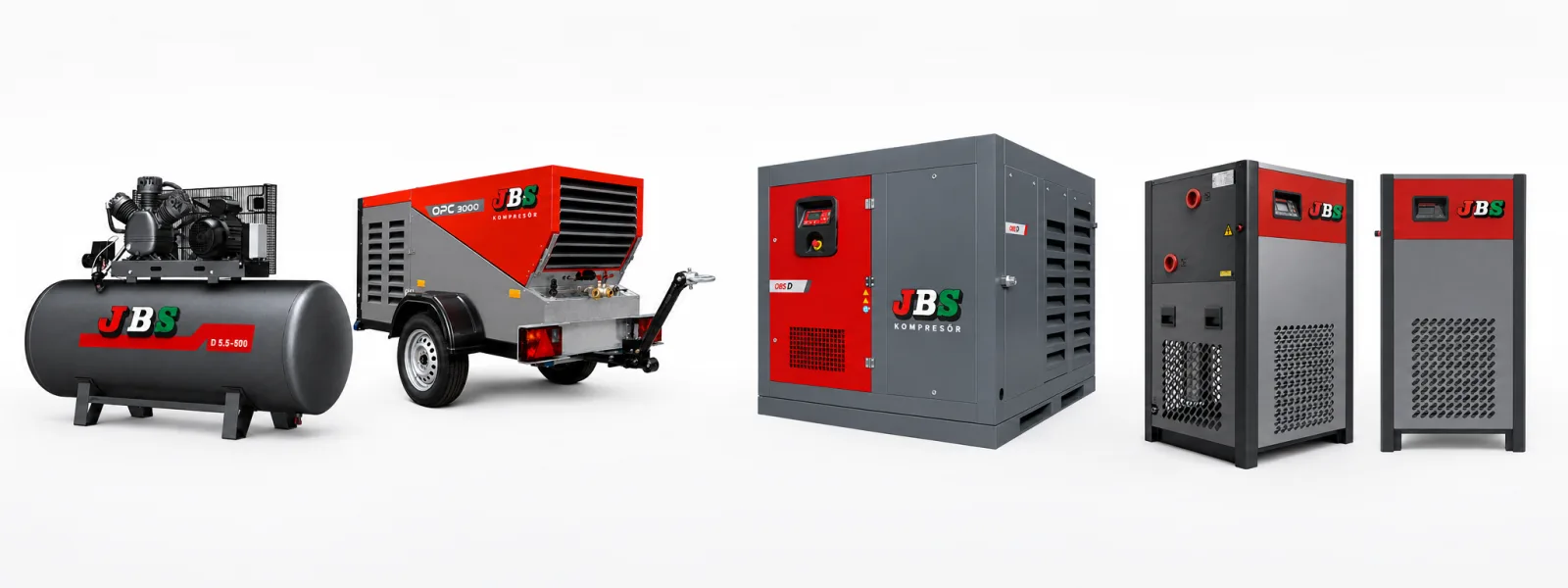
The JBS D-5.5-500 Piston Air Compressor has a 500 L receiver and is designed for professional workshop, automotive and service applications. Its current product specification lists 7 bar working pressure, 649 L/min intake capacity and a 4 kW / 5.5 HP motor.
View JBS D-5.5-500 Piston Air Compressor
Conclusion
The answer to “How many bar should a 500 litre air compressor have?” depends on the application.
Do not choose a compressor based on receiver size alone. Evaluate:
Pressure + airflow + motor power + receiver capacity + operating time
together.
Recommended Solutions
Related Products and Categories
Common Questions
Frequently Asked Questions
When Should a Screw Compressor Be Preferred?
It should be considered for businesses with regular, long-duration, and high compressed-air demand.
What Does a Tank-Mounted Screw Compressor Provide?
It enables the compressor, air receiver tank, and, in some configurations, components such as an air dryer to be installed as a compact unit.
How Many kW Should a Screw Compressor Be?
Motor power should not be selected in isolation. The total air consumption of the machines in the facility, required pressure, simultaneous usage rate, and possible future capacity increase should be calculated. Compressor selection should be based on the required m³/min flow rate.
What Is a Screw Compressor?
A screw compressor produces compressed air by reducing the volume of air trapped between two intermeshing helical rotors. It is widely used in businesses that require a continuous and stable compressed-air supply.
How Many Bar Should a Screw Compressor Be?
Operating pressure should be determined by considering the equipment with the highest pressure requirement and pressure losses in the piping system. Selecting unnecessarily high pressure can increase energy consumption.