Turnaround is the commercial metric
For a UK valeting or detailing business, the important question is not how many machines are in the bay.
It is how efficiently a vehicle moves from dirty arrival to customer handover.
A practical setup separates dry soil removal, deep textile cleaning, detail work, exterior washing and drying so one slow process does not hold up every vehicle behind it.
Vacuum before adding moisture
Loose sand, hair and debris should be removed before wet cleaning starts.
A commercial wet and dry vacuum is therefore a core piece of valeting equipment, but it should not be confused with a spray extraction machine.
Where seat fabric or carpet needs deep cleaning, spray extraction applies cleaning solution into the textile and recovers the contaminated liquid. UK professional guidance specifically treats this as a separate process because excessive residual moisture increases drying time.
Steam is for controlled detail work
Steam can be useful around door shuts, air vents, seat rails, trim joints and suitable interior surfaces.
It should not automatically replace an upholstery extractor on heavily contaminated fabric.
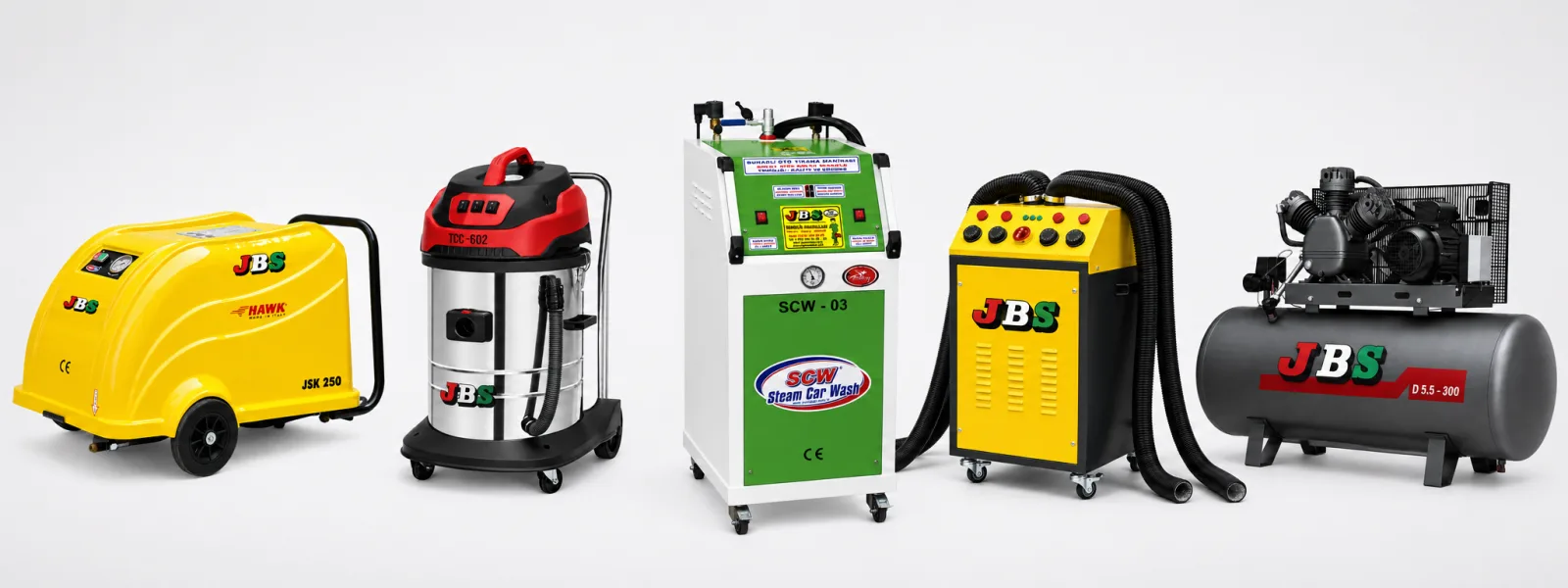
For a two-operator business, the JBS SCW-03 provides 8 bar steam pressure, 110–140°C operating temperature, a 15-litre tank, 220 V supply and dual-gun operation.
The correct workflow depends on the material rather than forcing every surface through the same cleaning method.
Drying capacity affects revenue
Deep textile cleaning is only commercially useful if the vehicle can be returned within a sensible time.
Forced-air drying, ventilation and careful control of moisture therefore affect daily bay capacity.
A cheaper extractor that leaves significantly more moisture behind may cost the business through longer vehicle occupation even when its purchase price is lower.
Mobile and fixed sites need different specifications
A fixed detailing studio can plan power supply, drainage, equipment storage and larger-capacity machines around permanent bays.
Mobile valeting requires a different balance of weight, cable reach, power demand and transportability.
Buying the largest machine available is not automatically the professional choice.
For a two-operator steam workflow, review the JBS SCW-03, then compare commercial vacuums and upholstery machines in the Professional Cleaning Machines range. The Auto Detailing Centers application page helps map equipment to a complete bay, while the Car Interior Steam Cleaning guide explains where steam fits alongside extraction. Once daily vehicle volume and the services you intend to sell are clear, request a detailing-equipment quotation from JBS.
Recommended Solutions
Related Products and Categories
Common Questions
Frequently Asked Questions
Can You Wash a Car with a Steam Machine?
A car can be washed with a steam machine when the correct steam pressure, nozzle type, distance and cleaning method are used according to the vehicle surface and dirt level.
Which Machines Should Car Detailing Centers Choose?
Steam car wash machines, upholstery cleaners, wet and dry vacuums, and pressure washers can be considered together for detailing centers. Steam systems are advantageous for interior detailing, door jambs, air vents, and seat rails.
How many cars can a car wash clean per day?
The number of cars a car wash can clean per day depends on the type of system, number of wash bays, washing time per vehicle, staff capacity, opening hours, and customer traffic. A small manual car wash may clean around 20–50 vehicles per day, while self-service or automatic systems can handle significantly higher volumes. For professional planning, daily vehicle capacity should be calculated according to the equipment and expected customer flow.