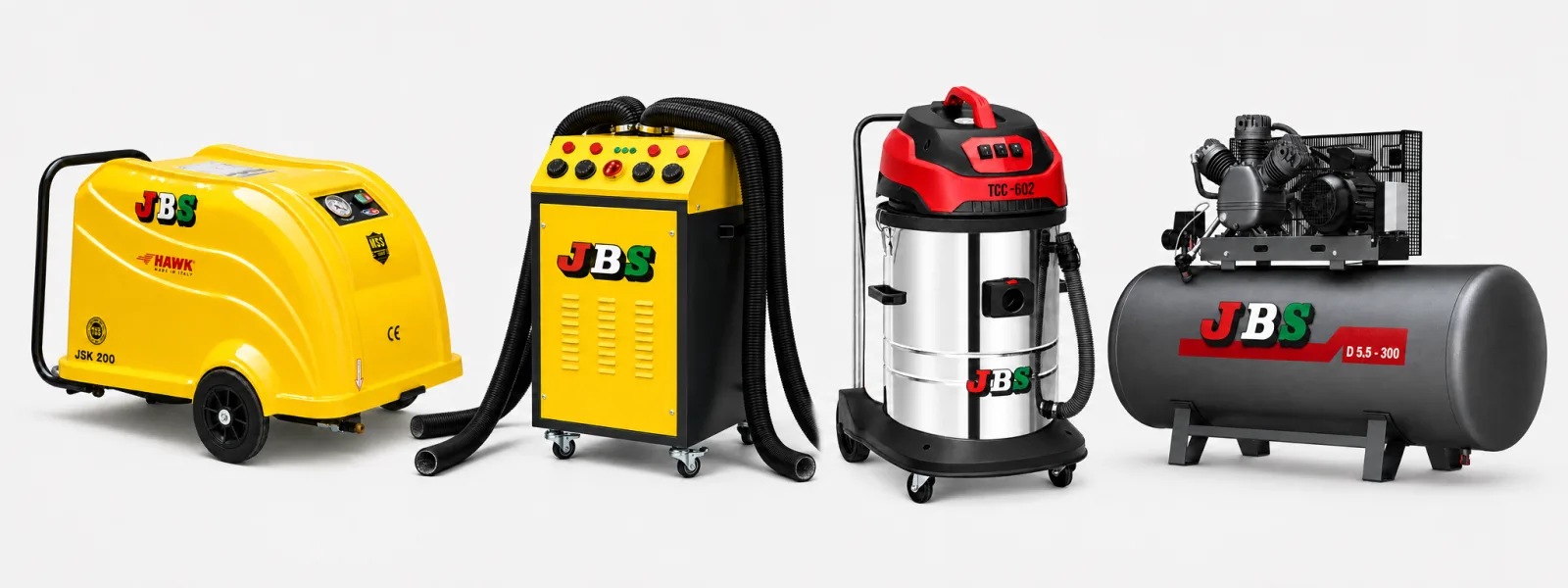
The car wash equipment needed to start a car wash business depends on the services you plan to offer, the number of wash bays, and your expected daily vehicle capacity. A basic professional setup normally includes a high-pressure washer, air compressor, foam tank, and wet and dry vacuum cleaner.
Businesses offering detailing and deep-cleaning services may also need a steam cleaner, upholstery extractor, polishing machine, vehicle dryer, and water treatment system. Equipment should be selected according to operating capacity, not purchase price alone.
What Equipment Is Needed to Start a Car Wash?
The main machines and equipment required for a professional car wash include:
-
Professional high-pressure washer
-
Air compressor
-
Foam spray tank
-
Wet and dry vacuum cleaner
-
Steam cleaning machine
-
Upholstery and carpet extractor
-
Vehicle dryer or air blower
-
Polishing machine
-
Water softening or treatment system
-
Pressure washer hoses and spray guns
-
Compressed-air guns
-
Water tank and drainage equipment
A new business does not necessarily need to purchase every machine at the beginning. You can start with essential equipment and expand your services according to customer demand.
Professional High-Pressure Car Washer
A professional high-pressure washer is the primary machine in a car wash business. It removes mud, dust, road grime, and other contaminants from vehicle surfaces.
Professional machines in the 150–200 bar range are commonly selected for passenger-car washing. However, pressure alone does not determine cleaning performance. Water flow rate, pump quality, motor power, and continuous operating capacity are equally important.
A heavy-duty three-phase machine may be more suitable for busy businesses that wash many vehicles throughout the day.
Cold-Water or Hot-Water Pressure Washer?
Cold-water pressure washers are generally sufficient for standard exterior vehicle cleaning. They usually have lower purchase and operating costs.
Hot-water pressure washers make it easier to remove grease, oil, and stubborn dirt. They are particularly useful for:
-
Engine and machinery cleaning
-
Commercial vehicle washing
-
Truck and heavy-vehicle cleaning
-
Workshops and industrial facilities
-
Greasy surfaces and undercarriages
When selecting a hot-water pressure washer, consider the burner capacity, fuel consumption, heating coil quality, maintenance requirements, water flow, and pump performance.
Air Compressor
An air compressor is used to pressurise the foam tank, operate air guns, remove water and dust from narrow areas, inflate tyres, and power pneumatic equipment.
A 200-litre piston compressor operating at 8–10 bar may be sufficient for a small or medium-sized business with one wash bay. Businesses using several pneumatic tools simultaneously may require a 300–500-litre high-flow piston or rotary-screw compressor.
Tank capacity is not the only important specification. The compressor’s actual air delivery and intended daily operating time must also be considered.
Foam Spray Tank
A foam tank applies diluted car shampoo to vehicle surfaces in a dense and even layer. Professional car wash businesses commonly use 60-litre or 100-litre stainless-steel foam tanks.
Important features include:
-
Tank capacity
-
Body material
-
Maximum working pressure
-
Safety valve
-
Pressure regulator
-
Hose length
-
Foam spray gun
-
Compatibility with the air compressor
The tank must never be operated above the safe working pressure specified by its manufacturer.
Wet and Dry Car Vacuum Cleaner
A professional wet and dry vacuum cleaner removes dust, sand, crumbs, dirt, and liquids from vehicle interiors. Domestic vacuum cleaners are generally unsuitable for intensive commercial use.
Industrial models with powerful suction and large collection tanks are better suited to professional car wash conditions. Double- or triple-motor vacuums may be preferred when several vehicles are cleaned throughout the day.
Token-operated or time-controlled vacuum systems are more appropriate for self-service car wash facilities.
Steam Cleaning Machine
A steam cleaner allows a car wash business to offer detailed cleaning in addition to standard exterior washing. Depending on the machine and cleaning method, steam may be used on:
-
Seats and upholstery
-
Air vents
-
Door panels
-
Plastic interior surfaces
-
Wheels and rims
-
Engine compartments under controlled conditions
-
Narrow and difficult-to-reach areas
When choosing a steam cleaner, consider its steam production capacity, temperature, operating pressure, wet and dry steam adjustment, boiler design, and continuous-use capability.
Upholstery and Carpet Extractor
An upholstery extractor sprays water and cleaning solution onto the fabric and then vacuums the dirty liquid back into the machine. It is commonly used for vehicle seats, carpets, floor mats, boot linings, and other textile surfaces.
Important features include:
-
Strong suction power
-
High water-recovery performance
-
Separate clean- and dirty-water tanks
-
A narrow vehicle upholstery nozzle
-
Long and durable hoses
-
Technical service and spare-parts availability
Powerful extraction reduces the moisture remaining in the fabric, but additional drying equipment may still be necessary.
Vehicle Dryer and Air Blower
A vehicle dryer removes water from the surface by producing a strong airflow. It is particularly useful around mirrors, grilles, door gaps, wheels, badges, and other areas that are difficult to dry with a towel.
Businesses offering upholstery cleaning may also need professional warm-air drying equipment. Effective drying shortens service times and helps reduce the risk of moisture-related odours.
Polishing Machine
A polishing machine is required if the business plans to offer paint correction, scratch removal, swirl removal, polishing, or paint-protection services.
Dual-action polishing machines provide more controlled operation and may be easier for beginners to use. Rotary polishers offer stronger cutting performance but have a greater risk of damaging the paint when used incorrectly.
Water Softening and Treatment System
Hard water can leave mineral deposits and water spots on vehicle surfaces. A water softener or reverse-osmosis system may therefore be necessary in areas with poor water quality.
The system’s capacity should be calculated according to the number of vehicles washed per day and the facility’s total water consumption. Purified water is particularly valuable for businesses offering spot-free rinsing.
Essential Car Wash Accessories
In addition to the main machines, a professional car wash may require:
-
High-pressure spray gun and lance
-
High-pressure hoses
-
Hose reels
-
Foam gun
-
Pressure regulator
-
Compressed-air gun
-
Microfibre cloths
-
Drying towels
-
Detailing brushes
-
Buckets and chemical dosing pumps
-
Electrical panel and residual-current protection
-
Floor grates and drainage system
-
Water storage tank
-
Personal protective equipment
Hoses, fittings, guns, and valves must be rated for the pressure and temperature of the equipment with which they are used.
Basic Car Wash Equipment Package
A small business offering standard exterior and interior cleaning can begin with:
-
Professional cold-water pressure washer
-
200-litre air compressor
-
60- or 100-litre foam tank
-
Professional wet and dry vacuum cleaner
-
Compressed-air gun
-
Pressure-washer hose and gun set
-
Water tank and drainage infrastructure
This package may meet the initial needs of a basic car wash with one wash bay.
Detailing Car Wash Equipment Package
A business offering detailing services can add the following equipment to the basic package:
-
Steam cleaning machine
-
Upholstery extractor
-
Seat and carpet dryer
-
Dual-action or rotary polisher
-
Vehicle drying blower
-
Water treatment system
-
Detailing guns, brushes, and accessories
These machines allow the business to offer additional services such as deep interior cleaning, steam detailing, paint correction, polishing, and paint protection.
What Should You Consider When Buying Car Wash Equipment?
Before purchasing equipment, determine:
-
Expected number of vehicles per day
-
Number of wash bays operating simultaneously
-
Services to be offered
-
Single-phase or three-phase power availability
-
Water pressure and storage requirements
-
Actual working pressure and water flow
-
Continuous operating capacity
-
Energy and fuel consumption
-
Warranty coverage
-
Access to technical support
-
Spare-parts availability
-
Installation and commissioning services
Two machines with similar pressure or motor specifications may differ significantly in pump quality, motor durability, heating system, components, and expected service life.
What Else Is Required to Open a Car Wash?
Equipment is only one part of the total investment. Depending on the project and local regulations, you may also need:
-
Business registration and operating permits
-
Water and electrical infrastructure
-
Drainage and wastewater systems
-
Oil separators or water treatment equipment
-
Suitable non-slip floor covering
-
Lighting and ventilation
-
Water storage tanks
-
Signage and security cameras
-
Professional cleaning chemicals
-
Staff equipment
-
Fire-safety equipment
-
Occupational health and safety measures
Permit and environmental requirements vary by country, municipality, and business model. Local authorities should therefore be consulted before construction or equipment installation begins.
Request a Quote for Professional Car Wash Equipment
The right car wash equipment should be selected according to your business model, available space, expected vehicle capacity, and planned services. A small facility can begin with essential washing and vacuuming equipment, while a busy or multi-bay operation will require higher-capacity professional systems.
Explore JBS Makina’s high-pressure car wash machines, steam cleaning systems, foam tanks, industrial vacuums, and auxiliary equipment. You can request a customised equipment package based on your facility and expected daily vehicle capacity.
Recommended Solutions
Related Products and Categories
Common Questions
Frequently Asked Questions
Which washing machine is suitable for car wash businesses?
For car wash businesses, the most suitable washing machine depends on daily vehicle volume, service type, available space, and budget. Professional pressure washers, steam cleaners, self-service wash systems, or automatic car wash machines can be preferred depending on the operation. For intensive commercial use, durability, stable pressure, high water flow, energy efficiency, easy maintenance, and reliable after-sales support are especially important.
Why do professional car wash machine prices vary?
Professional car wash machine prices vary according to the machine's technical specifications and operating capacity. Machines that can run continuously for long periods, provide high pressure, and use durable pump systems are generally positioned in a higher price segment.
Car Wash Business Equipment Cost Guide
Machine selection directly affects the cost of opening a car wash because pressure washers, steam machines, vacuum systems, foam tanks, compressors, installation needs and service support determine the total investment budget.
How much does it cost to open a car wash in 2026?
The cost of opening a standard professional car wash in a rented shop can range from approximately TRY 1,000,000 to TRY 3,000,000. The amount of renovation required and the machines selected determine the total budget.
How much do car wash machines and equipment cost?
A budget of approximately TRY 150,000–500,000 may be allocated for a pressure washer, foam tank, compressor, vacuum cleaner, and auxiliary equipment. The cost increases when steam, seat-cleaning, and drying machines are added.
How much electricity and water does a car wash machine consume?
Electricity and water consumption vary according to the machine's motor power, flow rate, and daily operating time. For businesses, choosing models with high energy and water efficiency can help reduce total operating costs over the long term.
What pressure rating should be chosen for a car wash machine?
The ideal pressure should be determined according to the intended use. Passenger-car washing, commercial-vehicle cleaning, construction-machinery cleaning, and industrial applications can require different performance levels. For this reason, water flow and pump capacity should be evaluated together with pressure rather than focusing only on a high bar rating.