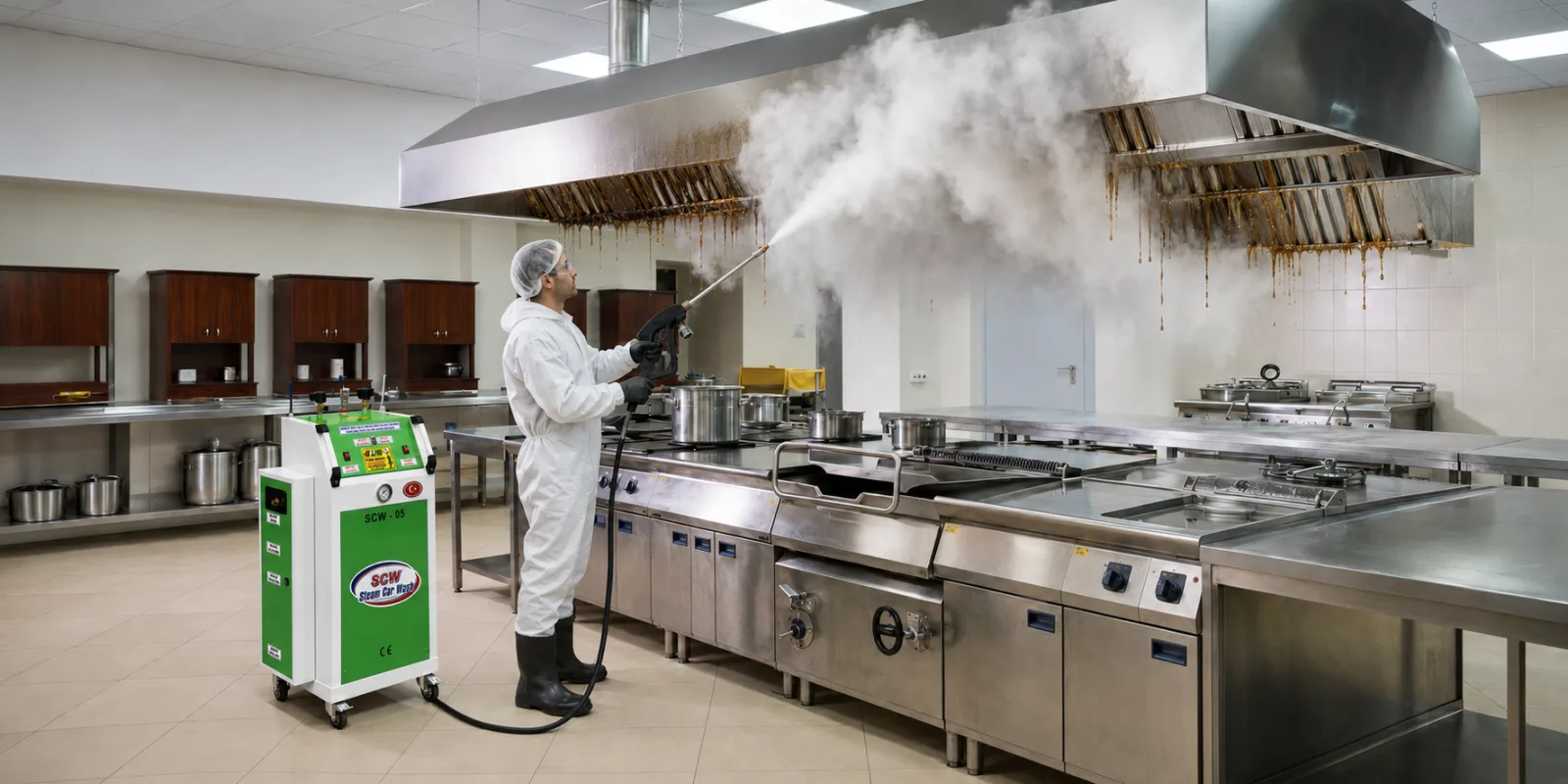
Treat Grease Removal as a Shift-Change Process
For a restaurant, hotel or contract caterer, cleaning performance is only part of the purchasing decision.
The kitchen also needs to be ready for the next service.
That means a commercial steam-cleaning process should be designed around grease load, available cleaning window, residue recovery and hand-back time, rather than maximum pressure alone.
Build a Cleaning Matrix Before Choosing Equipment
Different kitchen assets need different cleaning methods.
An extraction canopy, combi oven, fryer surround, stainless prep bench and anti-slip floor should not automatically be cleaned with the same attachment or steam setting.
A practical cleaning matrix should specify:
what is cleaned, how frequently, which method is used and who signs the task off.
This mirrors the HACCP-oriented approach used in professional commercial-kitchen guidance.
Fresh Fat and Carbonised Grease Are Different Jobs
Steam can loosen oily films and soften stubborn deposits, but long-baked grease may require a different process.
Where heavy deposits have polymerised around fryers, grills or oven areas, the operator may need mechanical pre-removal or an approved degreasing agent before steam finishing.
The commercial advantage comes from reducing unnecessary manual scrubbing—not pretending one method solves every contamination level.
Precision Steam Works Best Around Difficult Geometry
Commercial kitchens contain many areas that are slow to clean manually:
equipment edges, grooves, handles, switches, seals, joints and stainless fabrication details.
Professional kitchen guidance from Kärcher highlights steam for precisely these hard-to-reach areas, while OspreyDeepclean positions industrial dry-steam systems heavily in food-production and hygiene applications.
Steam should loosen the contamination; the workflow must then physically remove the dirty residue.
Grease Recovery Matters
A surface is not clean simply because the grease has melted.
Once the deposit is loosened, it needs to be collected with a clean cloth, suitable vacuum/recovery system or the kitchen's approved cleaning procedure.
For high-load operations, machines that combine steam with recovery can reduce the number of separate manual steps.
This is one reason professional suppliers distinguish between simple steam cleaners and steam-vacuum systems.
Extraction Canopies Need More Than Cosmetic Cleaning
Steam can be useful on suitable stainless canopy surfaces and around accessible filter housings.
However, surface cleaning should not be confused with specialist extraction-duct cleaning.
Grease inside ductwork is a separate maintenance and fire-risk issue and must be managed under the site's applicable inspection and cleaning regime.
Keep Food-Contact Surfaces Inside the HACCP System
Commercial cleaning and disinfection are not interchangeable terms.
Cleaning removes grease, food residue and other contamination. Disinfection is a separate controlled process intended to reduce microorganisms to an acceptable level.
Kärcher's professional commercial-kitchen guidance explicitly separates the two processes and recommends a documented cleaning schedule.
Steam should therefore be integrated into the kitchen's existing HACCP plan rather than marketed as a replacement for every approved hygiene procedure.
For wider food-production applications, see the JBS Industrial Steam Cleaner for Food Processing guide.
Specify the Machine Against the Cleaning Window
A small restaurant kitchen cleaned once after service has a different requirement from a hotel production kitchen or central catering facility.
Procurement should assess:
daily cleaning hours, grease severity, required steam output, recovery method, operator count, accessory requirements, available electrical supply and after-sales support.
For more intensive grease and equipment cleaning, the JBS SCW-05 professional steam system provides 15 bar pressure, 170–210°C steam, a 33-litre tank, dual guns and 380 V three-phase power.
The broader process is covered in How Is Industrial Steam Cleaning Performed?.
Provide kitchen type, grease load, equipment list, available cleaning window and electrical supply to request a technical quotation from JBS Makina.
Recommended Solutions
Related Products and Categories
Common Questions
Frequently Asked Questions
Who Can Use a Steam Car Wash Machine?
Steam car wash machines can be used by car wash businesses, detailing centers, auto dealerships, service centers, rent a car companies, fleet operators and mobile vehicle cleaning services.
Steam Car Wash Machines for Businesses
Steam car wash machines are suitable for car wash businesses, auto detailing centers, car dealerships, service centers, rent a car companies, fleet operators and mobile vehicle cleaning services.
What Affects Steam Car Wash Machine Prices?
Steam car wash machine prices are determined by the selected model, steam capacity, number of steam guns, heating system, power requirements, accessory package, service support and professional usage needs.