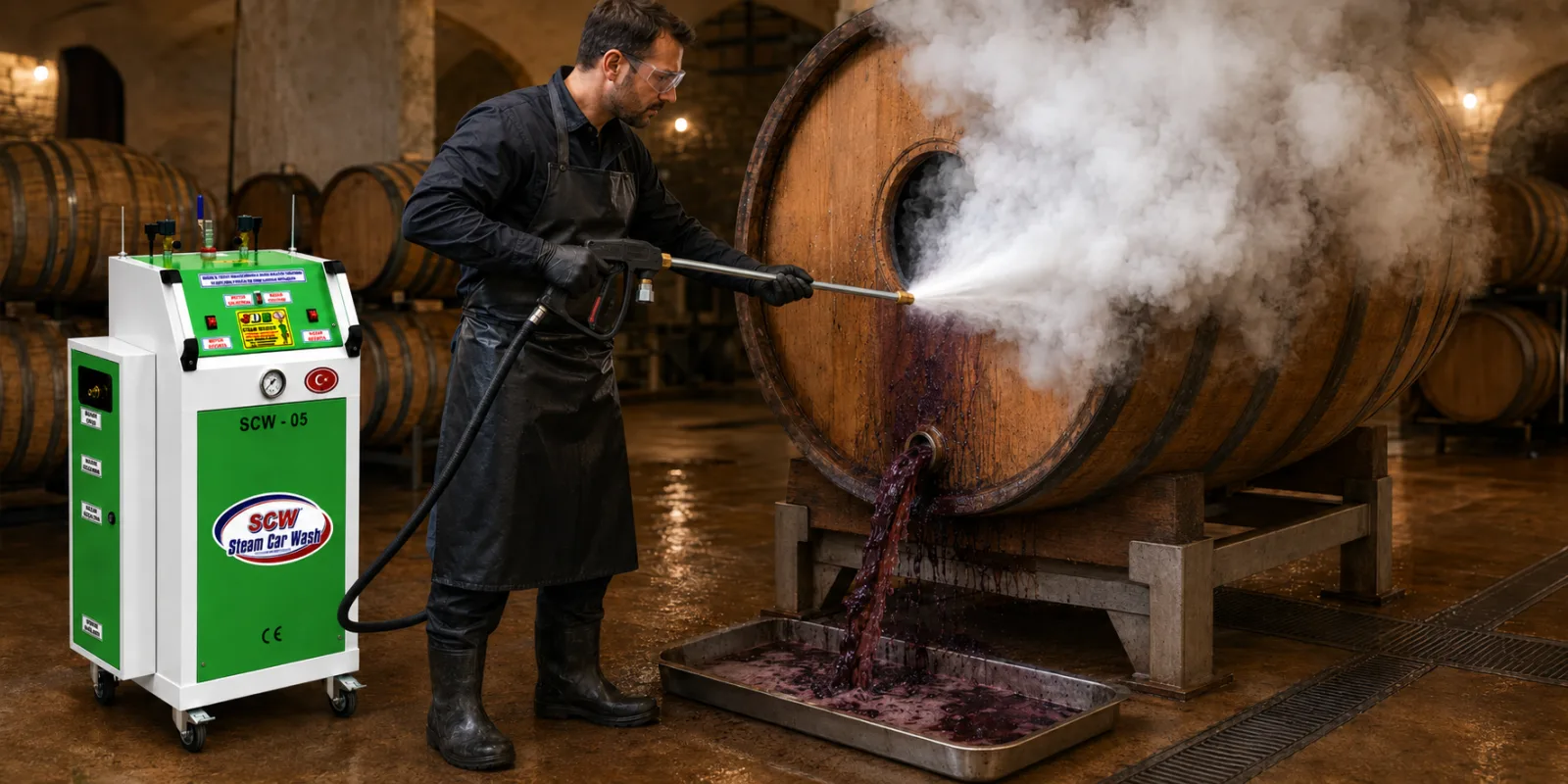
Why Do Wineries Use Steam for Barrel Cleaning?
Oak barrels are difficult to clean because wine residues, tartrates and spoilage organisms can remain inside the pores of the wood.
This is why leading winery steam-equipment suppliers focus heavily on dry steam, barrel sanitation, tartrate removal and Brettanomyces control rather than simply advertising “high pressure”.
Tecnovap, Steamericas and Reimers all position steam specifically for wine barrels, tanks and bottling equipment.
Step 1: Remove Loose Wine Residues
The barrel should first be drained and rinsed to remove loose lees, sediment and wine residues.
Steam works best after physical contamination has already been removed.
For heavily used barrels, the first objective should therefore be cleaning, followed by steam treatment as part of the winery sanitation process.
Step 2: Apply Steam Through a Barrel Tool
Professional systems use a dedicated barrel steam wand or diffuser inserted through the bung opening.
This allows steam to spread throughout the barrel instead of concentrating heat on only one area.
Steamericas, for example, offers a purpose-built wine barrel steam tool with temperature monitoring, while Tecnovap's winery systems use dedicated barrel accessories.
Step 3: Loosen Tartrates and Deposits
Heat helps soften tartaric deposits and wine residues attached to the internal wood surface.
Once loosened, these deposits can be removed more easily during the final rinse.
This is one of the main reasons “tartrate removal from wine barrels” is such an important search term in the English-language winery equipment market.
Step 4: Rinse and Drain the Barrel
After steaming, the barrel should be rinsed to remove loosened deposits and condensate.
The barrel is then drained and either refilled or handled according to the winery's storage and sanitation procedure.
Can Steam Help with Brettanomyces?
Brettanomyces control is one of the strongest commercial angles used by English-language competitors.
Both Tecnovap and Steamericas specifically position high-temperature steam for sanitation of oak barrel surfaces and difficult wood pores.
However, wineries should still validate their own sanitation protocol rather than relying only on steam temperature or pressure.
What Should You Look for in a Winery Steam Cleaner?
A professional winery should evaluate:
Steam temperature | Steam output | Continuous operation | Barrel steam wand | Food-grade steam pathway | Temperature control | Water supply | Service support
Maximum pressure alone is not the main buying criterion.
Reimers, for example, offers winery steam systems across different capacities and adjustable pressure ranges, while Steamericas and Tecnovap divide products according to winery size and application.
Can JBS Steam Machines Be Used in Winery Cleaning?
The JBS SCW-05 provides 15 bar steam pressure and 170–210°C steam for intensive professional and industrial cleaning.
For general winery equipment and suitable industrial surfaces, this level of steam performance may be evaluated according to the application.
Because the inside of a wine barrel is a direct food-contact surface, the complete steam pathway, hoses, fittings and barrel accessory must be confirmed as suitable for food-contact use before barrel-internal cleaning.
Conclusion
Wine barrel steam cleaning is most effective when it is treated as a complete process:
pre-rinse → controlled steam treatment → tartrate removal → final rinse → validated winery sanitation procedure.
For wineries, the correct steam system is not simply the machine with the highest pressure. Control, steam output, barrel accessories and food-contact suitability are more important.
Recommended Solutions
Related Products and Categories
Common Questions
Frequently Asked Questions
Can a steam cleaner be used to clean range hoods?
It can be used on suitable exterior surfaces of the hood and on removable metal filters. Steam should not be applied directly to the motor, fan, electrical connections, or inside the ductwork.
Can steam cleaning replace disinfection?
Steam cleaning should not automatically be considered a substitute for disinfection in every application. On food-contact surfaces, the facility's cleaning, rinsing, and sanitizing procedures must still be completed.