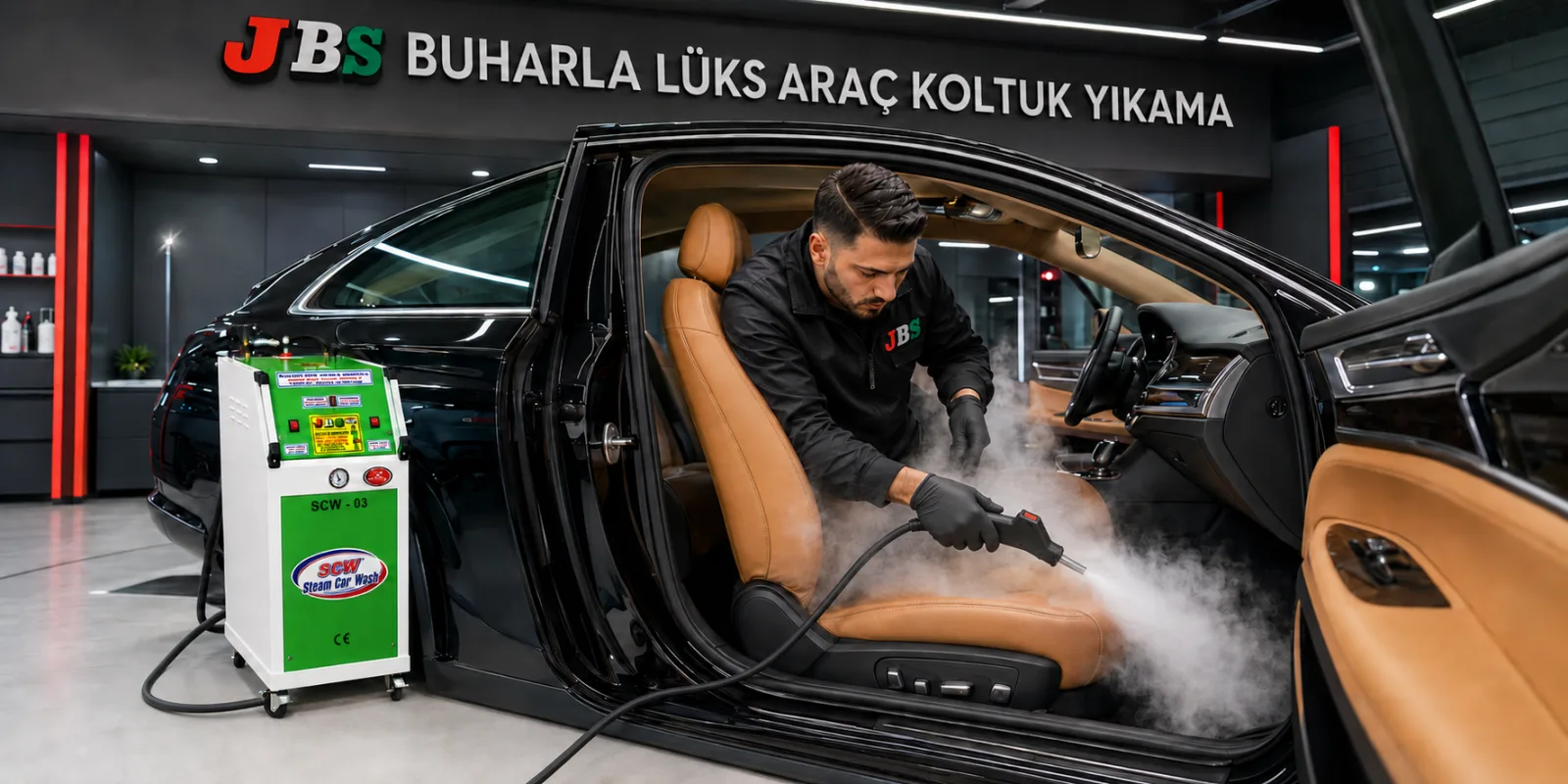
Seat Cleaning Should Be Built Around Vehicle Turnaround
For a professional valeting business, a seat is not finished when the stain disappears.
It is finished when the contamination has been removed, excess moisture recovered and the vehicle is ready to hand back.
That changes how a commercial operator should use steam.
Steam is excellent for controlled surface work, but deep upholstery cleaning may require extraction.
Kärcher’s professional upholstery workflow similarly separates dry vacuuming, spray extraction and drying rather than treating them as one process.
Start by Classifying the Upholstery
Before applying steam, identify the material.
Fabric seats, leather, Alcantara and bonded trim have different heat and moisture tolerances.
Any unfamiliar material should be tested in an inconspicuous area before the full seat is treated.
For fleet and dealership work, this check is particularly important because technicians may see several different interior specifications in one day.
Vacuum First
Remove dry contamination before introducing moisture.
Pay particular attention to seams, seat bases and the gap between the backrest and cushion.
A strong dry-vac stage reduces the amount of material that later has to be suspended and recovered during wet cleaning.
Use Steam for Surface Contamination
Controlled steam can help loosen oily fingerprints, light staining and contamination around stitching and textured fabric.
Do not saturate the cushion.
Keep the nozzle moving and use clean microfibre or controlled agitation to remove the loosened residue.
The objective is to clean the textile surface without forcing unnecessary moisture into the foam beneath it.
Deep Upholstery Needs Recovery
If a drink spill, old stain or heavy soil has penetrated the textile, simply adding more steam is not the answer.
A spray-extraction machine applies solution and then recovers dirty moisture from the upholstery.
Fortador’s professional systems make the same commercial distinction: upholstery-specific extraction hoses and integrated wet/dry recovery are sold alongside steam equipment.
For a busy detailing studio, that combination can be more useful than trying to make one cleaning method perform every task.
Leather Needs a Different Procedure
Leather should not be treated as wet-cleanable fabric.
Use minimal moisture, short exposure and appropriate working distance.
Remove loosened contamination promptly and finish with the care process recommended for the specific leather.
Cracked, recoloured or repaired leather should receive additional inspection before steam is used.
Alcantara Is About Controlling Moisture and Agitation
Alcantara can show changes in texture if it is over-wetted or aggressively brushed.
Use conservative steam application and gentle mechanical action.
Where the material manufacturer specifies a particular method, that guidance should override a generic steam-cleaning routine.
Drying Time Is Part of the Booking
A seat that is technically clean but still wet may delay vehicle handover.
Commercial operators should therefore record:
cleaning time + extraction time + drying time.
This is particularly important for dealerships, rental fleets and detailers running several bookings in one day.
JBS also offers dedicated interior-drying equipment for professional operations; for example, its four-arm hot-air generator is designed to accelerate drying of seats and upholstery.
Equipment Should Match the Number of Technicians
A two-technician studio may want steam available at two work points.
The JBS SCW-03 combines 8 bar operation, 110–140°C steam, a 15-litre tank, dual guns and 220 V power.
A single-operator business may be better suited to a smaller configuration.
The full equipment mix can be planned through JBS Auto Detailing Centers, where steam, vacuuming and drying are treated as complementary systems.
For the broader interior workflow, see the Professional Steam Cleaner for Auto Detailing guide.
Share daily vehicle volume, operator count and upholstery-service level to request a commercial quotation from JBS Makina.
Recommended Solutions
Related Products and Categories
Common Questions
Frequently Asked Questions
Who Can Use a Steam Car Wash Machine?
Steam car wash machines can be used by car wash businesses, detailing centers, auto dealerships, service centers, rent a car companies, fleet operators and mobile vehicle cleaning services.
Can steam cleaning replace disinfection?
Steam cleaning should not automatically be considered a substitute for disinfection in every application. On food-contact surfaces, the facility's cleaning, rinsing, and sanitizing procedures must still be completed.
How much water does steam car washing use?
Actual water consumption depends on the machine, steam flow rate, vehicle size, and cleaning time. Professional steam cleaning generally uses much less water than conventional pressure washing.
What Affects Steam Car Wash Machine Prices?
Steam car wash machine prices are determined by the selected model, steam capacity, number of steam guns, heating system, power requirements, accessory package, service support and professional usage needs.
How to Choose a Professional Steam Car Wash Machine?
When choosing a professional steam car wash machine, factors such as steam pressure, operating temperature, boiler power, water capacity, and continuous operating time should be evaluated together. A model with a capacity suitable for the daily number of vehicles, high steam generation capability, and fast heating performance should be preferred.
Steam Car Wash Machine Prices
Prices vary according to steam pressure, boiler power, fuel type, capacity, and equipment features. For a current price, the model suitable for the intended use should be selected and a quotation requested.