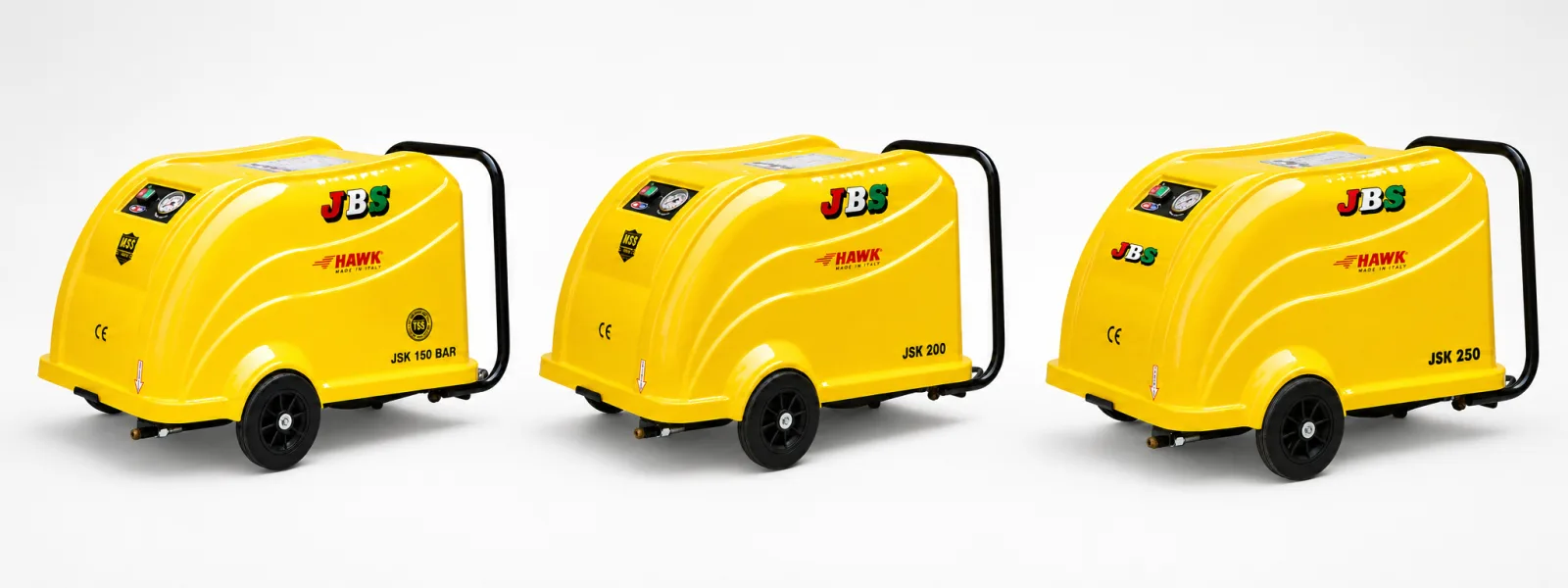
For normal vehicle cleaning, a 150-bar machine can provide sufficient capacity. For a busy commercial car wash, 200 bar offers more operating headroom, while 250 bar is better suited to commercial vehicles, chassis, machinery and heavier contamination.
Maximum machine pressure should not be confused with the pressure actually applied to paintwork. Nilfisk's car-cleaning guidance, for example, uses a controlled setting of around 90 bar for vehicle washing.
For smaller operations, the JBS JSK-150 provides adjustable 20–150 bar, 11 L/min and 220 V operation.
For higher-volume commercial washing, the JBS JSK-200 combines up to 200 bar with 14 L/min and a 5.5 kW three-phase motor. For trucks, machinery and more demanding work, the JBS JSK-250 provides up to 250 bar with 15 L/min.
The correct professional pressure washer is not the machine with the highest pressure rating; it is the machine with the right balance of pressure, water flow, pump performance and daily operating capacity.
Recommended Solutions
Related Products and Categories
Common Questions
Frequently Asked Questions
What Is a 200-Bar Car Wash Machine Used For?
A 200-bar machine provides stronger cleaning performance than a 150-bar model. It helps achieve more effective results on wheels, chassis, wheel arches, commercial vehicles, service areas, and more heavily soiled surfaces.
How much does a 200 bar car wash machine cost?
Prices for 200 bar car wash machines vary by brand, motor power, pump system, water flow rate, and equipment features. Rather than deciding based only on the bar rating, the machine's actual operating performance and suitability for the intended use should also be evaluated.
Can a 200-Bar Machine Damage Vehicle Paint?
An incorrect nozzle, applying pressure from too close a distance, or damaged paint can create a risk. Pressure can be applied safely with an appropriate working distance and a wide-angle nozzle.
How many bar do professional car washes use?
Professional car washes commonly use pressure washers in the range of approximately 100–150 bar for vehicle cleaning. Depending on the equipment and application, higher-pressure machines may also be used, but the pressure should be adjustable to protect paint, seals, tires, and other sensitive components. Water flow rate, pump quality, and continuous-duty capability are just as important as pressure.