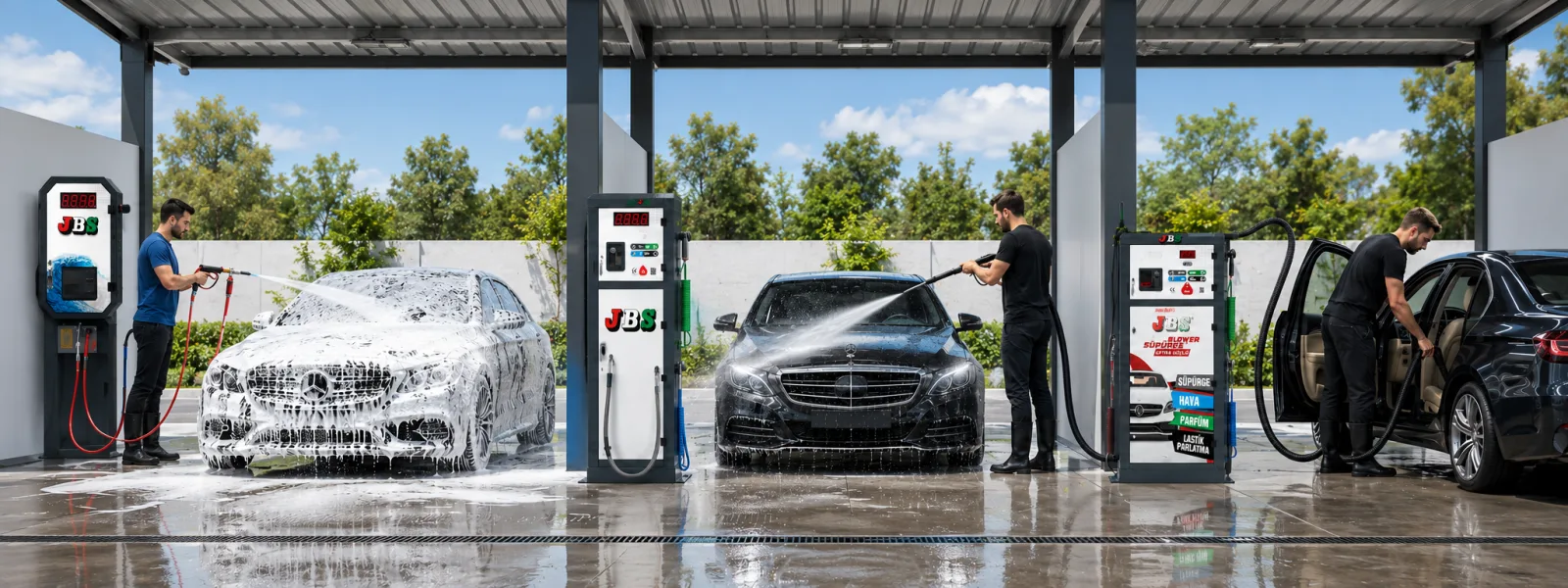
Treat the wash as a forecourt service, not a separate business unit
For UK petrol retailers, the commercial attraction is straightforward: customers already arrive to refuel, use the shop or access other vehicle services.
A wash bay can therefore become a secondary forecourt service rather than a destination that has to generate all of its own traffic.
Kärcher describes compact one- and two-bay self-service systems as suitable for service stations where space is limited, while UK forecourt suppliers focus heavily on installation, maintenance and equipment uptime.
That changes the equipment brief.
Peak-time throughput matters more than headline pressure
A single bay can be perfectly adequate at a quieter independent site.
At a busy roadside forecourt, however, the commercial problem may be a queue rather than cleaning power.
A dual-bay system allows two paying users to wash simultaneously. JBS CYJK is configured for this role with two wash positions, adjustable pressure up to 200 bar and 15 L/min water flow.
The site should therefore be specified around transactions per busy period, not simply around maximum bar.
Uptime belongs in the buying decision
A wash that is out of service cannot generate secondary revenue.
UK forecourt operators should assess pump access, hose and gun replacement, spare-parts availability and planned maintenance alongside acquisition cost.
The machine should also be positioned so service work can be completed without unnecessarily disrupting the fuel forecourt or vehicle circulation.
For UK installations, the electrical supply requires particular attention. JBS CYJK is rated at 380 V / 50 Hz three-phase, so compatibility with the actual local supply and installation design should be confirmed before ordering.
Keep payment and programme selection simple
An unattended customer should understand how to start the wash without staff assistance.
High-pressure washing and foam provide a straightforward base offer. Wax can create another paid programme, while a separate vacuum or blower point can extend the transaction after the customer leaves the wash bay.
Payment configuration should be selected for the destination market rather than assumed from the base machine specification.
Specify the forecourt around customer flow
Where two simultaneous users are commercially justified, review the JBS CYJK Dual-Bay Self-Service Car Wash. Compare compact, dual and central configurations in the Self-Service Car Wash Systems range, then match them to the practical requirements shown on the Gas Stations application page. The Self-Service Car Wash Equipment and Systems guide covers payment, water treatment and supporting equipment in more detail. Once site dimensions, expected traffic and available utilities are known, request a forecourt project quotation from JBS.
Recommended Solutions
Related Products and Categories
Common Questions
Frequently Asked Questions
What Determines the Price of a Self-Service System?
The price varies according to the number of bays, functions, payment system, pump group, site infrastructure, and level of automation.
What Is a Self-Service Car Wash System?
A self-service car wash system allows users to wash their own vehicles using coin-, card-, or QR-code-operated equipment. Functions such as foam, rinsing, wax, vacuuming, and air blowing can be provided in one area.
Does a Self-Service Car Wash System Require Maintenance?
Yes. The pump, hose, spray gun, nozzle, foam system, payment unit, filters, and vacuum and blower equipment should be checked regularly. Routine maintenance reduces the risk of failure and helps the system operate efficiently for longer.
Which System Is Most Suitable for Fuel Stations?
Self-service car wash systems are suitable for fuel stations. Pressure washing, foam, wax, vacuum, and blower functions can be offered together with coin-, card-, or QR-code-based payment systems.