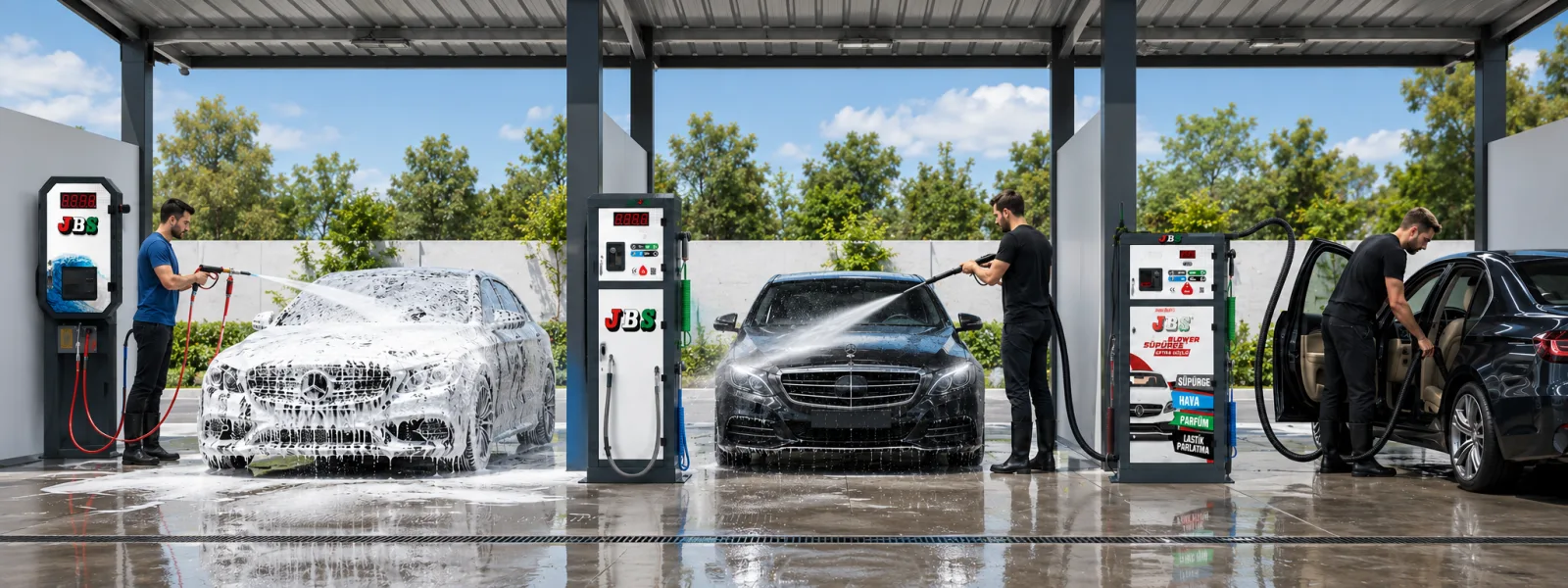
Self-service car wash equipment allows customers to wash their own vehicles using tokens, coins, payment cards, or contactless payment methods. These systems automatically provide services such as high-pressure water, foam, wax, rinsing, air, and vacuuming for a specified period.
A properly planned self-service car wash system offers several advantages, including lower staffing requirements, controlled water and chemical consumption, extended operating hours, and the ability to wash multiple vehicles simultaneously.
What Equipment Is Required for a Self-Service Car Wash?
The essential equipment used in a self-service car wash station may include:
- High-pressure car wash machine
- Jet foam system
- Foam spray gun
- Rinsing and wax system
- Programme selection panel
- Token, coin, or card payment unit
- High-pressure hose and spray gun
- Hose boom
- Water tank and plumbing system
- Chemical dosing pumps
- Water-softening and treatment system
- Air compressor
- Self-service car vacuum
- Vehicle-drying blower
- Technical room and electrical control panel
Depending on the facility’s capacity, each wash bay may have an independent washing unit, or several bays may be supplied by a central system.
Self-Service High-Pressure Car Wash Machine
The high-pressure washer is the main component of the system. It applies pressurised water to the vehicle surface to remove mud, dust, and road dirt.
Professional machines operating between 150 and 200 bar are commonly used in self-service systems for passenger cars. However, pressure alone does not determine cleaning performance. The following specifications should be evaluated together:
- Actual working pressure
- Water flow rate per minute
- Motor power
- Pump quality
- Continuous-duty capability
- Number of users supported simultaneously
- Electricity consumption
- Technical-service support
- Spare-parts availability
In multi-bay facilities, each wash bay may have a separate machine, or several stations may be supplied through a central pumping system.
How Does a Jet Foam System Work?
A jet foam system mixes car shampoo with water or compressed air in controlled proportions and applies it to the vehicle surface. The dense foam helps soften dirt before it is removed with pressurised water.
A professional foam system should offer:
- Adjustable chemical dosing
- Dense and consistent foam production
- Chemical-resistant pumps and hoses
- An easily refillable chemical tank
- Low maintenance requirements
- Controlled chemical consumption during every use
Using too much chemical increases operating costs. Insufficient dosing, however, reduces the cleaning performance expected by customers.
Self-Service Car Wash Programmes
The programmes available on self-service car wash machines may vary according to the model and system configuration. Common programmes include:
- High-pressure pre-wash
- Jet foam application
- Foaming brush
- Shampoo wash
- High-pressure rinse
- Wax application
- Spot-free rinse
- Air drying
A two-function system may be sufficient for a small business. More comprehensive facilities may prefer central systems offering four or more washing programmes.
The business operator should be able to adjust programme duration, chemical dosage, and selling price.
Token and Card Payment Systems
Self-service car wash equipment may accept the following payment methods:
- Tokens
- Coins
- Contactless debit or credit cards
- QR codes
- Business-specific wash cards
- Mobile payments
Token-operated systems may be simpler to install. Card and contactless payment systems provide greater convenience when customers do not have tokens or cash.
The payment unit must be resistant to water, impact, and outdoor conditions. After receiving payment, the system should automatically start the selected washing period and display the remaining time.
Why Is a Hose Boom Necessary?
A hose boom allows the high-pressure hose to move freely around the vehicle. It reduces the risk of the hose dragging along the ground, touching the vehicle, or becoming tangled around the user.
A high-quality hose boom should:
- Rotate through 360 degrees
- Support the weight of the hose
- Resist corrosion
- Use bearings suitable for intensive operation
- Allow unrestricted user movement
The hose and spray gun must also be suitable for professional working pressure and frequent use.
Self-Service Car Vacuum Cleaner
A self-service car vacuum allows customers to remove dust, sand, crumbs, and other debris from the vehicle interior. The vacuum unit may be installed in a separate area away from the wash bays.
Important features include:
- Strong suction performance
- Token or card operation
- Adjustable operating time
- Long and durable hose
- Easy-to-clean filter
- Large waste container
- Weather-resistant cabinet
- Motor suitable for intensive use
Dual-outlet vacuum cleaners that allow two customers to work simultaneously can increase service capacity at busy locations.
Water Treatment and Spot-Free Rinse System
Limescale and minerals in mains water can leave spots on the vehicle surface after drying. Professional facilities may therefore use water-softening, filtration, or reverse-osmosis systems.
A final rinse with treated water can:
- Reduce water spots
- Reduce the need for manual drying
- Improve customer satisfaction
- Limit limescale accumulation in pumps and plumbing
The water-treatment system should be selected according to a water analysis and the facility’s expected daily water consumption.
Central Self-Service Car Wash System
In a central system, pumps, chemical-dosing units, water tanks, and electrical controls are installed in a shared technical room. Several wash bays are supplied from this central area.
The advantages of a central system include:
- Centralised equipment control
- A cleaner appearance in the wash bays
- Easier maintenance
- Central management of chemical consumption
- Ability to supply several wash bays from one system
The system must be sized according to the maximum number of stations expected to operate simultaneously. An undersized pump or insufficient water flow can cause pressure loss when several customers use the system at the same time.
Advantages of Self-Service Car Wash Equipment
Self-service systems can provide the following advantages:
- Lower staffing requirements
- Controlled water consumption
- Measured chemical use
- Ability to wash multiple vehicles simultaneously
- Extended operating hours
- Automatic time-based charging
- Additional revenue from vacuuming and drying services
- Standardised washing programmes
- Easier monitoring of operating expenses
Profitability depends on location, customer traffic, number of wash bays, service price, programme duration, energy costs, and maintenance expenses.
What Should Be Considered When Installing a Self-Service Car Wash?
The following factors should be evaluated before installation:
- Expected number of vehicles per day
- Number of wash bays
- Number of simultaneous users
- Electrical infrastructure
- Mains water pressure and water quality
- Wastewater drainage
- Risk of freezing during winter
- Available space for a technical room
- Chemical-storage conditions
- Payment methods
- Security cameras and safety systems
- Technical-service and spare-parts availability
Drainage and wastewater infrastructure should be planned before the equipment is installed. Required permits must also be checked according to local municipal and environmental regulations.
Should You Choose 230 V or 400 V Equipment?
Some small-capacity self-service car wash machines can operate on 220–230 V single-phase electricity. More powerful pumping systems that supply several wash bays generally require a 380–400 V three-phase power supply.
The electrical panel, cable sizes, circuit breakers, grounding, and residual-current protection must be suitable for the selected equipment. Installation should be carried out by qualified electricians.
What Determines Self-Service Car Wash Equipment Prices?
Self-service car wash equipment prices vary according to:
- Number of wash bays
- Machine pressure and water flow
- Number of available programmes
- Central or independent system configuration
- Token, card, or contactless payment options
- Pump and motor quality
- Hot-water or cold-water operation
- Water-treatment system
- Vacuum and drying units
- Cabinet and stainless-steel body specifications
- Installation and transportation requirements
A proper price comparison should consider not only the equipment’s purchase price but also installation, energy consumption, chemical use, maintenance, and spare-parts costs.
Conclusion
Self-service car wash equipment may include a high-pressure washer, jet foam system, payment unit, programme selection panel, hose boom, water-treatment system, and car vacuum cleaner.
The system should be planned according to daily vehicle capacity, number of wash bays, electrical and water infrastructure, and the programmes offered to customers. Properly sized equipment helps control water, energy, and chemical consumption.
Contact JBS Makina to plan a self-service car wash system suited to your business and request a current quotation.
Recommended Solutions
Related Products and Categories
Common Questions
Frequently Asked Questions
What Determines Self-Service Car Wash Setup Prices?
The installation cost of a self-service car wash varies depending on the number of bays, machine functions, payment system, water and electricity infrastructure, installation area, equipment capacity and service support.
What Determines the Price of a Self-Service System?
The price varies according to the number of bays, functions, payment system, pump group, site infrastructure, and level of automation.
What should you consider when buying a self-service car wash system?
When buying a self-service car wash system, you should consider equipment quality, washing capacity, pressure and water flow, payment options, water treatment and recycling systems, detergent dosing, energy efficiency, maintenance requirements, spare parts availability, warranty, and after-sales technical support. It is also important to choose a system that can be customized according to the available space, expected customer traffic, climate conditions, and local infrastructure.
What systems are required to set up a self-service car wash facility?
A self-service car wash facility typically requires high-pressure washing systems, water storage and supply units, water treatment and recycling systems, detergent and foam dosing systems, payment terminals, control panels, vacuum stations, electrical infrastructure, drainage systems, and frost protection where necessary. Depending on the project, additional equipment such as spot-free rinse systems, air compressors, water softeners, security cameras, and remote monitoring systems can also be included.
What Is a Self-Service Car Wash System?
A self-service car wash system allows users to wash their own vehicles using coin-, card-, or QR-code-operated equipment. Functions such as foam, rinsing, wax, vacuuming, and air blowing can be provided in one area.
Can car wash machines be purchased from Turkey?
Yes. Car wash machines can be purchased from manufacturers and suppliers in Turkey and exported to many countries. Before placing an order, it is important to check product specifications, certifications, warranty conditions, spare parts availability, shipping terms, installation support, customs requirements, and after-sales service. For professional projects, choosing an experienced manufacturer with international shipping and technical support can make the purchasing process easier.
Who Is a Self-Service Car Wash System Suitable For?
It is suitable for fuel stations, car wash businesses, shopping-center car parks, residential-complex car parks, fleet operators, dealerships, and locations with high commercial-vehicle traffic. It can create an additional revenue stream in areas with high vehicle traffic.