Start With the Site, Not the Equipment Quote
A strong self-service site needs vehicle traffic, visibility and convenient entry and exit.
The commercial question is not simply whether enough cars pass the road.
Ask:
How many drivers can easily see the wash, enter the site and use a bay without creating traffic friction?
A cheaper site with poor access can produce weaker utilisation than a more expensive but highly visible forecourt.
Revenue per Bay Minute Is More Useful Than Cars per Day
Daily vehicle count alone hides how efficiently the site operates.
A useful operating measure is:
Revenue per occupied bay minute = wash revenue / paid bay minutes
This makes it easier to compare wash tariffs, programme use and customer behaviour.
It also identifies whether additional capacity is actually required or existing bays simply need better utilisation.
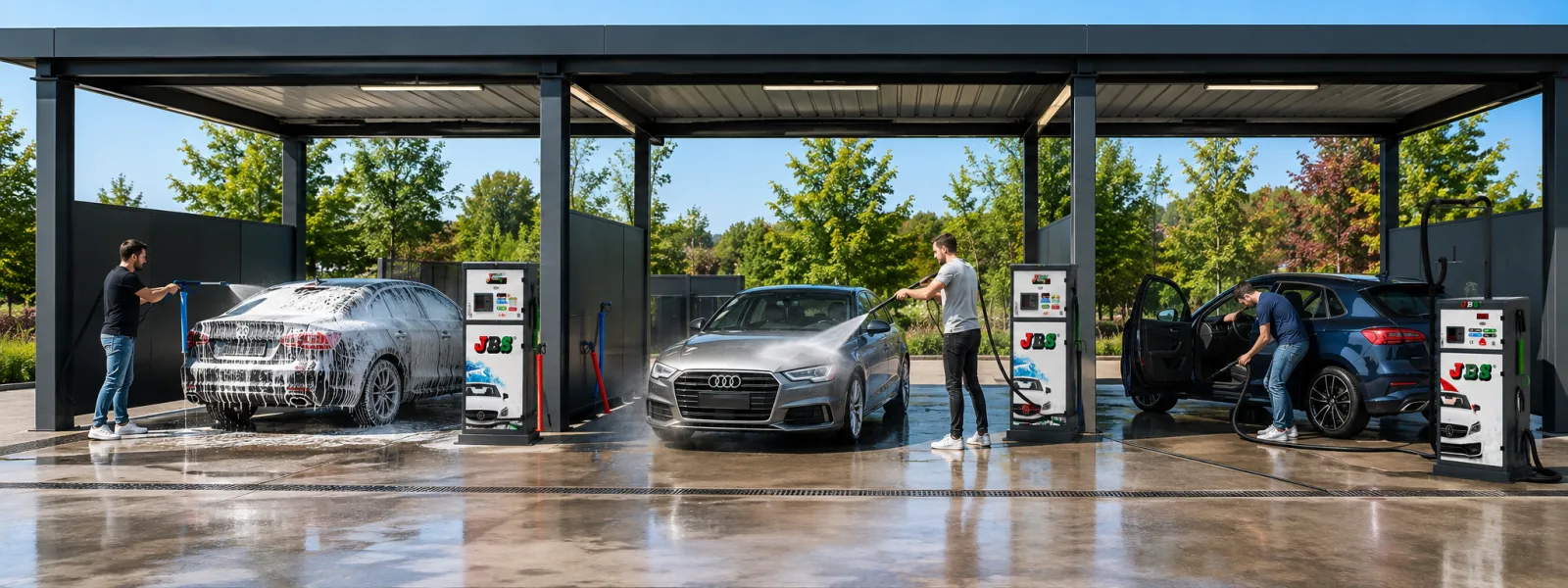
The JBS CYJK Dual-Bay Self-Service Car Wash System can support two simultaneous customers where peak demand justifies a second position.
Payment Friction Can Reduce Commercial Performance
UK self-service operators increasingly use contactless and digital payment because customers expect quick, familiar transactions.
Payment design can influence wash duration and average spend.
However, equipment capability must be specified accurately.
Current JBS standard configurations verify coins, tokens and banknotes. Card or contactless acceptance should only be included in a JBS proposal when the appropriate payment hardware has been confirmed for that project.
Protect Uptime
A self-service site may operate with limited staff, but that does not make maintenance less important.
Every unavailable bay reduces saleable capacity.
Model:
preventative servicing, spare parts, emergency response, pump wear and payment-system faults.
Remote monitoring can also become commercially useful on unmanned or multi-site operations because faults can be identified before customers repeatedly encounter an unavailable bay.
Ancillary Services Increase Site Revenue Without Occupying a Wash Bay
Vacuuming, air services and other paid after-wash facilities can generate additional revenue after the vehicle leaves the exterior wash position.
This matters because the wash bay is normally the site's most constrained productive space.
The objective is to increase customer value without unnecessarily extending wash-bay occupancy.
Do Not Use a Generic Payback Promise
Payback depends on capital cost, land structure, utilities, demand and operating margin.
A useful model is:
Payback period = total project investment / average monthly operating cash surplus
Run the calculation under low, expected and peak-demand scenarios.
If the project only works in the peak scenario, the investment case is weak.
Build the Investment Around Measurable Throughput
Review the JBS CYJK Dual-Bay System, compare configurations under Self-Service Car Wash Systems, and map the project against JBS Use Cases. Use the Self-Service Car Wash System Prices guide to define project CAPEX. Provide site dimensions, expected traffic, bay count, payment requirements and destination country to request a commercial project quotation.
Recommended Solutions
Related Products and Categories
Common Questions
Frequently Asked Questions
What should you consider when buying a self-service car wash system?
When buying a self-service car wash system, you should consider equipment quality, washing capacity, pressure and water flow, payment options, water treatment and recycling systems, detergent dosing, energy efficiency, maintenance requirements, spare parts availability, warranty, and after-sales technical support. It is also important to choose a system that can be customized according to the available space, expected customer traffic, climate conditions, and local infrastructure.
What systems are required to set up a self-service car wash facility?
A self-service car wash facility typically requires high-pressure washing systems, water storage and supply units, water treatment and recycling systems, detergent and foam dosing systems, payment terminals, control panels, vacuum stations, electrical infrastructure, drainage systems, and frost protection where necessary. Depending on the project, additional equipment such as spot-free rinse systems, air compressors, water softeners, security cameras, and remote monitoring systems can also be included.
What Is a Self-Service Car Wash System?
A self-service car wash system allows users to wash their own vehicles using coin-, card-, or QR-code-operated equipment. Functions such as foam, rinsing, wax, vacuuming, and air blowing can be provided in one area.