Start With Revenue Capacity per Bay
For a UK investor, equipment price is only useful when it is connected to the number of vehicles the site can process.
A single wash bay may suit a smaller forecourt or low-traffic location. A busy petrol station, roadside site or dedicated wash park may lose sales whenever customers see a queue and drive away.
That makes peak-time bay utilisation one of the first commercial numbers to model.
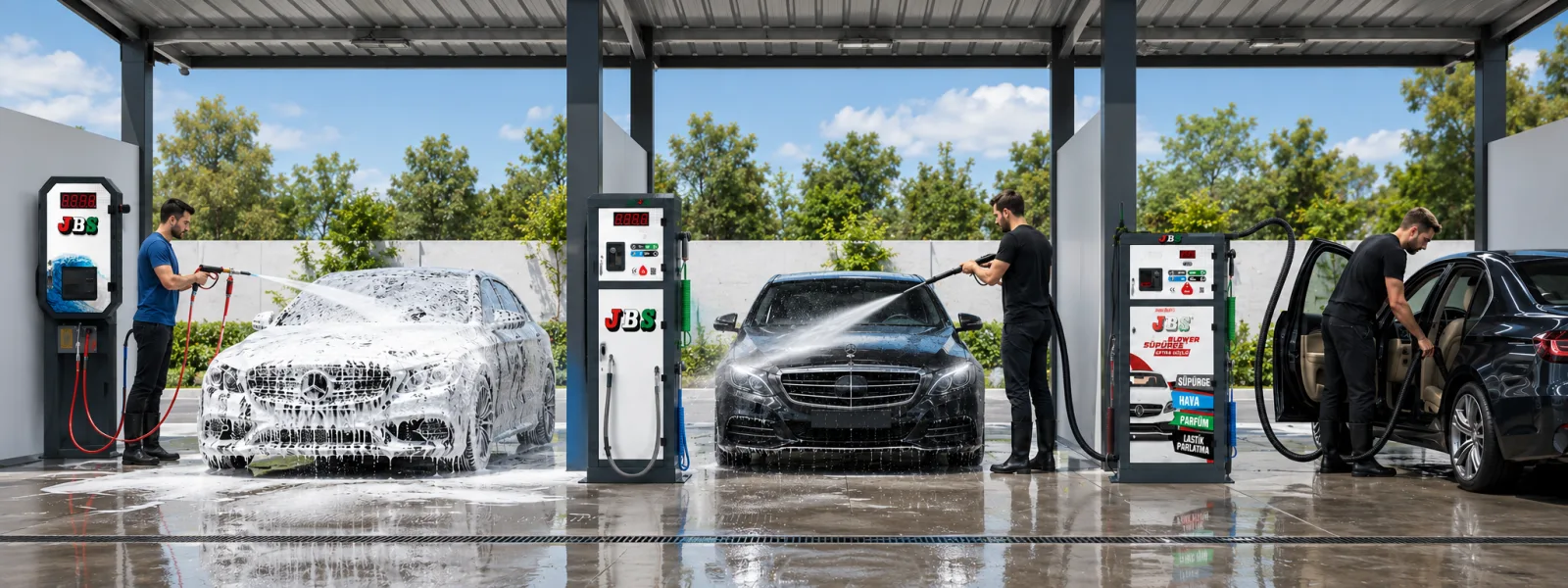
The JBS CYJK Dual-Bay Self-Service Car Wash System provides two simultaneous wash positions with 0–200 bar adjustable pressure and 15 L/min flow.
Separate Equipment CAPEX From Site CAPEX
A quotation for washing equipment is not the same as the cost of opening a self-service site.
The overall capital requirement may also include groundwork, drainage, wastewater infrastructure, three-phase electrical work, water storage or treatment, canopy construction, signage, security, technical-room installation and commissioning.
Comparing suppliers purely by headline machinery price can therefore produce a misleading investment decision.
Payment Convenience Has a Commercial Value
UK competitors increasingly treat payment technology as part of customer throughput.
If a customer spends time finding change or understanding a complicated payment process, the bay is occupied without generating useful washing time.
Coins and tokens may still suit some locations, while card or contactless acceptance can reduce payment friction.
Current standard JBS configurations support coins, tokens and banknotes. UK projects requiring card or contactless acceptance should define this during specification so compatible hardware can be confirmed.
The Coin-Operated Car Wash guide explains the relationship between payment, wash time and bay utilisation.
Do Customers Need Every Wash Programme?
More programmes increase equipment and control complexity.
Pressure wash and foam form a practical core offer. Wax, additional rinse programmes, vacuuming and air services can increase customer spend when demand exists.
The commercial question is not how many buttons can be fitted to the control panel.
It is which programmes customers will actually pay for.
Compare JBS single, dual and central configurations under Self-Service Car Wash Systems.
Water Treatment Changes Both CAPEX and OPEX
Water quality can affect wash finish, equipment scaling and the feasibility of spot-free rinsing.
A site may therefore require softening, filtration or reverse osmosis depending on incoming water quality and the selected wash programmes.
Water recycling can also change fresh-water demand, but capital cost, maintenance and local wastewater requirements must be considered.
These systems should be budgeted before construction rather than added as an afterthought.
Model the Site Before Buying the Machines
A useful financial model should combine equipment investment, site works, water, electricity, chemicals, payment fees, maintenance and downtime.
Then compare those costs with expected vehicles per day, average customer spend and peak-time bay utilisation.
This approach identifies whether the project needs one position, a dual-bay system or a larger central installation.
Build the Quote Around Your Site
Review the JBS CYJK Dual-Bay System, compare configurations under Self-Service Car Wash Systems, and review typical deployments under Self-Service Car Wash Facilities. Use the Coin-Operated Car Wash guide when planning payment and tariff strategy. Send your site dimensions, expected traffic, bay count, wash programmes and destination country to request a project quotation from JBS Makina.
Recommended Solutions
Related Products and Categories
Common Questions
Frequently Asked Questions
What Determines the Price of a Self-Service System?
The price varies according to the number of bays, functions, payment system, pump group, site infrastructure, and level of automation.
What should you consider when buying a self-service car wash system?
When buying a self-service car wash system, you should consider equipment quality, washing capacity, pressure and water flow, payment options, water treatment and recycling systems, detergent dosing, energy efficiency, maintenance requirements, spare parts availability, warranty, and after-sales technical support. It is also important to choose a system that can be customized according to the available space, expected customer traffic, climate conditions, and local infrastructure.
What systems are required to set up a self-service car wash facility?
A self-service car wash facility typically requires high-pressure washing systems, water storage and supply units, water treatment and recycling systems, detergent and foam dosing systems, payment terminals, control panels, vacuum stations, electrical infrastructure, drainage systems, and frost protection where necessary. Depending on the project, additional equipment such as spot-free rinse systems, air compressors, water softeners, security cameras, and remote monitoring systems can also be included.
What Is a Self-Service Car Wash System?
A self-service car wash system allows users to wash their own vehicles using coin-, card-, or QR-code-operated equipment. Functions such as foam, rinsing, wax, vacuuming, and air blowing can be provided in one area.
How much does a self-service car wash cost?
The cost of a self-service car wash depends on factors such as the number of wash bays, pressure washing systems, water treatment and recycling equipment, payment systems, vacuum stations, construction work, electrical infrastructure, and installation requirements. Land, permits, maintenance, and operating costs should also be considered when calculating the total investment.