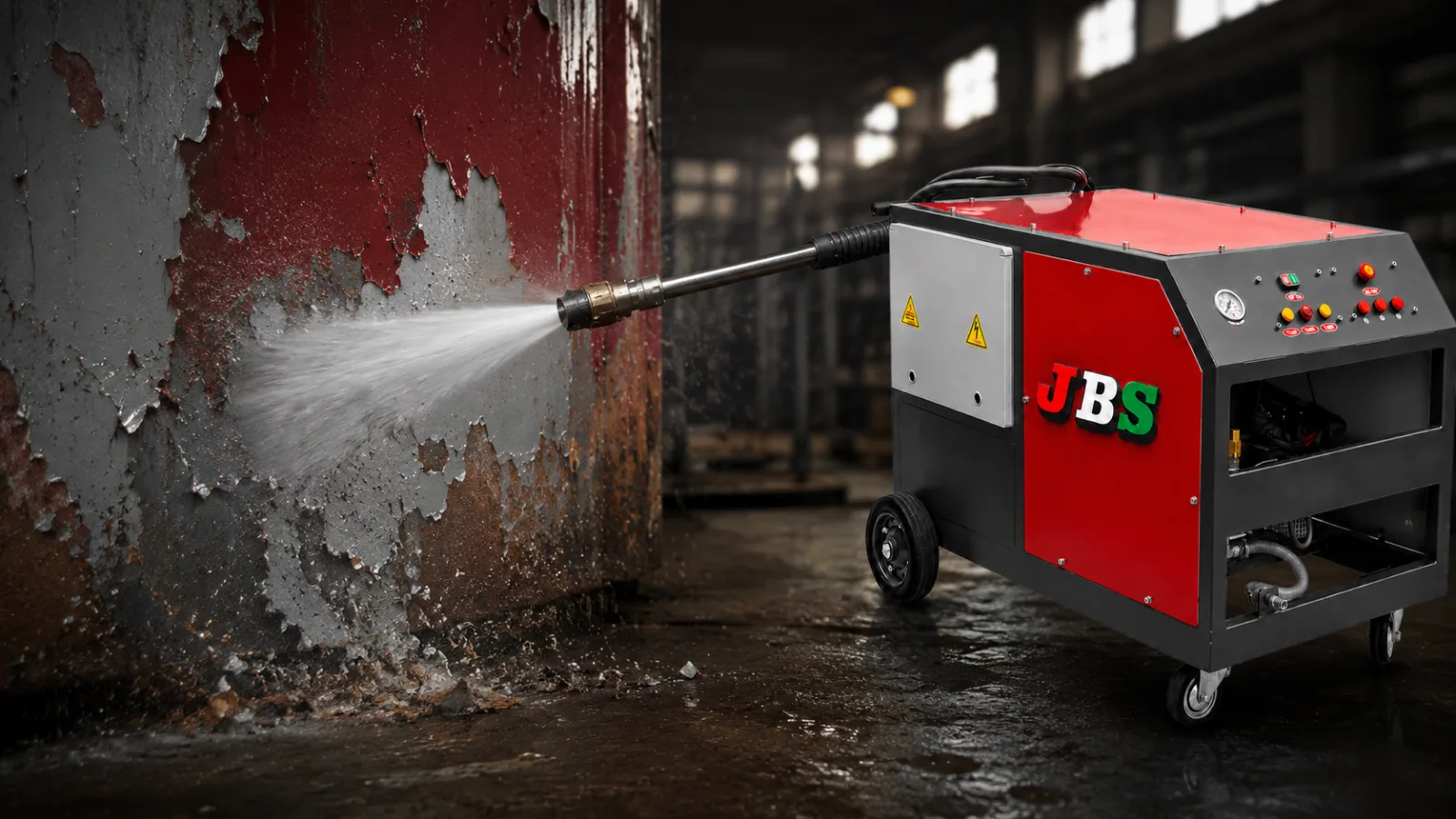
Start with the finish specification
For a UK contractor, “remove the paint” is not a complete scope.
The quotation should define whether the job requires:
-
removal of loose coating;
-
cleaning before inspection;
-
corrosion removal;
-
preparation before repainting;
-
complete coating removal;
-
a specified surface condition.
The required finish changes the water-jetting method.
500–600 bar is not automatically UHP
UK Water Jetting Association terminology places 500–600 bar below its UHP category.
That distinction matters when comparing equipment and contractor quotations.
A 500-bar machine may remove weakened coatings and contamination, but specialist full coating removal can involve substantially higher pressure classes or alternative preparation methods.
Calling every industrial water jet “UHP” makes technical comparison harder.
Flow matters on large steelwork
The JBS-500 provides up to 500 bar with 41 L/min flow.
For large steel structures, machinery and robust concrete, flow can be valuable because the system must not only attack a weakened coating but also carry detached material away.
The JBS-600 raises maximum pressure to 600 bar while reducing flow to 30 L/min.
The appropriate combination depends on the job rather than the larger pressure number.
Pure water and wet abrasive blasting are different processes
UK suppliers also offer wet sand-blast attachments that use the water stream to draw abrasive media into the jet.
These systems can remove paint, rust and scale, but they should not be confused with pure-water jetting.
A contractor must specify whether abrasive media is permitted, how waste will be contained and what surface profile is required before recoating.
Plan containment and flash-rust control
Paint fragments and wastewater need to be contained and managed.
Bare steel can also begin to flash-rust after water cleaning, particularly if drying and recoating are delayed.
The next coating system therefore affects the cleaning specification.
The surface should be inspected and prepared according to the coating manufacturer’s requirements rather than judged only by appearance.
For industrial cleaning and removal of weakened coatings, review the JBS-500 500 Bar Industrial Water Jet and compare available pressure/flow combinations in the High-Pressure Water Jetting Machines range. Match the machine to factory and maintenance work through Industrial Surface Cleaning, then use the Where Are High-Pressure Water Jets Used? guide to define the broader application. Once the coating, substrate and required finish are known, request a project-specific JBS quotation.
Recommended Solutions
Related Products and Categories
Common Questions
Frequently Asked Questions
What Does a Professional Water Jet Machine Do?
It is used to remove paint, rust, coatings, mud, deposits, concrete residue, and stubborn surface contamination. It is mainly preferred for industrial applications and durable surfaces.
Which Tasks Is a 600-Bar Water Jet Suitable For?
It may be preferred for demanding professional applications such as coating removal, heavy-industry surfaces, shipyards, concrete cleaning, rust removal, and removal of hard residue.
What Is the Most Important Criterion When Choosing a Water Jet Machine?
The application area, surface durability, pressure, water flow rate, pump quality, nozzle selection, safety, and service support should be evaluated together.
What Does Water Flow Rate Mean in a Water Jet Machine?
Water flow rate is the amount of water delivered by the machine within a given time. It is generally expressed in litres per minute and directly affects cleaning speed.