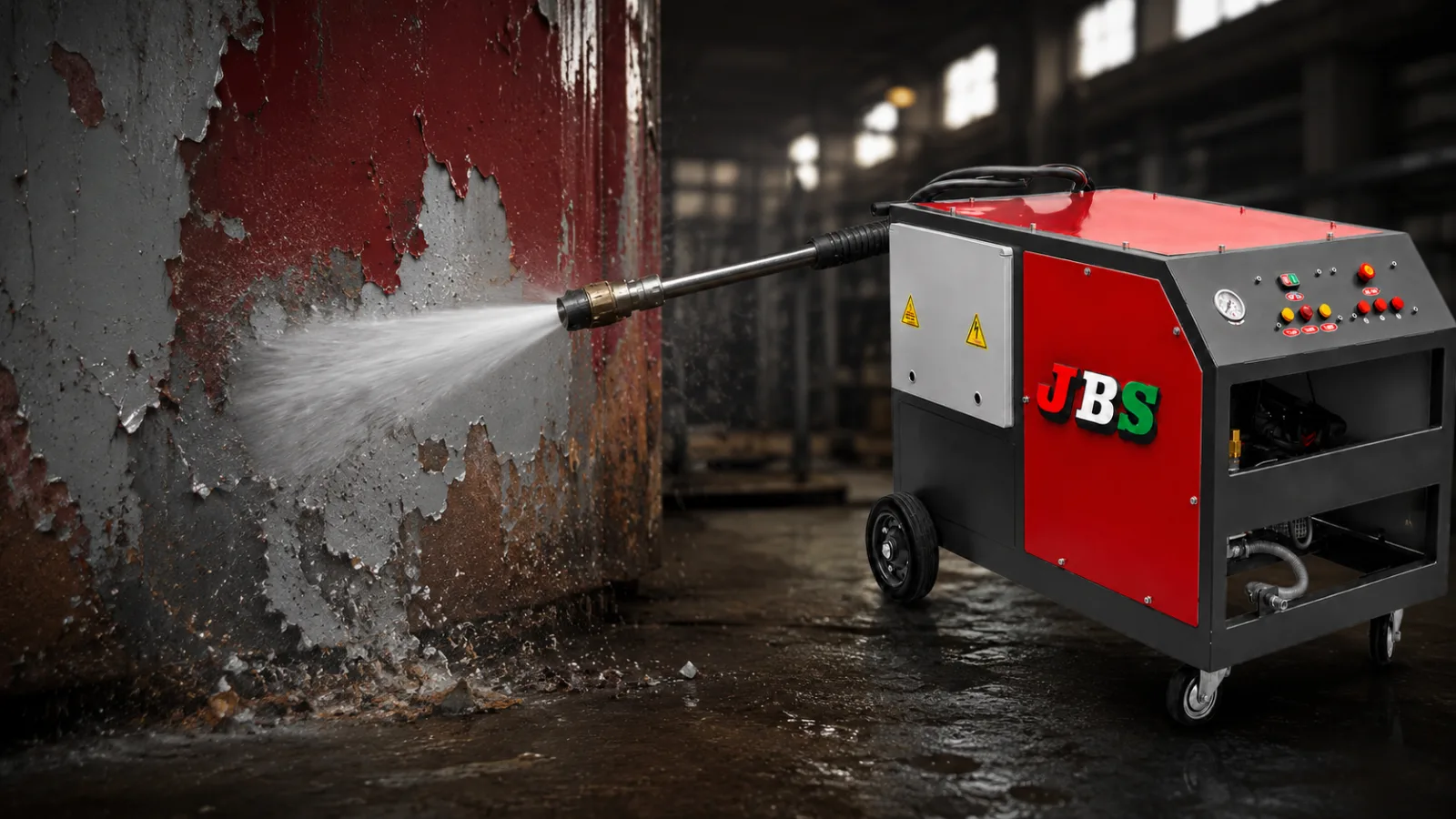
Water-jet paint removal uses the mechanical force of high-pressure water to remove loose, blistered or poorly adhered coating layers. It can be used on suitable steel structures, industrial machinery, tanks, ship surfaces and robust concrete areas.
Main Advantages
- Fast treatment of large suitable surfaces
- Can reduce manual scraping
- May reduce the need for chemical paint strippers
- Can limit the use of abrasive blasting media
- Produces less airborne dust than many dry methods
- Can reach irregular shapes, joints and recesses
- Removes surface dirt together with weakened coatings
- Leaves no abrasive-media residue on the surface
- Can be adjusted through pressure, flow and nozzle selection
500 Bar and 600 Bar Applications
Both pressure ranges can be effective depending on the coating and substrate. The correct pressure must be determined by test area, surface condition and required removal rate.
Which Surfaces Are Suitable?
Durable steel, industrial equipment, tanks, marine structures and robust concrete are common candidates. Thin, fragile or sensitive surfaces require a different method or much lower intensity.
Water Jet vs. Abrasive Blasting
Water jetting avoids abrasive-media cleanup and can reduce dust, while abrasive blasting may provide a different surface profile for coating adhesion. The next coating specification should guide the preparation method.
Surface Protection After Cleaning
Wet-cleaned steel should be dried and protected promptly because flash rust can form quickly.
Safety
High-pressure water can cause severe injury. Proper PPE, trained operators, inspected hoses and controlled work zones are essential.
Conclusion
Water-jet paint removal offers speed and clean working advantages when the substrate is suitable and the process is matched to the coating and next surface-treatment step.
Recommended Solutions
Related Products and Categories
Common Questions
Frequently Asked Questions
Should You Buy a Low-Flow Water Jet Machine?
It may be sufficient for small and limited applications. However, low flow can extend the working time when cleaning large surfaces, stripping paint, removing rust, or washing heavy equipment.
What Should Be Considered When Choosing a Water Jet Machine?
Pressure, water flow rate, pump quality, motor power, nozzle compatibility, hose durability, safety equipment, and service support should be evaluated together.
Can a water jet system be used for paint removal?
Yes. High-pressure and ultra-high-pressure water jet systems can be used to remove paint, coatings, rust, and other surface contaminants. The required pressure and water flow depend on the coating thickness, surface material, and desired cleaning result. For professional paint removal, the system should be selected specifically for surface preparation applications.
Is pressure alone enough when choosing a water jet system?
No. Pressure is important, but it is not the only factor to consider when choosing a water jet system. Water flow rate, pump capacity, nozzle type, motor or engine power, duty cycle, hose length, surface type, and the intended application also affect cleaning performance. For professional use, pressure and flow rate should always be evaluated together to select the right system.
How many bar should a water jet system have?
The required pressure depends on the application. Lower-pressure systems may be sufficient for general cleaning, while paint removal, rust removal, surface preparation, and heavy industrial cleaning may require much higher pressure. When choosing a water jet system, pressure should always be evaluated together with water flow rate, nozzle type, surface material, and operating conditions.
Should a water jet system be suitable for continuous operation?
For professional or industrial applications, a water jet system should be designed for continuous operation if it will be used for long working periods. Continuous-duty systems generally offer more durable pumps, motors, cooling systems, and components, helping reduce downtime and overheating. The required duty cycle should always be selected according to the daily workload and operating conditions.
Does it make sense to buy the cheapest water jet system?
Not always. The cheapest water jet system may have lower pump quality, limited durability, insufficient pressure or water flow, and higher maintenance requirements. For professional use, it is more important to evaluate performance, component quality, operating costs, spare parts availability, and after-sales support. Choosing the right system for the application can provide better efficiency and lower long-term costs.