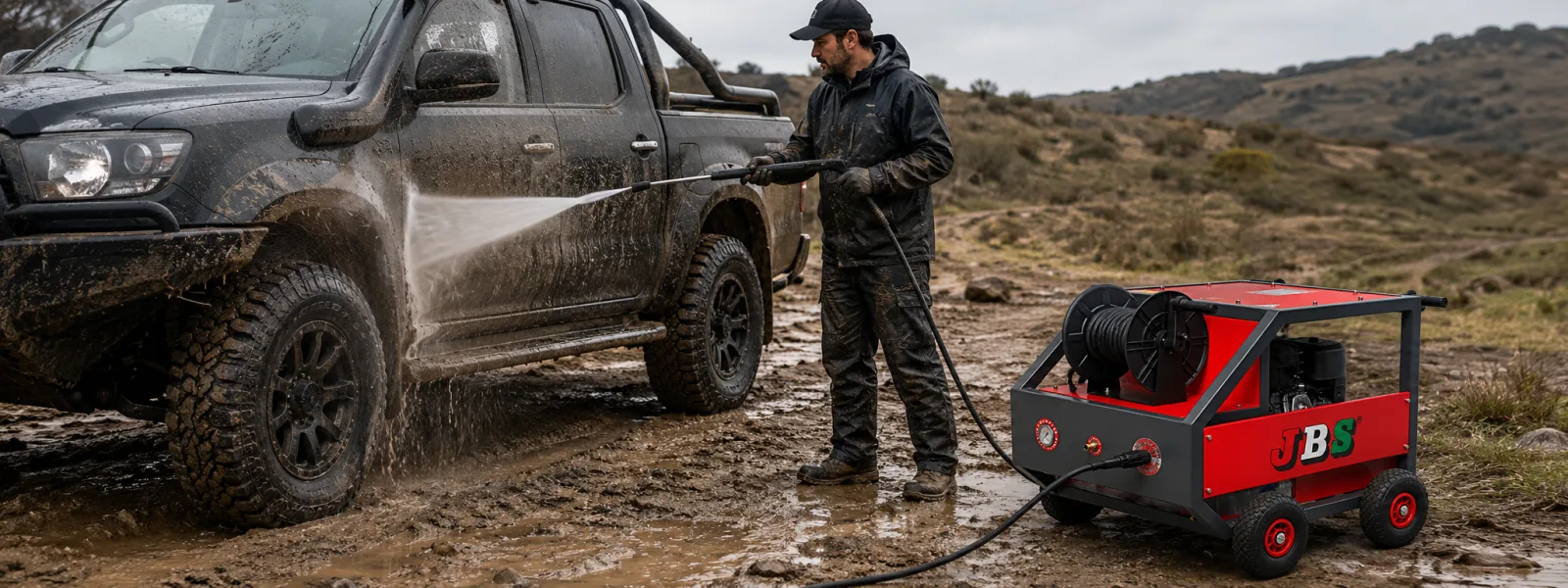
UK buyers specify a working package, not a bar number
The UK industrial market commonly describes this class as industrial water jetting or ultra-high-pressure cleaning equipment rather than simply a large pressure washer.
Current UK suppliers offer 500-bar units at substantially different flow rates: FlowJet lists 18 and 30 L/min configurations, while Morclean markets UHP machines across 500 and 700 bar classes. That makes the point clearly: pressure does not define the whole machine.
For a contractor, the purchasing brief should start with substrate, contamination and required production rate.
Where 500 bar earns its place
The JBS 500 bar water jet delivers 41 L/min with adjustable pressure up to 500 bar.
That relatively high water volume can be valuable where the operation involves large areas and loosened material needs to be carried away efficiently.
Typical project profiles include heavy plant wash-down, concrete surfaces, marine maintenance, industrial floors, tanks and robust steelwork.
For broad-area cleaning, throughput can matter more than having another 100 bar available.
Why choose 600 bar instead?
The JBS 600 bar water jet delivers up to 600 bar at 30 L/min.
That shifts the specification towards greater local jet impact rather than maximum water volume.
For corrosion, loose coatings, hardened process deposits and more demanding surface preparation on suitable substrates, that additional pressure reserve may be useful. JBS positions the 600-bar unit around steel, concrete, tanks, marine structures and heavy industrial maintenance rather than routine vehicle washing.
Marine work shows why application matters
In marine maintenance, cleaning, coating removal and surface preparation are separate process requirements.
A hull may need marine growth and contamination removed before inspection; another section may require loose coating or corrosion removal before recoating.
The equipment, nozzle and operating pressure should therefore follow the task.
That approach is more commercially useful than buying the highest pressure machine available.
What should go on a UK quotation request?
Before requesting an UHP pressure washer quotation, define the substrate, material to be removed, working area, required hose length, expected operating hours, available three-phase supply and preferred tooling.
The JBS-500 operates at up to 500 bar with 41 L/min; the JBS-600 trades some flow for a 600-bar ceiling at 30 L/min. Both current JBS configurations use 45 kW three-phase drives.
If water volume and broad-area flushing are priorities, review the JBS-500 industrial water-jetting machine. Where tougher deposits justify additional pressure reserve, compare the JBS-600. The wider Industrial Water Jetting Equipment range and Industrial Surface Cleaning application page help define the project scope, while the high-pressure water-jet applications guide provides additional planning context. Once substrate, duty cycle and site utilities are known, request a project-specific JBS quotation.
Recommended Solutions
Related Products and Categories
Common Questions
Frequently Asked Questions
How Should You Choose Between a 500-Bar and 600-Bar Water Jet?
The choice should be made by evaluating surface durability, the material to be removed, the required water flow rate, and the application method.
Do 500-Bar and 600-Bar Water Jet Machines Cost the Same?
No. A 600-bar machine generally requires components with higher pressure resistance and more powerful equipment, so its price may differ.
How many bar should a water jet system have?
The required pressure depends on the application. Lower-pressure systems may be sufficient for general cleaning, while paint removal, rust removal, surface preparation, and heavy industrial cleaning may require much higher pressure. When choosing a water jet system, pressure should always be evaluated together with water flow rate, nozzle type, surface material, and operating conditions.