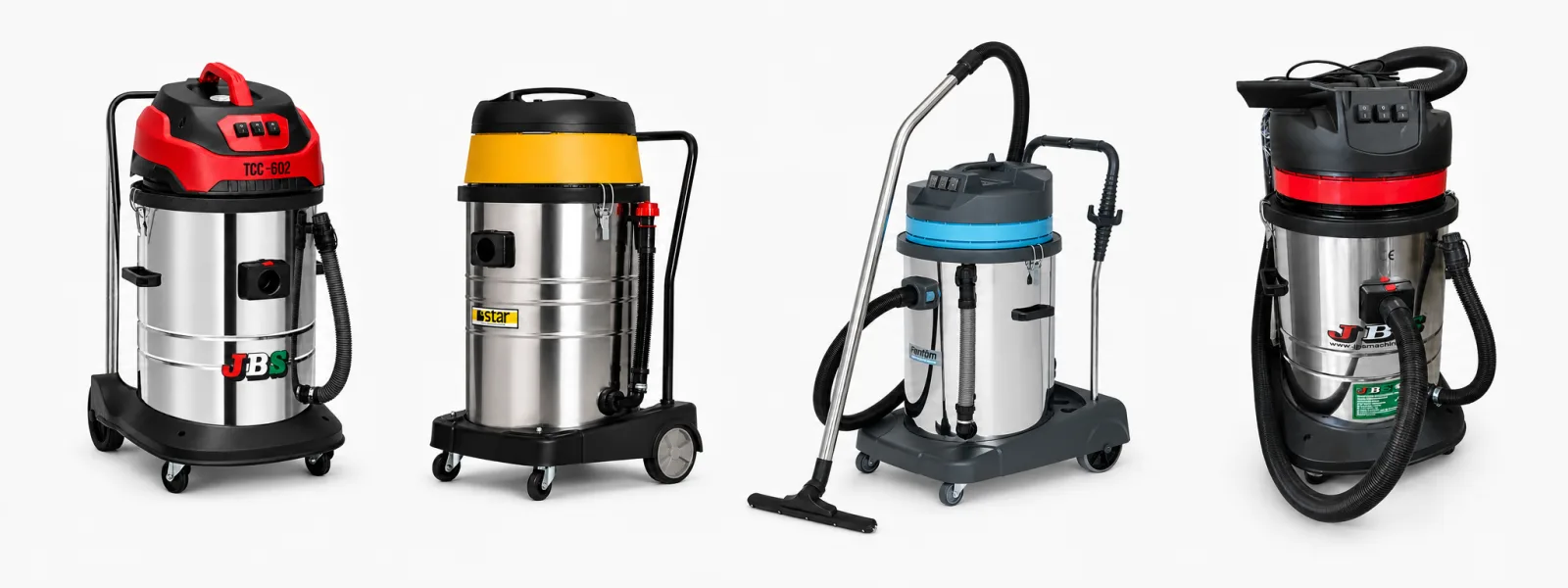
Choosing an industrial vacuum cleaner based only on wattage or motor count can be misleading. In professional car washes, detailing centres, workshops and commercial facilities, real cleaning productivity depends on vacuum pressure, airflow, tank capacity, filtration and expected duty cycle.
Nilfisk specifically highlights airflow, power and application type when selecting industrial vacuums, while Kärcher focuses strongly on wet/dry capability, filtration and maintaining suction during demanding professional work.
JBS models can be compared in the Industrial and Car Vacuum Cleaners range.
Suction and Airflow Matter More Than Wattage Alone
Vacuum pressure helps lift stubborn debris, while airflow determines how efficiently dust, sand, crumbs and loose contamination move through the hose.
A high motor rating therefore does not automatically guarantee the best cleaning performance.
For regular professional use, the JBS-602 2-Motor Wet and Dry Vacuum Cleaner provides 2,800 W, 2,000 mm H₂O suction, 159 L/s airflow and a 70-litre tank.
For more intensive workloads, the JBS-603 3-Motor Wet and Dry Vacuum Cleaner offers three motors with 4,200 W combined power and 2,000 mm H₂O suction.
Wet/Dry Capability, Filtration and Tank Size
A professional vacuum may need to collect dust, sand and dry debris one moment and liquids or wet contamination the next. Wet/dry capability therefore provides important flexibility for car washes and workshops.
Tank capacity should match daily workload, while filters, hose diameter, crevice tools and upholstery nozzles should match the material being collected.
The best industrial vacuum is not simply the machine with the most motors. It is the machine that delivers the right balance of suction, airflow, filtration, capacity and durability for the actual job.
Recommended Solutions
Related Products and Categories
Common Questions
Frequently Asked Questions
How Many Vacuum Motors Should Be Preferred?
Motor capacity should be determined according to the area size, operating time, and dirt intensity.
Does Every Vacuum Motor Fit Every Machine?
No. Voltage, power, dimensions, mounting arrangement, and airflow characteristics must be compatible with the machine.
Are a Car Vacuum and a Carpet and Upholstery Cleaner the Same?
No. A vacuum cleaner performs suction, while a carpet and upholstery cleaner washes the surface and extracts dirty water with the appropriate system.
Can a Wet and Dry Vacuum Extract Water?
If the product is technically designed for wet and dry use, it can extract liquids when the correct procedure is followed.
Can a Vacuum Cleaner Be Used Without a Filter?
Operation contrary to the manufacturer's design may damage the motor. The correct filter system should be used.
Which Accessories Are Important for a Car Vacuum?
A crevice tool, upholstery nozzle, hose length, filter, and connection components affect ease of use.