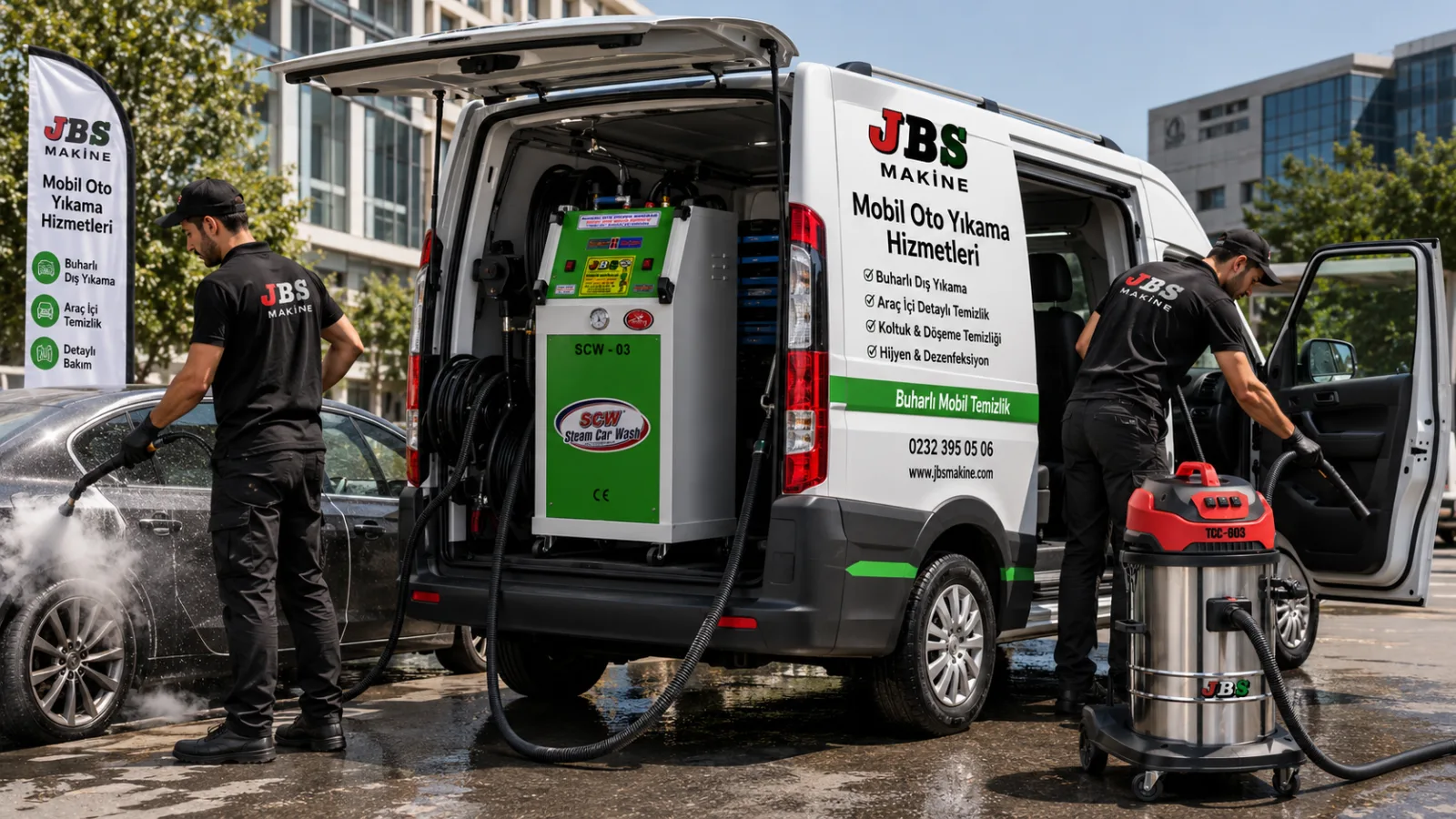
Build the Van Around Water, Power and Payload
A professional UK mobile valeting van should be able to arrive on site and work without assuming that the customer will provide a tap or electrical socket.
That changes the equipment decision completely.
Instead of asking “what cleaning products do I need?”, start with three limits:
van payload, onboard water and available electrical power.
Water Is Usually the Heaviest Part of the Setup
Every litre carried in the tank adds roughly another kilogram before the pressure washer, vacuum, generator, shelving and chemicals are loaded.
This makes van payload a practical buying specification rather than a vehicle detail.
The tank should be securely mounted and positioned with axle load and vehicle balance in mind.
Do not simply install the largest tank that fits.
Calculate it from water consumption per job × expected jobs between refills.
Choose the Pressure Washer Around Flow, Not Just Bar
Mobile valeting needs enough cleaning performance without wasting valuable onboard water.
When comparing commercial pressure washers, assess:
-
working pressure,
-
litres per minute,
-
electrical demand,
-
ability to draw from an onboard tank,
-
hose length,
-
commercial duty requirements.
A higher maximum pressure figure does not automatically make a machine better for mobile work.
Power: Generator, Battery or Customer Supply?
A genuinely self-contained van needs a planned power source.
Possible configurations include:
-
petrol generator,
-
inverter generator,
-
battery/inverter system,
-
mains supply where available.
Add the load of every item that may run together.
A pressure washer, wet/dry vacuum, extractor and steam cleaner can quickly turn a seemingly adequate generator into an undersized one.
The Core Working Kit
For standard exterior and interior valeting, the practical equipment list is relatively short:
-
Commercial pressure washer
-
Onboard water tank and feed pump
-
Hose reel
-
Wet and dry vacuum
-
Foam lance
-
Buckets and wash media
-
Wheel and detailing brushes
-
Drying towels
-
Exterior and interior chemicals
-
Cable and hose management
-
PPE
Polishers, extractors, steam equipment and air compressors should be added only when the service menu justifies them.
Plan Wastewater Before the First Job
A mobile business also needs to consider what happens after water hits the vehicle.
Where washing produces contaminated run-off, the operating setup may require containment and appropriate collection rather than allowing wastewater to enter unsuitable drainage.
That can make items such as a wash mat, recovery pump and dirty-water storage part of the commercial setup, not optional accessories.
Steam Can Reduce Dependence on Large Water Storage
A mobile operator offering detailed interior, door-shut, wheel and controlled exterior cleaning can also assess steam.
The JBS SCW-03 uses a 220 V / 50 Hz supply, 15-litre tank, two steam guns and an 8 bar steam system.
For a solo operator, a smaller single-gun configuration may also be more space-efficient.
The choice should be based on the services being sold, not simply machine capacity.
Avoid Building a Workshop on Wheels
A mobile valeting van earns money while travelling and cleaning.
Unused machinery consumes:
-
payload,
-
floor space,
-
fuel,
-
electrical capacity,
-
purchase budget.
Build around the services customers actually book, then add specialist equipment as revenue grows.
Specify the Van Around Your Daily Jobs
Review the JBS SCW-03, compare the Steam Car Wash Machine range and see how the equipment fits Mobile Car Wash Services. For a broader equipment plan, use the Car Wash Equipment Needed to Start a Car Wash Business guide. Send your daily jobs, vehicle type, available payload and power requirements to request a commercial quotation.
Recommended Solutions
Related Products and Categories
Common Questions
Frequently Asked Questions
What equipment is required for a mobile car wash?
A mobile car wash basically requires a pressure washer, water tank, foam system, hoses and hose reels, vacuum cleaner, cleaning chemicals, microfiber cloths, brushes, and vehicle interior-cleaning equipment. The equipment needed may vary according to the services offered and the number of vehicles handled per day.
What is included in a mobile car wash set?
A mobile car wash set may include a water tank, pressure washer, vacuum cleaner, steam cleaner, generator, hoses, cables, and various cleaning accessories, depending on the configuration. The components are designed to provide professional vehicle cleaning directly at the customer’s location.
Can a mobile car wash system be installed in a van?
Yes. A mobile car wash system can be installed in a van with the right layout and payload capacity. Equipment such as a water tank, pressure washer, vacuum, steam cleaner, generator, and hoses can be integrated into the vehicle to create a compact and efficient mobile car wash solution.
What should a mobile car wash machine be like?
A mobile car wash machine should be compact, durable, easy to transport, and suitable for professional use. It should provide sufficient pressure and water flow while keeping water and energy consumption efficient. Depending on the application, features such as an integrated water tank, generator compatibility, hose storage, steam cleaning, vacuuming, and easy maintenance can make the system more practical for mobile vehicle cleaning services.