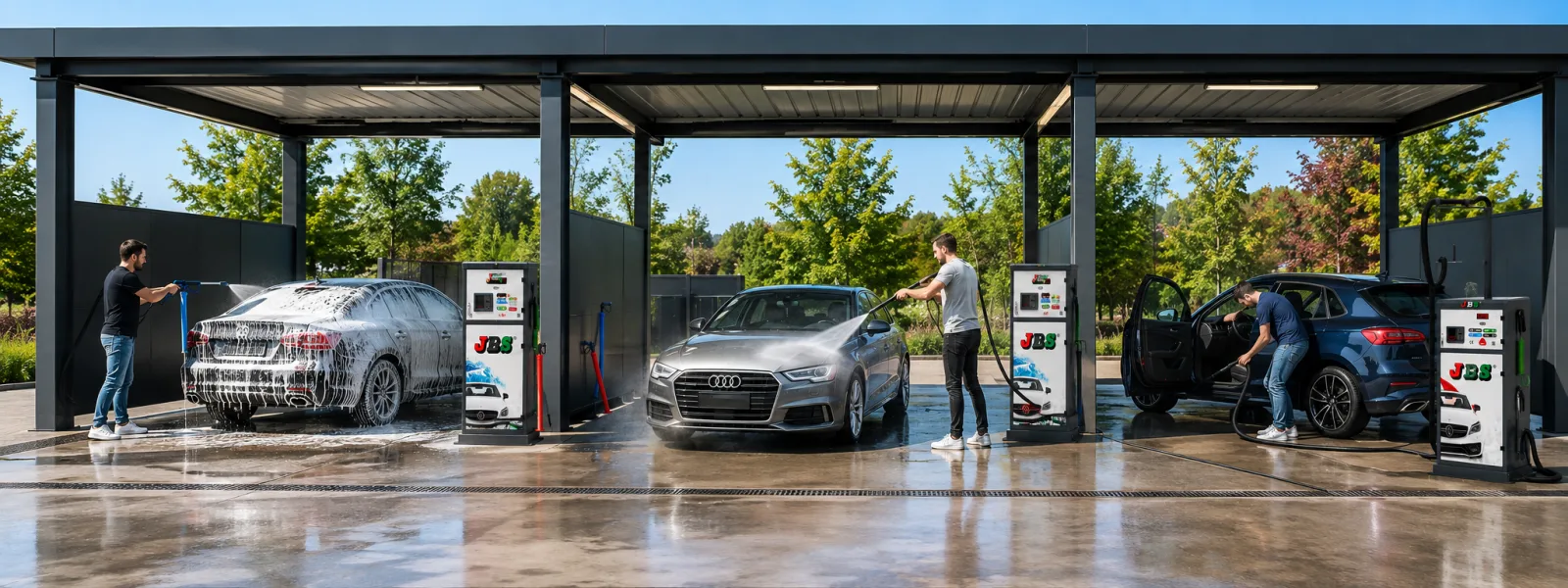
Self-Service Car Wash Equipment Maintenance: An Operator's Guide
An unattended self-service wash bay earns nothing when its pump stops, the foam programme fails or customers cannot pay. Operators should therefore maintain the entire transaction chain, not just the pressure washer. A practical schedule covers water supply, mechanical components, chemical dosing, payment controls and drainage. Inspection intervals must follow the equipment manufacturer and local site conditions rather than a universal timetable.
Check Every Wash Bay Before Trading
Walk through each bay before opening. Inspect spray guns, hoses, swivels and overhead booms for leaks, abrasion or damaged connections. Check that hoses cannot trip customers or contact vehicles unexpectedly. If a high-pressure component looks damaged, close the bay until qualified personnel make it safe.
Carry out a controlled test of installed wash and foam programmes. Verify that accepted coins or tokens result in the correct time allocation, and confirm that instructions remain legible. Payment acceptance and the actual wash duration should agree. Never open electrical enclosures during routine customer-service checks.
Protect Pumps with Consistent Water Supply
Pressure instability often starts upstream: inadequate inlet flow, dirty filters, air entering the line or a worn nozzle. The pump must never run dry. Record abnormal vibration, unusual noise and pressure changes rather than repeatedly restarting a faulty unit.
Clean inlet filters and check lubricants only according to the exact pump manual. Internal valves, seals, regulators and motor protection systems require competent technicians. Our pressure washer maintenance guide explains the underlying component risks; a multi-bay installation also needs site-wide hydraulic checks.
Maintain Foam, Wax and Payment Performance
Incorrect dilution can produce poor foam, excessive chemical consumption and unhappy users. Monitor chemical levels, approved dilution ratios, dosing lines and injection points. Keep products labelled and never mix incompatible chemicals. Check whether each programmed service delivers what customers paid for.
For coins and banknotes, look for moisture ingress, rejected payments and dispensing errors. Card terminals or mobile payment devices belong on the checklist only where actually installed. Reconcile transactions against usage records to identify repeated failures without assuming the control system provides remote monitoring.
Manage Drainage, Water Treatment and Freezing
Inspect drainage channels, collection points and any installed treatment or recycling equipment. Wastewater handling must comply with the site's local discharge permissions. A lower water bill does not excuse uncontrolled discharge.
Hard-water deposits, poor feedwater quality and unmaintained filters can compromise operation. For colder European sites, document frost protection for external pipes, pumps and exposed fittings. Do not presume that standard machinery includes winterisation, reverse osmosis or water recycling unless these have been specified.
Use Maintenance Records to Decide When to Upgrade
Record faults by bay, downtime, replaced parts and labour cost. Repeated breakdowns may reflect the site's water capacity or number of simultaneous users, not simply a defective pump. Compare your operating requirements with the JBS self-service car wash systems range, including central arrangements where appropriate.
Stop losing paying wash sessions to avoidable downtime. Tell JBS Makina your bay count, peak usage, existing pump configuration and payment setup. Request a technical equipment review and a tailored commercial quotation before replacing major components.
Recommended Solutions
Related Products and Categories
Common Questions
Frequently Asked Questions
How many self-service car wash bays should a commercial site install?
The right self-service car wash equipment depends on site dimensions, peak-hour vehicle demand, customer access and expected wash duration. For a compact forecourt or single-bay operation, the JBS YK offers pressure washing and jet foam. The JBS YKC adds a wax programme. Where two vehicles need simultaneous access, the JBS CYJK provides a dual-bay washing solution. Larger installations can consider the JBS 4FMS central system, subject to the required number of wash positions and confirmed technical capacity. UK forecourt operators, garages and car wash investors should assess queue management, access routes and future expansion before choosing equipment.
Which wash programmes should a commercial self-service jet wash offer?
A successful self-service jet wash should provide clearly defined programmes that match customer expectations and the site's operating model. JBS equipment offers different configurations covering high-pressure washing, jet foam, rinsing and wax application. The JBS YK provides a straightforward wash-and-foam solution, while the JBS YKC adds a quick-wax function. The JBS 4FMS combines four wash programmes within a central system. Separate vacuum and air-blower stations can expand the customer experience without occupying a washing bay. UK operators should assess programme duration, chemical consumption and customer usability. Adding more wash options only makes commercial sense when customers understand and regularly use them.
Can JBS self-service car wash equipment accept coins, tokens or contactless payments?
JBS coin-operated car wash systems are available with payment configurations supporting tokens, coins or banknotes. The payment controller links the accepted amount to a defined operating time or wash programme, allowing site operators to establish a suitable charging structure. Contactless bank cards, mobile wallets and app-based payments are increasingly relevant to UK self-service car wash operators. However, compatibility with these payment methods must be confirmed for the specific JBS configuration before purchase. International buyers should also verify currency compatibility, payment-controller requirements and the equipment included in the quotation. A clear payment process can help customers start washing quickly and reduce unnecessary delays at busy sites.
Which payment methods can be used in self-service car wash systems?
Self-service car wash systems can be configured for tokens, coins, banknotes or, depending on the project, electronic payment solutions. The right payment system should be selected according to the target country, customer habits, business model and the maintenance requirements of the payment infrastructure.