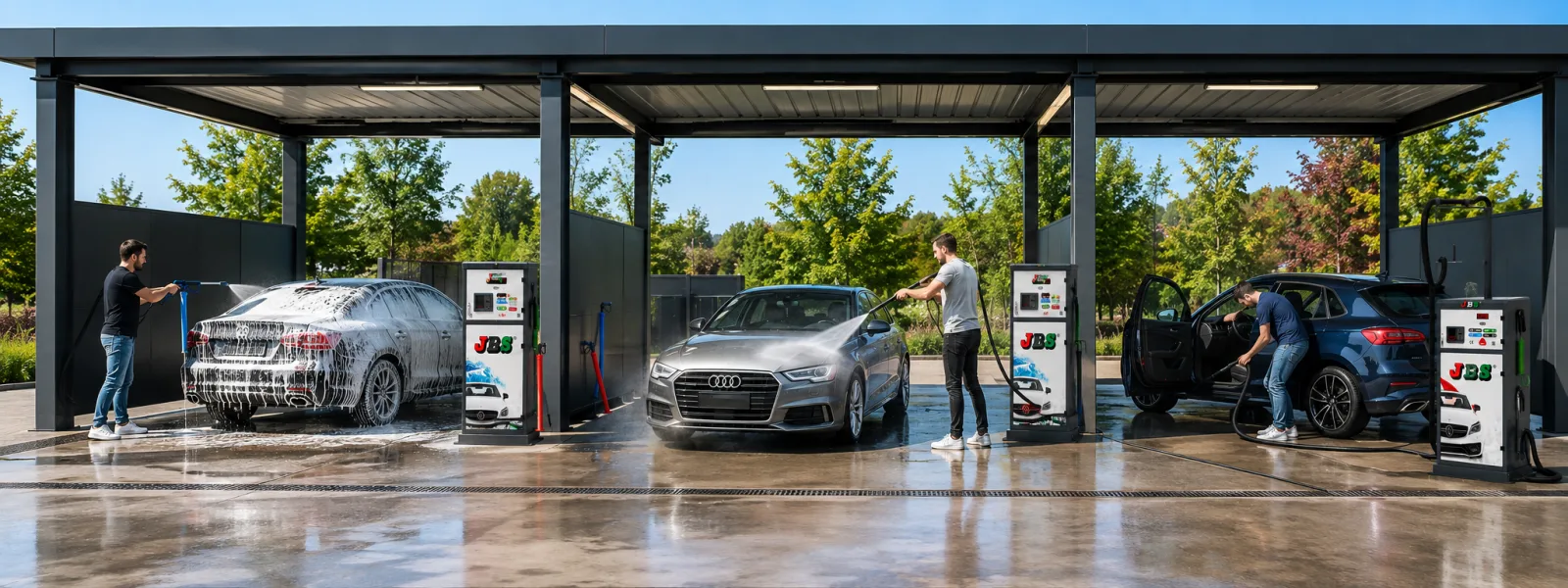
Self-Service Car Wash Electricity Costs: How to Calculate Energy Use and Profitability
For petrol station operators, commercial landlords and independent wash businesses, self-service car wash electricity cost is more useful when expressed as an expense per paying customer than as a monthly utility total.
A location can have a low electricity bill because few customers visit, while another consumes substantially more electricity and earns considerably higher revenue.
The objective is to understand what each paid wash costs, how many customers your equipment can serve and whether the installed electrical capacity supports profitable operation.
JBS Makina manufactures commercial self-service washing systems in Türkiye for different wash-bay arrangements.
Measure Electricity Cost per Paid Washing Session
Start by recording the electricity consumed by the washing equipment over a defined period.
Then divide this consumption by the number of completed paid washing sessions.
For example, suppose a separately metered washing installation consumes 720 kWh during a month and records 1,200 paid sessions.
The average equipment consumption is:
720 kWh ÷ 1,200 sessions = 0.6 kWh per session.
To calculate energy expense per customer, multiply the result by your commercial electricity tariff.
This method works best when the meter covers only the equipment being evaluated.
If the same meter supplies lighting, vacuum cleaners and other building services, those additional loads must be identified before comparing wash programmes.
Understand the Difference Between Motor Rating and Energy Consumption
Equipment brochures frequently display motor power in kilowatts.
However, a motor rating is not necessarily the amount of electricity the complete machine draws from the supply.
The relevant quantity for the electricity bill is measured electrical energy in kilowatt-hours.
Consider an illustrative machine with an average electrical input of 6 kW while actively washing.
Five minutes of operation would consume approximately 0.5 kWh.
Ten minutes would consume approximately 1 kWh.
Actual electricity input depends on motor efficiency, mechanical loading, operating controls and the other components connected to the system.
JBS self-service models include 5.5 kW motors, but these published ratings should not be presented as measured site consumption.
Pricing Wash Programmes Around Operating Costs
A commercial jet wash sells timed access to services rather than simply selling water.
Your wash menu might include high-pressure cleaning, foam and an additional finishing programme.
Each service has its own cost profile.
Foam introduces chemical consumption, while an optional wax programme may create additional customer revenue.
The JBS YKC Self-Service Wash, Foam and Wax Machine allows operators to offer these three exterior-care functions from one unit.
When setting prices, calculate the cost of the actual programme mix customers purchase.
A profitable pricing decision should consider electricity, water, chemicals, transaction fees and maintenance, rather than assuming every customer uses the same resources.
Peak Demand and Electrical Infrastructure for Busy Sites
Energy consumption over a month is different from peak power demand.
Several customers may activate washing equipment simultaneously during the busiest periods.
Additional loads can come from vacuum cleaners, water treatment systems and control equipment.
For a larger facility, the electrical design should identify all connected loads and expected operating combinations.
The JBS CYJK Dual-Bay Jet Foam System is intended to serve two vehicles at once.
Its complete electrical requirement must be confirmed from the actual number of motors and operating configuration. A single advertised motor rating must not automatically be doubled or assumed to represent the entire installation.
When Does a Central System Make Commercial Sense?
A central equipment arrangement may be attractive to wash-park operators managing multiple bays.
The JBS 4FMS Four-Function Central System combines pressure washing, foam, wax and rinsing within a centrally organised technical layout.
This can simplify access to equipment for maintenance and help standardise the services offered across a site.
However, centralisation does not automatically guarantee lower electricity consumption.
Operators should compare installed equipment, simultaneous capacity, maintenance access, future expansion and expected vehicle traffic.
The right configuration depends on the commercial site, not just the number of washing programmes advertised.
Idle Consumption Can Reduce Your Operating Margin
A facility may draw electricity even when nobody is washing a vehicle.
Payment equipment, controllers, lighting, water preparation systems and other auxiliaries can contribute to base-load consumption.
As a simple example, a continuously operating 100-watt load consumes 2.4 kWh in 24 hours.
Over 30 days, that becomes 72 kWh.
This is a mathematical illustration, not a published JBS standby measurement.
Check whether equipment needs to remain energised overnight, whether lighting schedules are appropriate and whether unused auxiliary systems can be safely switched off.
Reducing unnecessary idle consumption can improve margins without changing the customer-facing wash programme.
Turn Equipment Data Into Better Purchasing Decisions
International buyers should request a complete specification covering the selected machine, included accessories, motor electrical characteristics and expected operating arrangement.
Confirm the destination country's electrical compatibility, local installation requirements and delivery terms.
If you also plan to sell interior cleaning services, treat the electricity use of self-service vacuum units as a separate business activity.
Compare the wider JBS Self-Service Car Wash Equipment Range and consult the Self-Service Car Wash Equipment Checklist.
Monitor paid sessions and metered consumption after installation to test whether actual operating margins match your projections.
Get Factory Pricing Based on Your Business Model
Opening a commercial wash site, expanding a petrol forecourt or sourcing equipment for multiple locations?
Avoid ordering machinery based only on the advertised pump pressure or headline motor rating.
Ask JBS Makina to identify the wash-bay configuration, available programmes, electrical specifications, payment options and accessories that match your project.
Discuss factory pricing, wholesale requirements, spare parts, warranty and export delivery terms before making your purchasing decision.
REQUEST A PROJECT-SPECIFIC JBS MANUFACTURER QUOTATION
CONTACT JBS MAKINA SALES DIRECTLY ON WHATSAPP
Provide your destination country, expected paid washes, site layout, number of bays and available power supply. Request a clear equipment specification and commercial offer.
Recommended Solutions
Related Products and Categories
Common Questions
Frequently Asked Questions
How many wash bays are required for a self-service car wash?
The ideal number of wash bays depends on location, expected daily vehicle volume, peak-hour traffic and available investment budget. Smaller sites can start with fewer bays, while locations with high traffic volumes may require multiple wash bays to reduce waiting times and increase operating capacity.
What pressure is recommended for a self-service car wash machine?
The required operating pressure depends on the equipment and application. Selected JBS Makina models feature adjustable pressure from 0 to 200 bar.
How much does a self-service car wash system cost?
Self-service car wash system prices depend on the number of washing bays, machine specifications, washing programs, payment options, and installation requirements. Contact JBS Makina for a customized quotation.
What is the difference between single-bay and dual-bay car wash systems?
A single-bay system serves one vehicle at a time, while a dual-bay system allows two vehicles to be washed simultaneously. The right choice depends on expected customer traffic.