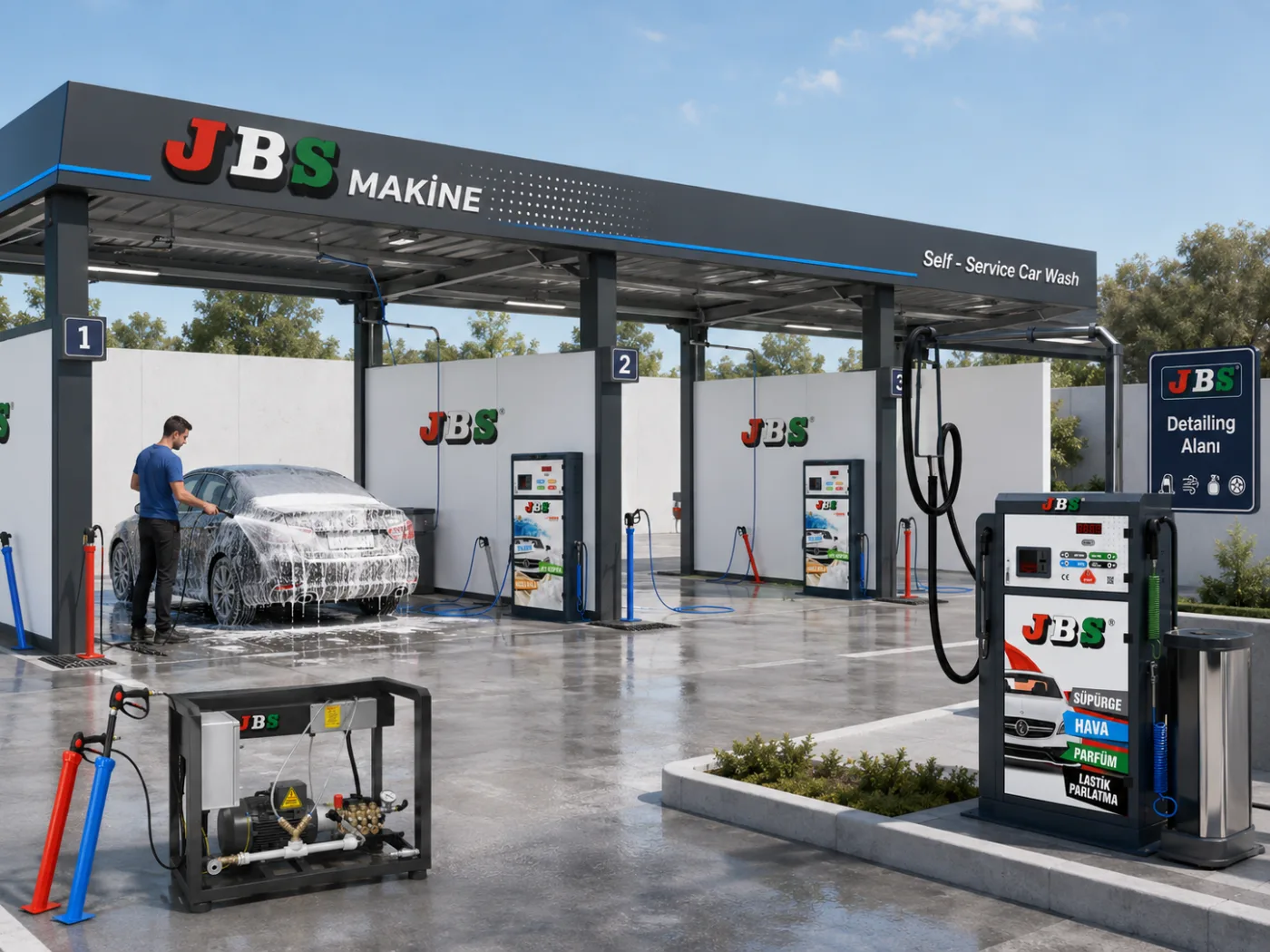
Starting a self-service car wash requires more than installing a pressure washer. A professional facility needs the right combination of high-pressure washing, foam, rinsing, wax, payment control, vacuuming, air blowing and site infrastructure.
Leading self-service manufacturers also design their systems as complete solutions rather than standalone machines. Modular wash bays, chemical dosing, water treatment, payment terminals and additional cleaning services are commonly planned together.
JBS Makina offers different configurations within its self-service car wash systems range. The current product family includes wash-and-foam machines, wash-foam-wax systems, dual-bay equipment, central systems, vacuums and blower units.
High-Pressure Wash and Foam System
The main equipment in every wash bay is the high-pressure washing system. Pressure, water flow and pump capacity should be selected according to the number of bays and expected daily use.
For a simple self-service setup, the JBS-YK Self-Service Wash and Foam Machine combines high-pressure washing and dense foam in one unit.
Businesses that want to add a premium care option can choose the JBS-YKC Wash, Jet Foam and Wax Machine, which combines washing, foam and quick wax.
Central System for Multiple Wash Bays
A single-bay site and a high-traffic multi-bay facility should not use the same system configuration. When several customers wash simultaneously, pump capacity and water supply become critical.
The JBS-4FMS 4-Function Central System centrally manages washing, foam, wax and rinsing and is designed for multi-bay installations.
Payment, Vacuum and Blower Equipment
A self-service car wash also needs a practical payment and time-control system. Coin, token, card or QR solutions can be selected according to the business model. Modern competitors increasingly combine payment with digital control and remote management.
Exterior washing can be complemented with interior cleaning. The JBS-4BS Self-Service Blower Vacuum provides vacuuming and air-blowing functions as an additional customer service.
Do Not Forget the Infrastructure
Water supply, filtration, electrical capacity, drainage, chemical storage and optional water softening or reverse osmosis should be planned before installation.
The right self-service car wash is therefore not the facility with the most equipment. It is the system where wash-bay capacity, pump performance, useful wash programs, payment technology and additional services are correctly matched to actual customer traffic.
Recommended Solutions
Related Products and Categories
Common Questions
Frequently Asked Questions
What Determines Self-Service Car Wash Setup Prices?
The installation cost of a self-service car wash varies depending on the number of bays, machine functions, payment system, water and electricity infrastructure, installation area, equipment capacity and service support.
What Determines the Price of a Self-Service System?
The price varies according to the number of bays, functions, payment system, pump group, site infrastructure, and level of automation.
How Should You Choose Between Coin-Operated and Card-Based Systems?
The decision should be based on the target users, business management needs, payment method, and remote reporting requirements.