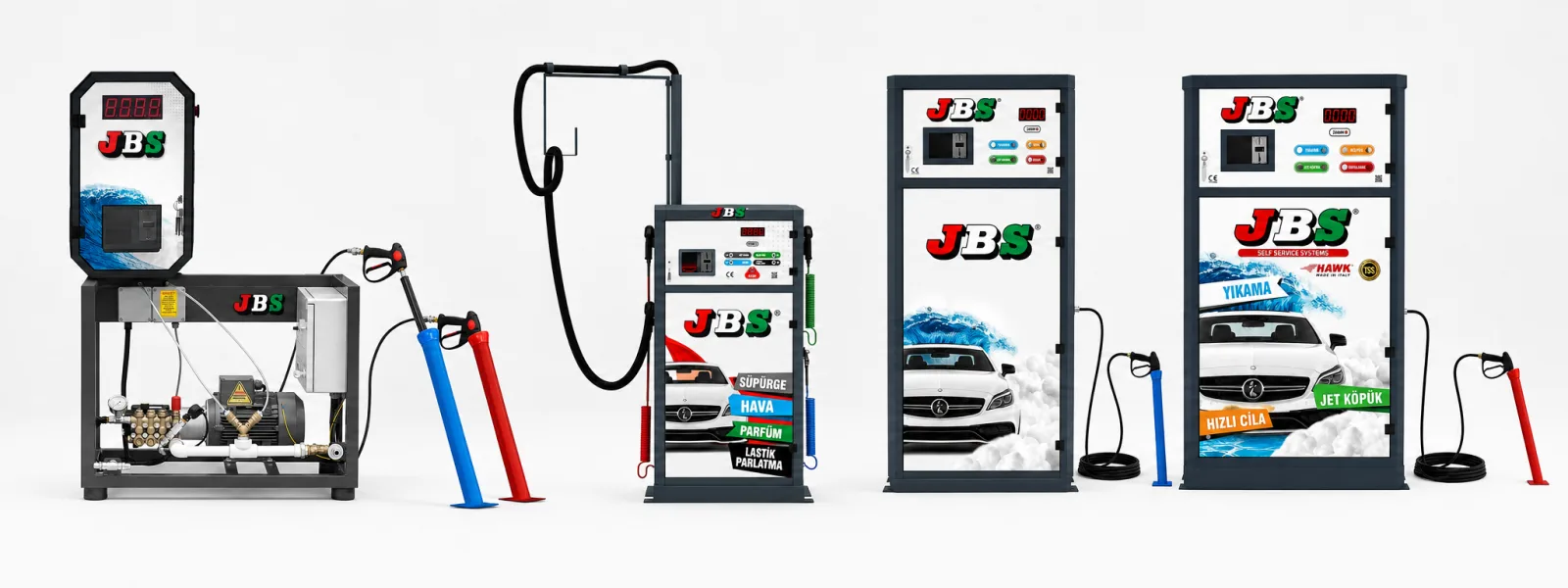
Self-Service Car Wash Build Quality, Payment Electronics and Engineering
A commercial self-service car wash must remain dependable under repeated customer use, water spray, cleaning chemicals and changing outdoor conditions. Maximum pressure is only one part of equipment quality.
A system offering 200 bar may still experience costly interruptions if its cabinet, payment hardware or electrical connections are poorly protected.
JBS Makina manufactures self-service washing equipment for single, dual and multi-bay facilities. Evaluating these systems requires attention to both mechanical construction and electronic reliability.
Outdoor Cabinet Construction and Corrosion Protection
Self-service washing equipment is frequently installed in environments exposed to moisture, detergents and temperature fluctuations.
Steel cabinet durability depends on material selection, surface preparation and the protective coating system. Industrial coatings can reduce corrosion when applied with suitable primers, sufficient coverage and careful edge protection.
However, the coating specification must match the installation environment.
Buyers should verify cabinet material, coating type, corrosion protection at welded joints and drainage arrangements.
An attractive outer finish alone does not prove long-term weather resistance.
P5 Digital Control Panels and Moisture Protection
Digital controls coordinate wash programmes, payment signals and operating time.
Selected JBS self-service configurations feature a P5 digital display, allowing operators to present different paid washing functions.
For reliability, the electronics behind the display require appropriate protection against moisture.
Protective circuit-board coatings, correctly rated enclosures and suitable cable glands can help reduce corrosion and electrical faults.
A P5 display does not automatically establish the enclosure's IP rating or confirm that every circuit board has a special moisture-resistant coating. Those details should be verified for the specific equipment supplied.
Coin Mechanisms, Payment Signals and Customer Experience
A payment acceptor must recognise the selected currency and transmit the correct signal to the machine controller.
JBS configurations support coins, tokens and banknotes. Card and contactless payment should be treated as project-specific options requiring integration confirmation.
Dirty sensors, damaged connectors or moisture entering the payment housing may cause rejected payments or interrupted wash sessions.
Operators should compare payment-module accessibility, replacement availability and the compatibility of payment signals with the controller.
A reliable customer payment process is as important as the washing pressure behind it.
Pump Performance and Electrical Component Quality
The JBS self-service range includes 200-bar-class systems with 15 L/min specifications and Italian pump configurations.
However, pressure alone does not establish reliable simultaneous operation across several bays.
Motor output, pump duty, water supply, chemical dosing and electrical protection must be considered together.
Contactors, thermal protection and correctly selected residual-current protection contribute to appropriate motor control and electrical safety.
Accessible service compartments help technicians inspect hydraulic and electrical components without unnecessary dismantling.
Maintenance Access and Long-Term Operating Value
For a commercial operator, a fault means more than the cost of replacing a component. It can mean an unavailable wash bay and lost customer transactions.
Cabinet durability, replaceable payment modules, spare-parts availability and accessible electronics should therefore influence equipment selection.
Explore self-service car wash facility applications and the practical guide to equipment needed for a self-service car wash.
Commercial operators planning interior-cleaning services can also compare professional vehicle vacuum equipment.
Specify Better Equipment. Protect Your Wash Bay Revenue.
Compare the full JBS self-service car wash systems range, including single-bay, dual-bay and central configurations.
Request a technical quotation directly from JBS Makina.
Provide your location, number of bays, expected daily traffic and preferred payment methods. Request documented cabinet coating specifications, electrical enclosure protection, controller details, pump configuration, warranty terms and spare-parts support.
Choose equipment according to its complete engineering specification, not pressure alone.
Recommended Solutions
Related Products and Categories
Common Questions
Frequently Asked Questions
What makes a self-service car wash cabinet suitable for outdoor installation?
An outdoor self-service car wash cabinet should be designed to withstand water exposure, cleaning chemicals and changing weather conditions. Suitable metal construction, industrial protective coatings, corrosion-resistant fasteners and effective drainage help protect the equipment. Buyers should verify enclosure materials, coating specifications and the declared environmental protection rating.
How does a P5 digital controller improve self-service car wash operation?
A P5 digital display, integrated with the appropriate controller, allows customers to select wash programmes and monitor their purchased operating time. It can support functions such as pressure washing, foam, wax and pause. Reliable performance depends on compatible payment interfaces, properly protected electrical connections and correctly configured control electronics.
Why do coin acceptors and payment electronics fail in self-service car washes?
Common causes include dirty coin sensors, damaged connectors, moisture intrusion, incorrect currency settings and electrical faults. These problems can lead to rejected payments or interrupted wash sessions. Accessible payment modules, protected wiring and preventive maintenance help minimise disruption, particularly in unattended commercial washing facilities.
How can operators reduce downtime in a multi-bay self-service car wash?
Operators should evaluate pump capacity, electrical protection, payment-module reliability and access to replacement parts before installation. Regular inspections of hoses, valves, control cabinets and payment equipment help identify potential faults. Modular components and accessible service compartments can shorten repair times and improve wash-bay availability.