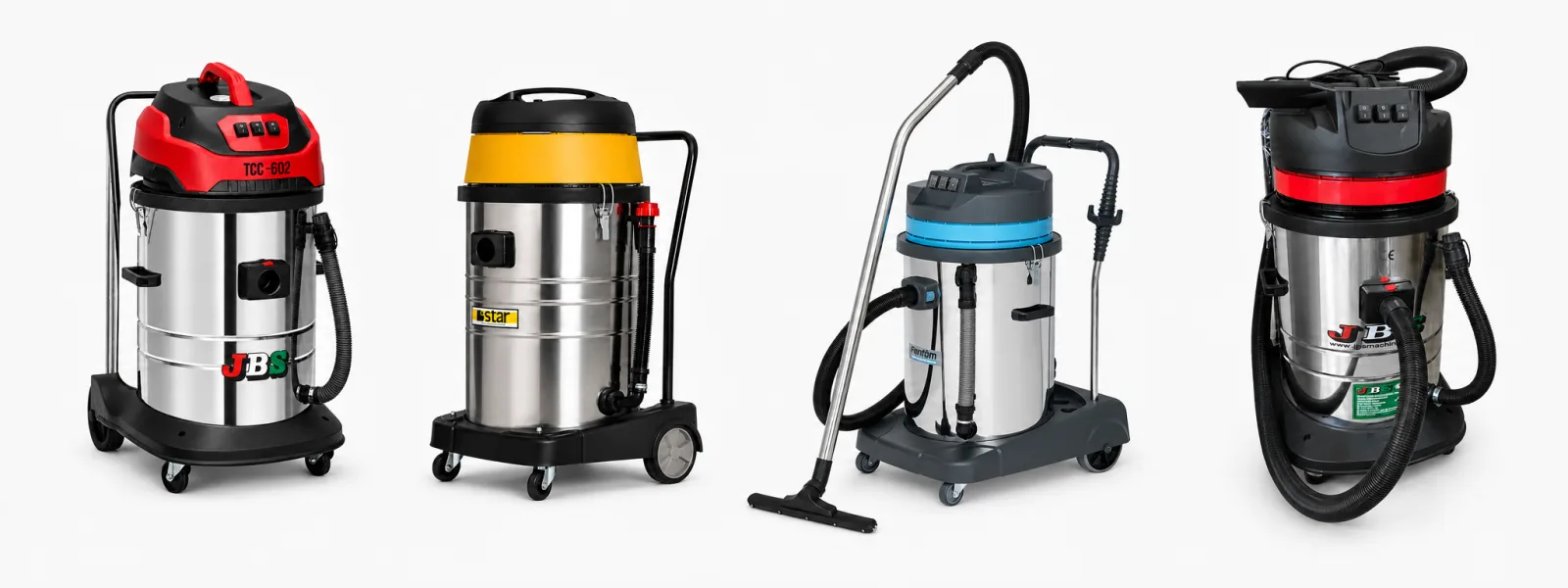
A professional car wash vacuum cleaner is a powerful industrial cleaning machine designed to remove dust, sand, hair, crumbs, mud, and liquid residue from vehicle interiors. Unlike domestic vacuum cleaners, professional models are manufactured for extended use, heavy vehicle traffic, and demanding working conditions.
A car wash vacuum should not be selected solely according to motor power. Suction performance, airflow, vacuum pressure, number of motors, tank capacity, filtration system, and spare-parts availability should all be evaluated together.
What Is a Professional Car Wash Vacuum Cleaner Used For?
Professional car wash vacuum cleaners can be used to clean:
- Seats and gaps between seats
- Vehicle floors and floor mats
- Luggage compartments
- Door pockets
- Seat rails
- Areas around the pedals
- Areas beneath the dashboard
- Minor liquid spills
- Dirty water remaining after upholstery cleaning
Using suitable attachments makes it easier to reach narrow gaps, spaces between seats, and other difficult areas.
What Is a Wet and Dry Car Wash Vacuum Cleaner?
A wet and dry car wash vacuum cleaner is a professional machine capable of collecting both dry dirt and a certain amount of liquid. This feature provides a significant advantage for car wash and vehicle-detailing businesses.
In dry mode, the machine removes dust, sand, hair, and crumbs. In wet mode, it can extract liquids from floor mats, floors, or surfaces following upholstery cleaning.
However, a conventional wet and dry vacuum is not the same as an upholstery extractor. An extractor sprays cleaning solution onto the surface and then recovers the dirty water. A standard car wash vacuum is primarily designed to collect existing dirt and liquids.
Differences Between Single-, Twin-, and Triple-Motor Vacuum Cleaners
Professional car wash vacuum cleaners are available with different motor configurations.
Single-Motor Car Wash Vacuum Cleaner
Single-motor models are suitable for businesses with low or moderate workloads. Their compact construction takes up less space, and their electricity consumption is generally lower.
They may be preferred by small car washes, vehicle workshops, and detailing businesses that clean a limited number of vehicles each day.
Twin-Motor Car Wash Vacuum Cleaner
Twin-motor models are designed for businesses requiring stronger suction and longer operating periods. On machines with independently controlled motors, the operator can use one or both motors according to the cleaning requirement.
Twin-motor vacuum cleaners are generally more suitable for car washes with heavy customer traffic.
Triple-Motor Car Wash Vacuum Cleaner
Triple-motor vacuum cleaners are used by high-volume businesses requiring a large tank and powerful vacuum performance. They may be suitable for large vehicles, commercial vehicles, service fleets, and continuously operating car wash facilities.
A higher number of motors does not automatically mean a better machine. Motor quality, cooling system, airflow, and vacuum performance must also be examined.
How Should Suction Power Be Evaluated?
Vacuum-cleaner performance cannot be assessed by wattage alone. Wattage indicates the motor’s electrical consumption; it does not directly represent suction performance.
When comparing professional vacuum cleaners, consider:
- Vacuum pressure
- Airflow
- Number of motors and total motor power
- Hose diameter and length
- Filter design
- Tank fill level
- Continuous-duty capacity
An excessively narrow, long, or blocked hose can reduce suction performance. Dirty filters may also cause an otherwise powerful machine to operate inefficiently.
What Tank Capacity Is Required?
Tank capacity should be selected according to the business’s daily vehicle volume and operating intensity.
- 30–60 litres: Small and medium-sized businesses
- 60–80 litres: Busy car wash facilities
- 80 litres and above: High-capacity applications
A larger tank reduces the frequency of emptying but also increases the machine’s dimensions and weight. A drainage hose or tilting tank can make it easier to empty the machine when full.
Stainless-steel tanks offer durability against moisture, water, and intensive use. Plastic-bodied models may be lighter and easier to move.
Why Is the Filtration System Important?
The filtration system helps prevent collected dust from returning to the environment or reaching the motor compartment. A blocked or unsuitable filter can reduce suction performance and cause the motor to overheat.
Important features for professional use include:
- Easily removable filter
- Washable or replaceable filter options
- Filter arrangement suitable for wet and dry operation
- Filter-protection system
- Readily available consumable parts
The manufacturer’s filter instructions should be checked before collecting liquids. Some machines require the dry filter to be removed or replaced with a different filter before wet operation.
Which Attachments Should Be Included?
The correct attachments make it possible to clean different vehicle surfaces more quickly. Essential accessories include:
- Long vacuum hose
- Crevice tool
- Seat and upholstery nozzle
- Floor and mat nozzle
- Round brush attachment
- Extension tubes
- Wet-floor attachment
- Hose and cable storage area
Narrow crevice tools are useful for seat rails and door pockets, while wider nozzles make floor-mat and luggage-compartment cleaning faster.
What Is a Coin-Operated Car Wash Vacuum?
A coin-operated car wash vacuum is a self-service machine that customers can use for a specified period after making a payment. It may operate with tokens, coins, cards, or contactless payment systems.
A self-service vacuum should offer:
- Adjustable operating time
- Powerful and continuous suction
- Weather-resistant cabinet
- Long and durable hose
- Easy-to-clean filtration system
- Large waste tank
- Secure payment unit
- Motor suitable for intensive operation
Dual-outlet models may allow two customers to clean their vehicles simultaneously. These systems can provide additional revenue for petrol stations, self-service car washes, and busy vehicle-cleaning centres.
What Should You Consider When Buying a Professional Car Wash Vacuum Cleaner?
The following features should be checked before purchasing:
- Wet and dry cleaning capability
- Actual vacuum-pressure and airflow values
- Number of motors and independent motor controls
- Tank capacity
- Stainless-steel or impact-resistant body
- Hose length and diameter
- Ease of filter cleaning
- Noise level
- Wheel durability
- Power-cable length
- Tank drainage system
- Availability of replacement motors, filters, and hoses
- Warranty and technical-service support
For heavily used businesses, stable and continuous operation is generally more important than short periods of high power.
How Should a Car Wash Vacuum Cleaner Be Maintained?
Regular maintenance helps preserve suction performance and extend motor life.
- Empty the tank regularly
- Clean and dry the tank after wet operation
- Inspect and clean the filters when necessary
- Remove blockages from hoses and attachments
- Check the power cable for damage
- Monitor changes in motor sound
- Prevent the tank from overfilling during liquid collection
- Follow the manufacturer’s maintenance instructions
Reduced suction does not always indicate a motor failure. A full tank, blocked hose, dirty filter, or air leak can also cause performance loss.
Professional Car Wash Vacuum Cleaner Prices
Professional car wash vacuum cleaner prices vary according to:
- Number of motors and total power
- Wet and dry operation
- Tank capacity
- Body material
- Vacuum pressure and airflow
- Filtration system
- Hose and accessory quality
- Coin, card, or contactless payment capability
- Single- or dual-user operation
- Brand, warranty, and technical service
- Spare-parts availability
Price comparisons should not be based solely on motor wattage. Durability under intensive working conditions, consumable costs, maintenance requirements, and technical-service support should also be considered.
Conclusion
A professional car wash vacuum cleaner is one of the essential pieces of vehicle-interior cleaning equipment, providing powerful suction, wet and dry operation, a large tank, and durable construction.
Single-motor models may be sufficient for small businesses. Twin- or triple-motor machines may be preferred by busy car wash centres. The correct choice depends on the number of vehicles cleaned each day, operating time, vehicle types, and services provided.
Contact JBS Makina to select a professional car wash vacuum cleaner suited to your business and request a current quotation.
Recommended Solutions
Related Products and Categories
Common Questions
Frequently Asked Questions
How Many Vacuum Motors Should Be Preferred?
Motor capacity should be determined according to the area size, operating time, and dirt intensity.
Does Every Vacuum Motor Fit Every Machine?
No. Voltage, power, dimensions, mounting arrangement, and airflow characteristics must be compatible with the machine.
Can a Wet and Dry Vacuum Extract Water?
If the product is technically designed for wet and dry use, it can extract liquids when the correct procedure is followed.
How much do car wash machines and equipment cost?
A budget of approximately TRY 150,000–500,000 may be allocated for a pressure washer, foam tank, compressor, vacuum cleaner, and auxiliary equipment. The cost increases when steam, seat-cleaning, and drying machines are added.
What Is a Self-Service Car Wash System?
A self-service car wash system allows users to wash their own vehicles using coin-, card-, or QR-code-operated equipment. Functions such as foam, rinsing, wax, vacuuming, and air blowing can be provided in one area.
Is a Vacuum and Blower Area Necessary?
Yes. A vacuum and blower area makes a self-service car wash more complete. After exterior washing, users can clean and dry the vehicle interior in the same location, creating an additional revenue opportunity for the business.
Which Machines Should Car Detailing Centers Choose?
Steam car wash machines, upholstery cleaners, wet and dry vacuums, and pressure washers can be considered together for detailing centers. Steam systems are advantageous for interior detailing, door jambs, air vents, and seat rails.