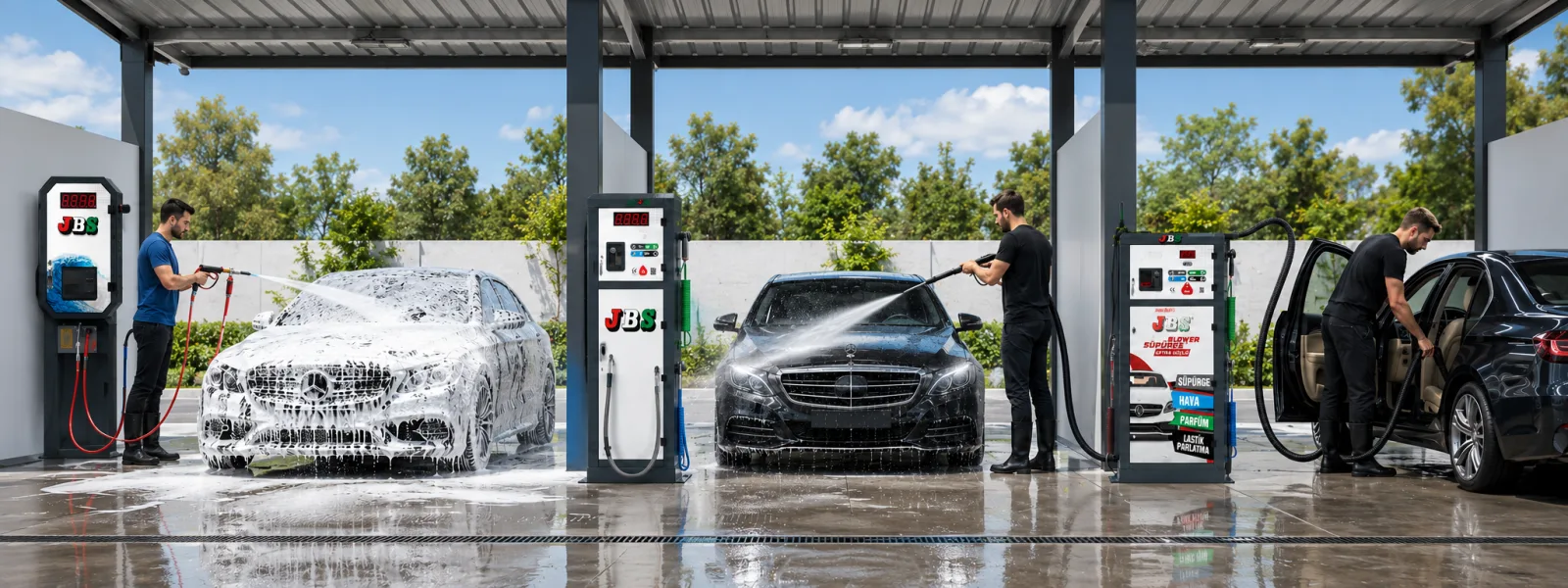
A self-service car wash allows the driver to wash the vehicle using programmes selected from a control panel after payment by coin, token, card or contactless method. Typical programmes include pre-wash, foam, high-pressure wash, rinse and wax.
How Does a Self-Service Car Wash Work?
The customer selects a programme and receives a defined amount of operating time. For effective cleaning, the programmes should be used in the correct order and the high-pressure gun should be kept at a safe distance from the vehicle.
Recommended Washing Order
- Park the vehicle correctly inside the wash bay.
- Use pre-wash to remove loose dirt and mud.
- Apply foam evenly over the vehicle.
- If a brush programme is available, use it only when the brush is clean and suitable for the paint.
- Rinse thoroughly with high-pressure water.
- Clean wheels and wheel arches separately.
- Apply the wax programme if desired.
- Dry the vehicle or allow excess water to drain before driving away.
Important Tips
Do not allow foam or chemicals to dry on the surface. Keep the gun moving, avoid spraying too closely at damaged paint or sensitive trim, and rinse the vehicle completely before the programme ends.
Can the Brush Scratch the Car?
A dirty or worn shared brush can trap sand and abrasive contamination. Where paint condition is a priority, rinse the brush carefully first or use a contactless method when available.
How Long Does It Take?
Wash time depends on vehicle size, dirt level, programme duration and the customer's technique. Efficient programme selection reduces unnecessary time and cost.
Conclusion
A self-service car wash gives good results when pre-wash, foam, rinse and wax are used in a logical sequence and the pressure equipment is handled carefully.
Recommended Solutions
Related Products and Categories
Common Questions
Frequently Asked Questions
What Determines Self-Service Car Wash Setup Prices?
The installation cost of a self-service car wash varies depending on the number of bays, machine functions, payment system, water and electricity infrastructure, installation area, equipment capacity and service support.
What should you consider when buying a self-service car wash system?
When buying a self-service car wash system, you should consider equipment quality, washing capacity, pressure and water flow, payment options, water treatment and recycling systems, detergent dosing, energy efficiency, maintenance requirements, spare parts availability, warranty, and after-sales technical support. It is also important to choose a system that can be customized according to the available space, expected customer traffic, climate conditions, and local infrastructure.
What systems are required to set up a self-service car wash facility?
A self-service car wash facility typically requires high-pressure washing systems, water storage and supply units, water treatment and recycling systems, detergent and foam dosing systems, payment terminals, control panels, vacuum stations, electrical infrastructure, drainage systems, and frost protection where necessary. Depending on the project, additional equipment such as spot-free rinse systems, air compressors, water softeners, security cameras, and remote monitoring systems can also be included.
Which car wash system is suitable for fuel stations?
For fuel stations, the most suitable car wash system depends on available space, customer traffic, budget, and the desired level of automation. Self-service car wash systems, automatic rollover car washes, and compact pressure washing solutions are commonly preferred. For high-traffic locations, durable equipment, fast washing cycles, reliable payment systems, water treatment, and low maintenance requirements are especially important.