Water Consumption Is an Operating Metric, Not a Marketing Number
For a mobile valeting or commercial detailing business, low water consumption can affect much more than the utility bill.
It changes onboard tank size, van payload, refill frequency, drainage requirements and how many bookings can be completed before the operator needs to replenish water.
That makes litres per vehicle a genuine commercial KPI.
However, it should not be treated as a universal specification.
Why Published Figures Vary So Much
Fortador provides a useful example of why comparisons need context. One of its mobile-steam articles cites approximately 2–5 litres per cleaning session, while another business-planning article uses 5–7 litres per vehicle. Its self-service steam system is instead specified at approximately 10 L/hour.
Those figures are not necessarily contradictory. They refer to different machines, programmes and working conditions.
For a commercial buyer, the lesson is simple: ask what the published consumption figure actually covers.
Pressure Washing Uses a Different Water Model
Traditional professional vehicle washing is normally specified using flow rate.
Kärcher reports that vehicle wash systems may require around 150–350 litres per wash, depending on system and programme, while self-service systems average roughly 80 litres. These are different technologies and should not be treated as a direct machine-to-machine comparison with steam cleaning.
For pressure washers, JBS likewise calculates operating water use from L/min multiplied by active trigger time.
Steam equipment is evaluated differently because water is converted into a controlled steam stream rather than being delivered continuously at a high liquid flow rate.
Measure Water Per Completed Service
Mobile and fixed-site operators should measure consumption against the service actually sold.
A maintenance exterior clean, a full interior-and-exterior valet and a detailed wheel/door-jamb service are not equivalent.
A useful commercial trial is to record:
starting tank level → number of completed vehicles → remaining tank level.
That creates a litres-per-completed-service figure that can then be used for pricing, route planning and tank selection.
Tank Capacity Is Not Water Consumption
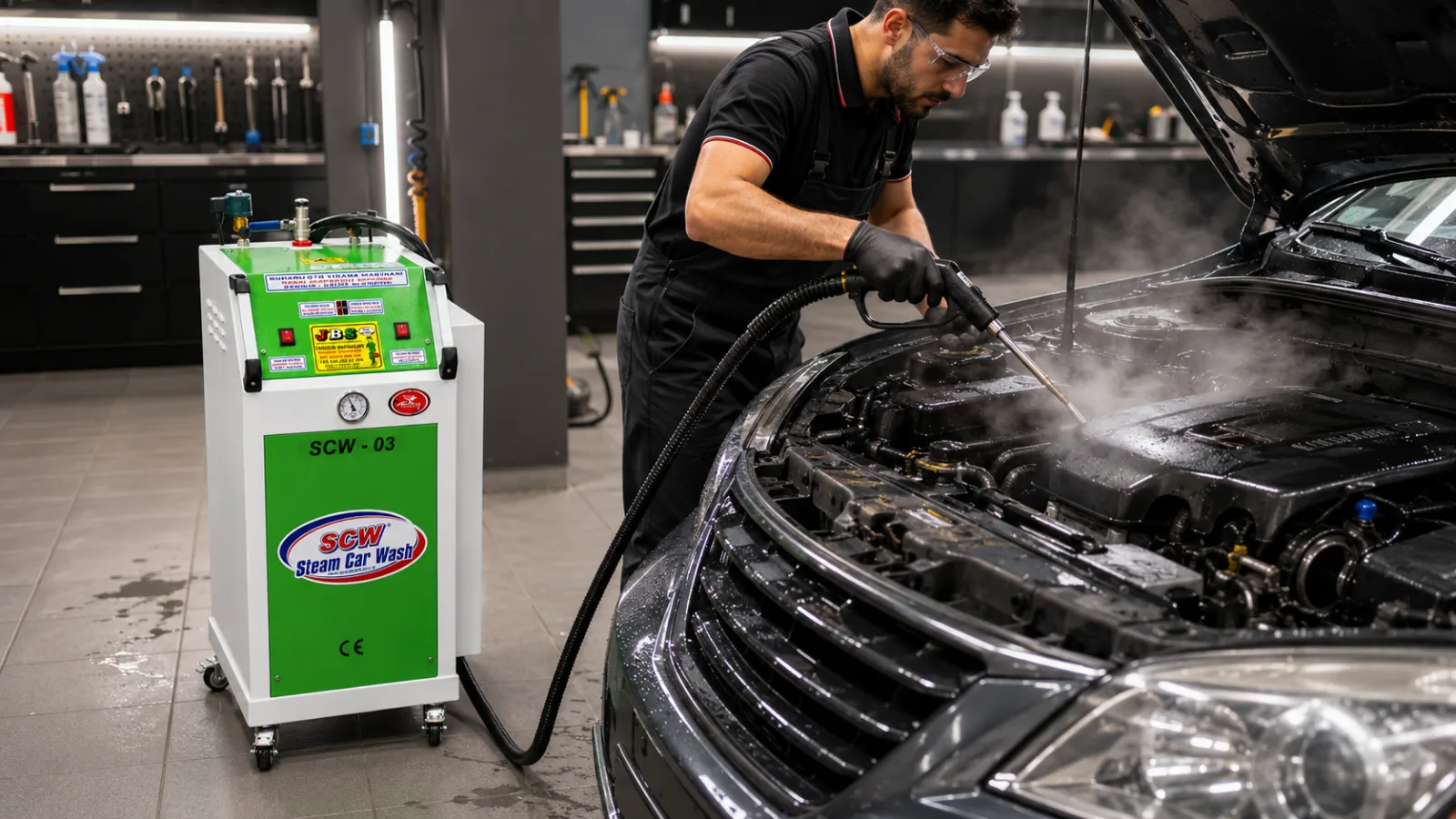
The JBS SCW-03 Steam Car Wash Machine has a 15-litre tank, dual guns, 8 bar steam pressure, 110–140°C operation and a 220 V supply.
A 15-litre tank does not mean that every vehicle consumes 15 litres.
Actual usage depends on active steam time and the job being completed.
This distinction matters when comparing machines because tank capacity affects autonomy, while consumption affects running cost.
For Mobile Valeting, Every Litre Adds Payload
Water has weight.
A van carrying unnecessary reserve water sacrifices payload that could otherwise be used for the steam unit, vacuum, extractor, chemicals, hose reels and other equipment.
A low-water workflow can therefore make the van easier to package and extend the number of jobs completed between refills.
This is why mobile operators should optimise litres per booking, not simply install the largest possible water tank.
Low Water Does Not Mean Steam Replaces Everything
Heavy mud and extensive road contamination may still justify pressure washing before steam is used for detailing.
Interior wet extraction can also require additional water.
The commercial advantage comes from assigning each process to the job where it performs efficiently rather than trying to make one machine handle every cleaning stage.
The wider equipment logic is covered in JBS's Professional Steam Cleaner for Auto Detailing guide.
Businesses can compare different capacities in the JBS Steam Car Wash Machine range and see how the equipment fits a complete operation at Auto Detailing Centers.
For a direct water-use comparison with pressure systems, review JBS's Professional Car Wash Pressure Washer Water Consumption guide.
Share your daily vehicle volume, service package and operating environment to request a commercial quotation from JBS Makina.
Recommended Solutions
Related Products and Categories
Common Questions
Frequently Asked Questions
Who Can Use a Steam Car Wash Machine?
Steam car wash machines can be used by car wash businesses, detailing centers, auto dealerships, service centers, rent a car companies, fleet operators and mobile vehicle cleaning services.
Steam Car Wash Machines for Businesses
Steam car wash machines are suitable for car wash businesses, auto detailing centers, car dealerships, service centers, rent a car companies, fleet operators and mobile vehicle cleaning services.
What Affects Steam Car Wash Machine Prices?
Steam car wash machine prices are determined by the selected model, steam capacity, number of steam guns, heating system, power requirements, accessory package, service support and professional usage needs.
Can You Wash a Car with a Steam Machine?
A car can be washed with a steam machine when the correct steam pressure, nozzle type, distance and cleaning method are used according to the vehicle surface and dirt level.
Why Does the Price of a Steam Car Wash Machine Vary by Model?
Steam car wash machine prices vary by model depending on steam capacity, number of steam guns, heating system, power requirements, accessory package, production quality, service support and professional usage needs.