A High PSI Number Does Not Make a Washer Commercial
UK domestic pressure washers can reach surprisingly high pressure ratings.
That is why comparing a homeowner machine and a commercial washer by PSI or bar alone gives a poor purchasing signal.
A commercial buyer should instead ask:
How many productive hours can this machine deliver repeatedly?
For a vehicle-wash business, uptime matters more than a specification that is reached only briefly.
Duty Cycle Is the Commercial Difference
A homeowner might pressure-wash a car, patio or driveway periodically.
A commercial operator can trigger the gun repeatedly across several vehicles every day.
That changes the load placed on:
the pump, motor, seals, bearings, hose and unloader system.
Professional equipment is therefore designed around repeated workload, maintenance and component replacement rather than occasional convenience alone.
Flow Rate Can Matter More Than Additional Pressure
The water still needs to remove loosened contamination from the surface.
For car washes, vans and larger vehicles, L/min can therefore have more effect on productive rinsing than simply selecting another 20 or 30 bar.
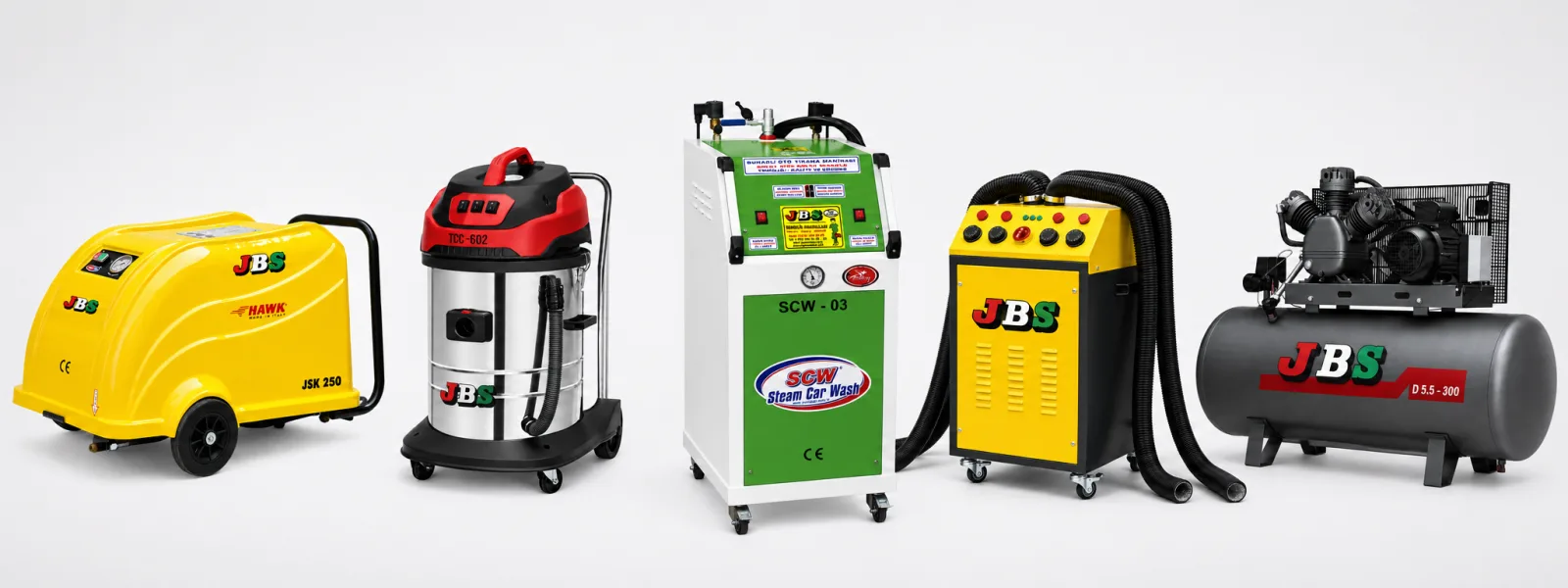
The JBS JSK-200 Commercial Pressure Washer combines adjustable pressure up to 200 bar with 14 L/min flow for regular commercial applications.
Commercial Equipment Should Be Repairable
A domestic user can sometimes tolerate replacing a small washer after several years.
For a business, equipment downtime interrupts revenue.
Commercial procurement should therefore consider whether pumps, seals, valves, hoses, guns and other wear components can be identified and replaced.
Service access and spare-parts availability belong in the Total Cost of Ownership, not outside it.
230 V Does Not Automatically Mean Domestic
Some professional equipment operates on single-phase electrical supplies.
Others require three-phase power as output and daily workload increase.
The supply voltage alone does not classify the washer.
UK buyers should confirm voltage, phase, frequency and circuit requirements for the exact machine, particularly when purchasing equipment manufactured for international markets.
When Is a Domestic Washer the Better Choice?
For personal car cleaning, garden furniture, patios and occasional household jobs, a domestic unit can be the more sensible purchase.
It is compact, easy to store and does not force the user to pay for commercial durability that may never be required.
Commercial specification begins to make financial sense when cleaning becomes a revenue-producing daily process.
Specify the Washer Around Productive Work
Review the JSK-200 Commercial Pressure Washer, compare professional options under Car Wash Machines, and match capacity to your Car Wash Business. Use the Vehicle Throughput Pressure Washer Guide to estimate workload. Provide daily vehicle volume, trigger-on hours, electrical supply and vehicle mix to request a commercial quotation from JBS Makina.
Recommended Solutions
Related Products and Categories
Common Questions
Frequently Asked Questions
Who Is a Semi-Professional Car Wash Machine Suitable For?
It is suitable for car wash businesses, service centers, dealerships, small fleets, and in-house cleaning areas with low or moderate daily vehicle volumes.
Semi-Professional Car Wash Machine Price Factors
The price of a semi-professional car wash machine varies depending on pressure level, water flow rate, pump quality, motor power, power supply, accessory package, service support and intended usage intensity.