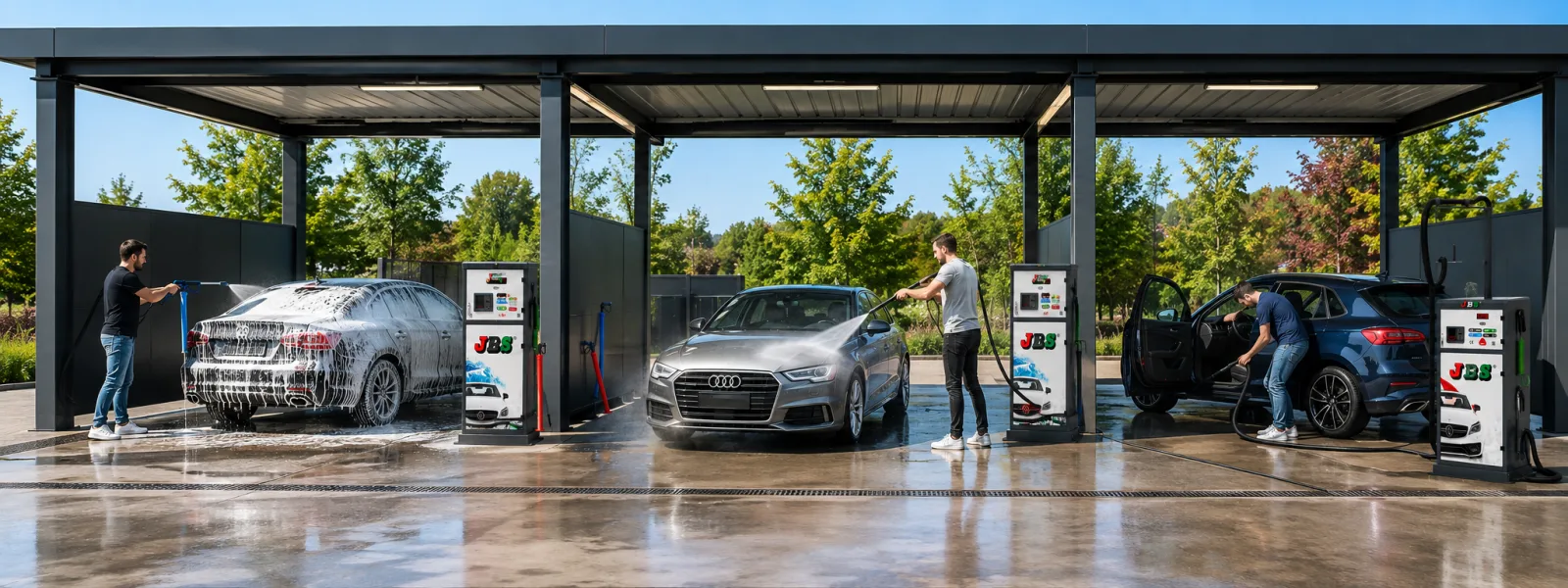
Start with the wash bay, not the foam appearance
UK commercial buyers often compare foam equipment by injector size, nozzle configuration, flow rate and compatibility with the existing pressure-washer installation.
That is the right approach.
A foam lance that is poorly matched to water flow can produce disappointing results regardless of the detergent being used. Likewise, a larger tank does not automatically create better foam.
The commercial objective is consistent chemical application without slowing down the bay.
Staffed hand wash: keep the system flexible
For a staffed hand car wash or valeting operation, a compressed-air foam tank remains straightforward.
The operator can apply pre-wash chemical where it is actually required, adapt application to vans or heavily contaminated vehicles and work independently from a timed customer programme.
JBS J-KT100 provides a 100-litre capacity, 5-bar operating pressure and a 10-metre hose. It requires a suitable compressed-air supply.
For busy staffed sites, the larger capacity primarily reduces refill interruptions; it should not be purchased on the assumption that 100 litres produces “better” foam than a smaller tank.
Self-service sites need repeatability
An unattended or customer-operated site has a different requirement.
A self-service car wash foam system needs predictable programme time, chemical dosing and simple customer operation. The operator is no longer standing beside every vehicle controlling how much product is applied.
That changes the purchasing decision.
Single-bay sites may need a simple wash-and-foam configuration, while petrol forecourts and higher-throughput wash parks may justify dual or centralised systems.
The commercial advantage is control: programme duration and chemical consumption can be planned around the site’s pricing model.
Which option costs less to run?
There is no universal answer.
For an existing staffed wash with a capable compressor, a foam tank may be the lower-complexity investment.
For a purpose-built self-service site, an integrated car wash foam system can make more commercial sense because foam becomes part of a timed paid programme rather than a manual labour task.
Compare chemical cost per wash, refill frequency, labour requirement, downtime and the number of vehicles the site must serve during peak periods.
For a staffed bay, start with the JBS J-KT100 100 L Foam Tank; if the site is moving toward customer-operated bays, compare the wider Self-Service Car Wash Systems range. You can match the equipment to typical Car Wash Business applications and use the Self-Service Car Wash Equipment guide when planning programmes, payment and dosing. Once bay count, expected throughput and available utilities are clear, request a project quotation from JBS.
Recommended Solutions
Related Products and Categories
Common Questions
Frequently Asked Questions
How Should You Choose Between a 60-Litre and 100-Litre Foam Tank?
The choice should be based on daily vehicle volume, foam consumption, refill frequency, and workspace conditions.
Which Safety Components Are Important on a Foam Tank?
The safety valve, pressure gauge, regulator, and secure connections should be checked regularly.