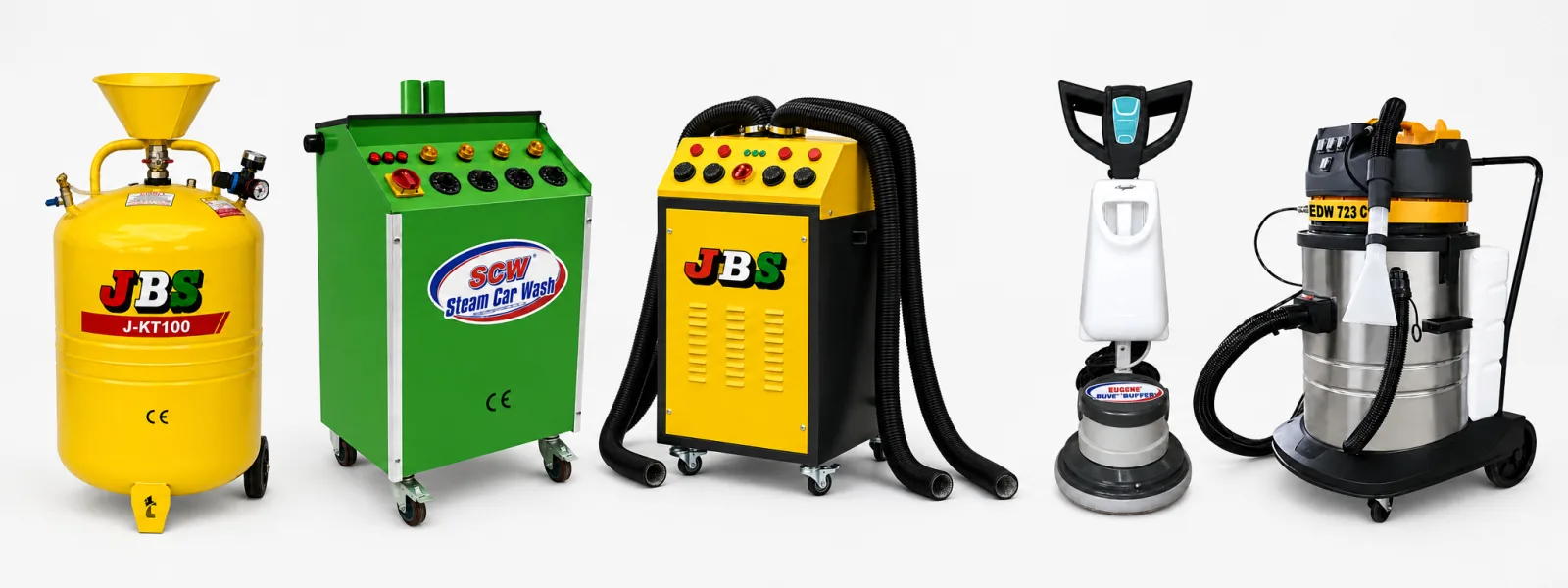
Capacity Should Follow Throughput, Not Foam Thickness
For commercial operators, moving from a 60-litre to a 100-litre foam tank does not automatically produce thicker foam.
Both JBS models operate at 5 bar and use a 10-metre hose with a trigger-operated foam gun. Foam performance is influenced by detergent dilution, compressed-air supply, pressure regulation and application setup.
Tank size primarily changes how often operators need to refill the prepared solution.
Where a 60-Litre Tank Makes Commercial Sense
The J-KT60 60 L Foam Tank targets operations where manoeuvrability and sensible working capacity matter more than maximum volume.
It is suited to:
-
independent car washes,
-
professional valeting bays,
-
detailing studios,
-
dealerships and workshops,
-
sites with moderate daily vehicle throughput.
For smaller bays, carrying unnecessary solution volume can also make a larger unit less convenient to move.
Why Higher-Throughput Sites Move to 100 Litres
Busy car-wash sites lose productive time every time a foam unit needs refilling.
The J-KT100 100 L Foam Tank provides a larger prepared-solution capacity while retaining the same 5 bar working pressure.
This is particularly relevant for fleet operators, busy commercial washes, van preparation sites and businesses handling vehicles consecutively throughout a working shift.
Technical Comparison
| Specification | J-KT60 | J-KT100 |
|---|---|---|
| Capacity | 60 L | 100 L |
| Working pressure | 5 bar | 5 bar |
| Hose length | 10 m | 10 m |
| Foam gun | Trigger-operated | Trigger-operated |
| Refill frequency | Higher | Lower |
| Typical workload | Low–medium | Medium–high |
Compare both units in the JBS Foam Tanks range.
Check Compressor Air Delivery Before Ordering
In the UK professional-equipment market, pneumatic foam sprayers are commonly specified not only by tank volume but also by working pressure, compressor requirement, pressure gauge and safety equipment.
The compressor must therefore provide enough usable airflow for the intended duty cycle.
A large receiver alone does not guarantee adequate performance.
Does a 100-Litre Tank Use More Detergent?
Not automatically.
Chemical cost per vehicle depends on dilution ratio, application time, vehicle size and operator technique.
The 100-litre tank simply stores more prepared solution between refills.
For a business washing vans or commercial vehicles, this can be significantly more useful than comparing tank size alone.
Choose Around Your Wash Operation
A 60-litre system is generally the more practical choice where daily throughput is moderate and the unit must remain compact.
A 100-litre system becomes attractive where downtime between consecutive vehicles matters.
For a complete installation, compare professional car wash equipment, review solutions for car wash businesses, and use the Professional Car Wash Machines and Equipment guide when planning the wider wash bay. Send your daily vehicle throughput and compressor specification to JBS Makina for a technical quotation.
Recommended Solutions
Related Products and Categories
Common Questions
Frequently Asked Questions
How Should You Choose Between a 60-Litre and 100-Litre Foam Tank?
The choice should be based on daily vehicle volume, foam consumption, refill frequency, and workspace conditions.
Can Every Chemical Be Used in a Foam Tank?
Professional chemicals compatible with the tank, seals, and hose materials should be used.
Which Safety Components Are Important on a Foam Tank?
The safety valve, pressure gauge, regulator, and secure connections should be checked regularly.