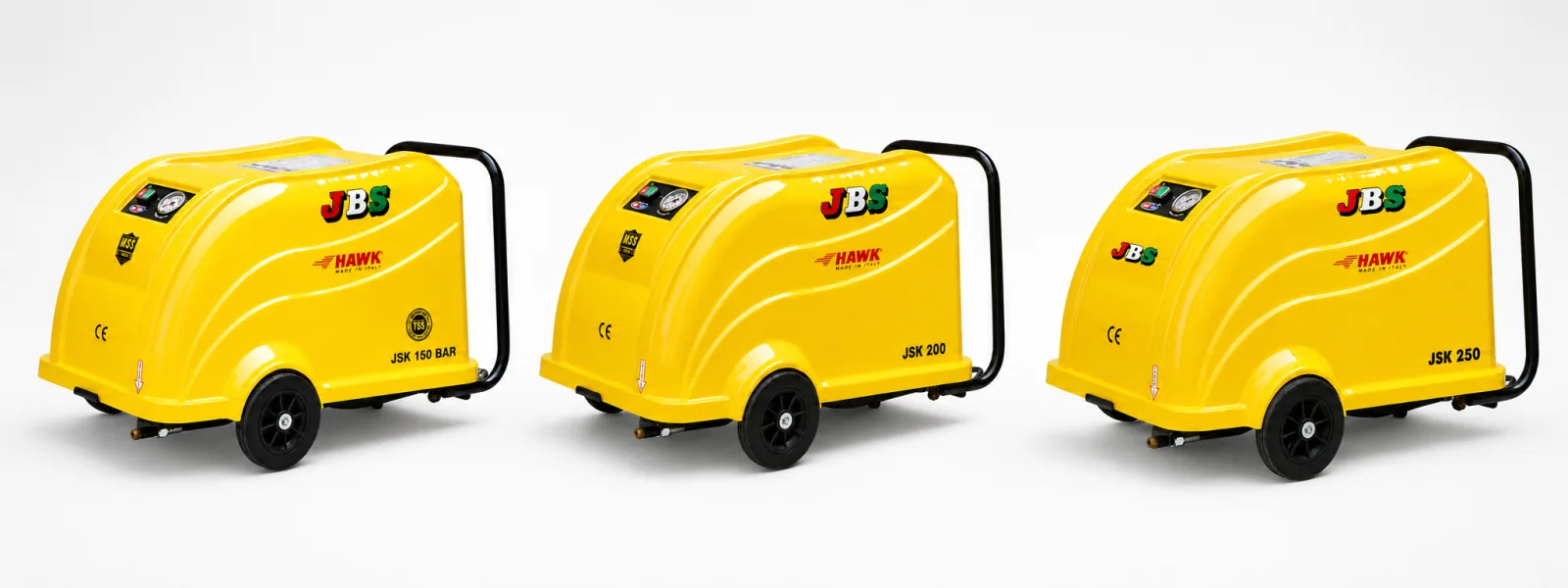
Differences Between 150 Bar, 200 Bar, and 250 Bar Pressure Washers
Choosing between 150, 200 and 250 bar affects cleaning speed, electrical requirements, water consumption and total operating cost. The correct pressure class should match the vehicle type, contamination level and daily workload rather than simply targeting the highest PSI.
A 150 bar pressure washer, 200 bar pressure washer and 250 bar pressure washer can all be commercial machines, but they serve different operating requirements.
150 Bar Pressure Washer: Light Commercial and Vehicle Cleaning
150 bar equals approximately 2,176 PSI. This class is well suited to passenger cars, motorcycles, detailing operations and light-commercial cleaning where extreme pressure is unnecessary.
The JBS JSK-150 combines:
-
20–150 bar adjustable pressure
-
11 L/min water flow — approximately 2.9 GPM
-
3 kW motor
-
220 V single-phase power
-
Italian HAWK pump
The JSK-150 Cold Water Pressure Washer is therefore practical for businesses without three-phase electrical infrastructure.
Typical applications include:
-
Passenger cars
-
Motorcycles
-
Light commercial vehicles
-
Dealerships
-
Small and medium car wash operations
200 Bar Pressure Washer: Professional Car Wash Duty
200 bar equals approximately 2,901 PSI and provides a stronger balance between pressure and water flow for professional vehicle washing.
The JBS JSK-200 provides:
-
20–200 bar adjustable pressure
-
14 L/min — approximately 3.7 GPM
-
5.5 kW motor
-
380 V three-phase power
-
Italian HAWK pump
The JSK-200 Commercial Pressure Washer is positioned for higher daily vehicle volumes, workshops, fleets and professional car wash bays.
For sustained commercial duty, pump construction also matters. Triplex plunger pumps with brass manifolds and ceramic plungers are widely used in professional equipment because these components are designed for durability and serviceability.
250 Bar Pressure Washer: Industrial-Grade Cleaning
250 bar equals approximately 3,626 PSI. This pressure class is intended for more demanding contamination and heavy-duty applications.
The JBS JSK-250 combines:
-
20–250 bar adjustable pressure
-
15 L/min — approximately 4.0 GPM
-
5.5 kW motor
-
380 V three-phase power
-
Italian HAWK pump
The JSK-250 Cold Water Pressure Washer is designed for commercial vehicles, heavy equipment and demanding cleaning work.
Typical applications include:
-
Trucks and trailers
-
Construction sites
-
Heavy machinery
-
Agricultural equipment
-
Chassis cleaning
-
Industrial floors and equipment
A 250 bar pressure washer is not automatically better than a 200 bar machine. Excess pressure can be unnecessary for routine passenger vehicle washing.
Pressure vs Water Flow: Why GPM Matters
Pressure and flow perform different jobs.
PSI creates stripping force. GPM provides rinsing capacity.
Mi-T-M uses the concept of Cleaning Units:
Cleaning Units = PSI × GPM
For example, a lower-pressure machine with higher flow can sometimes complete rinsing work faster than a higher-pressure machine with restricted flow. Professional contractors often place significant value on GPM because chemicals loosen contamination while water flow removes it.
Using the JBS cold-water range:
| Model | Pressure | Approx. PSI | Flow | Approx. GPM | Power |
|---|---|---|---|---|---|
| JSK-150 | 150 bar | 2,176 PSI | 11 L/min | 2.9 GPM | 3 kW / 220 V |
| JSK-200 | 200 bar | 2,901 PSI | 14 L/min | 3.7 GPM | 5.5 kW / 380 V |
| JSK-250 | 250 bar | 3,626 PSI | 15 L/min | 4.0 GPM | 5.5 kW / 380 V |
Pump, Motor and Electrical Supply Matter Too
Professional buyers should compare more than pressure and flow.
Key technical factors include:
-
Pump construction
-
Brass pump head or manifold
-
Ceramic plungers
-
Motor power
-
Pump RPM
-
Thermal protection
-
Bypass or Total Stop systems
-
Single-phase vs three-phase supply
-
Spare-parts availability
Kränzle, for example, highlights forged special-brass pump heads and ceramic-coated plungers specifically for improved service life in professional equipment.
Which Pressure Washer Should You Choose?
Use the workload as the starting point:
-
150 bar: passenger cars, motorcycles and light-commercial work
-
200 bar: professional car wash bays, fleets and higher daily vehicle volumes
-
250 bar: trucks, heavy machinery, construction and industrial cleaning
If your site only has single-phase power, electrical infrastructure may also determine the available machine class. In the JBS range, JSK-150 uses 220 V single-phase power, while JSK-200 and JSK-250 use 380 V three-phase power.
What Affects Commercial Pressure Washer Prices?
Commercial pressure washer prices should not be compared by bar rating alone.
The purchase price is influenced by:
-
Pump manufacturer and construction
-
Flow rate
-
Motor power
-
Electrical system
-
Hot or cold water capability
-
Safety and control systems
-
Hose and accessory package
-
Warranty
-
Spare-parts and service support
A lower purchase price can become expensive if the machine increases labor time or suffers frequent downtime.
Get the Right Pressure and Flow for Your Operation
The correct machine is the one that matches your actual workload.
Compare JBS commercial pressure washers for car washes or request a technical recommendation based on vehicle type, daily volume, available electrical supply and cleaning requirements.
Recommended Solutions
Related Products and Categories
Common Questions
Frequently Asked Questions
How Are Car Wash Machine Prices Determined?
Car wash machine prices vary depending on pressure capacity, water flow rate, pump quality, heating system, power requirements, accessories, service support and business usage needs.
Is a Single-Phase Car Wash Machine Sufficient for Professional Use?
It may be sufficient for small businesses with a low daily vehicle volume. However, three-phase models may be more suitable for intensive use.
Can a 220 V Car Wash Machine Be Used to Wash Commercial Vehicles?
It can be used for light commercial vehicles. However, more powerful three-phase machines should be preferred for intensive commercial-vehicle washing, chassis cleaning, and heavy dirt.
Which Car Wash Machine Model Is Best for Your Business?
The right car wash machine model should be selected according to daily vehicle volume, pressure requirement, water flow rate, power supply, usage intensity, surface type, accessories and service support.