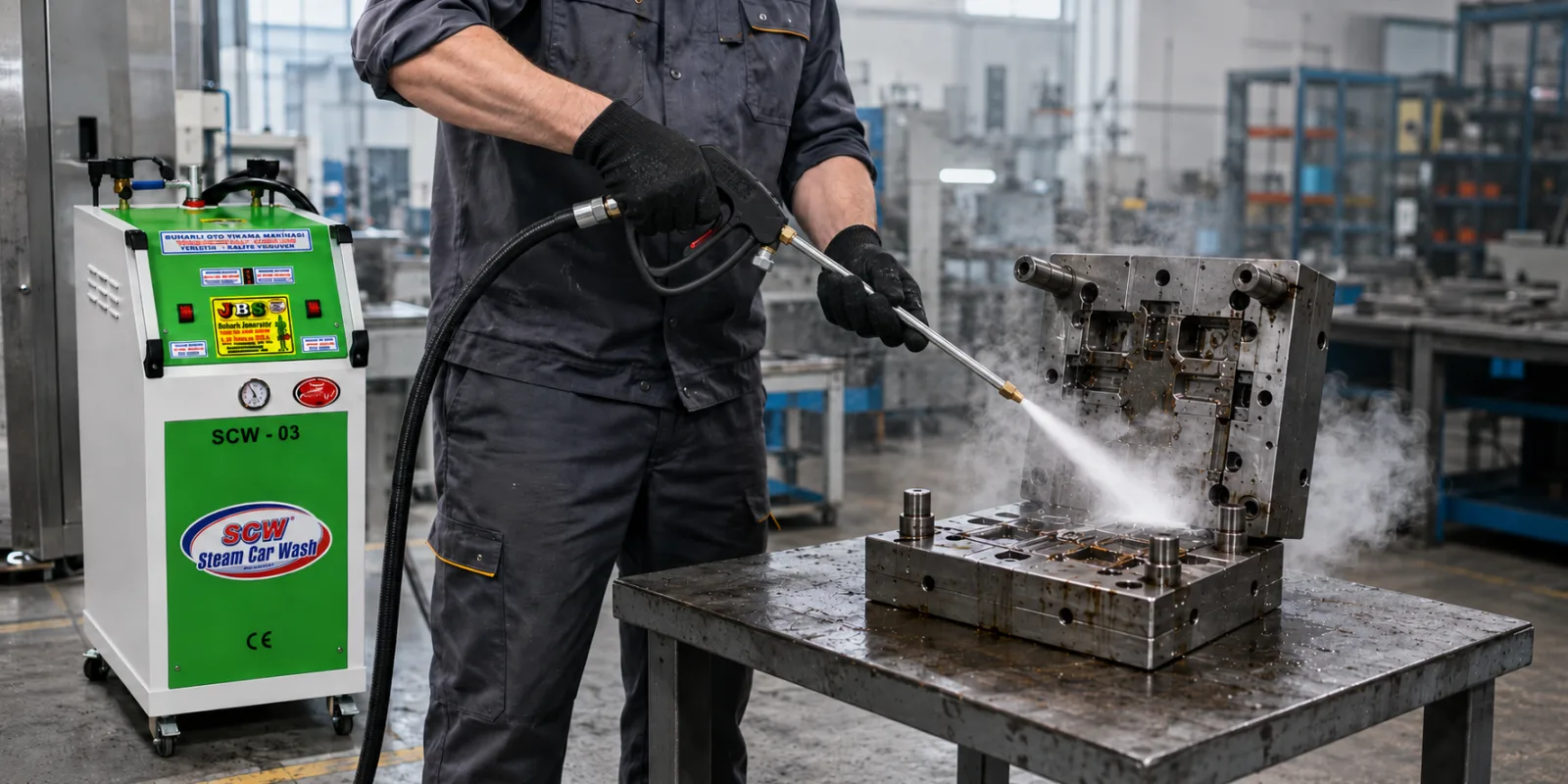
Why Steam Clean Injection Molds?
Injection molds operate under repeated heat, pressure and production cycles.
Over time, resin residue, release agents, lubricants, pigment deposits and degraded polymer contamination can build up on mold surfaces.
English-language industrial competitors such as REA focus heavily on one business problem: reducing mold-maintenance downtime while maintaining production quality.
That makes steam cleaning particularly interesting for routine maintenance where dismantling the entire tool would otherwise take valuable production time.
Where Does Steam Fit into Mold Maintenance?
Steam cleaning is not the only mold-cleaning technology.
Industrial plants also use:
dry ice | ultrasonic cleaning | laser cleaning | chemical cleaning | high-pressure washing
The correct method depends on the residue and mold design.
Steam performs particularly well where heat can soften oily or greasy contamination and where operators need access to complex external mold surfaces and machinery details.
Cleaning Production Equipment
The same industrial steam system can also be used, where suitable, on:
- machine frames,
- production tooling,
- mechanical assemblies,
- oil-contaminated components,
- accessible conveyor structures,
- workshop equipment.
Cimel specifically markets dry saturated steam for molds, industrial machinery and production equipment because it can remove oil and manufacturing residues while limiting excessive water use.
Protect Precision Mold Surfaces
Precision molds should never be treated as ordinary dirty metal.
Before steaming, check:
surface coating | mold steel | seals | polished cavities | temperature limits | electrical components
The nozzle should remain moving instead of applying concentrated heat to a single precision area.
Moisture must also be removed after cleaning. Mold-cleaning specialists warn that steam introduces moisture, which makes proper drying particularly important on corrosion-sensitive tooling.
Can Steam Reduce Production Downtime?
Potentially, yes.
One advantage of industrial steam cleaning is that operators can clean accessible mold and machine surfaces without large wash-down volumes.
For factories, the real value is therefore not simply “cleaner molds”. It can also mean:
faster maintenance | reduced manual scrubbing | lower water usage | quicker changeovers | less production interruption
Choosing an Industrial Steam Cleaner
For manufacturing, look beyond maximum pressure.
Important factors include:
steam output | temperature | continuous operating capacity | hose length | accessories | three-phase power | number of operators
The JBS SCW-05 produces 15 bar steam at 170–210°C, with a 33-litre tank, 380 V power and dual-gun operation.
It can be evaluated for suitable industrial machinery, metal equipment and mold-maintenance applications after material compatibility has been checked.
JBS SCW-05 Industrial Steam System
Conclusion
For injection-molding plants, steam cleaning should be viewed as part of a preventive mold-maintenance strategy, not simply as a washing method.
The correct process depends on contamination type, surface finish, corrosion risk and required production uptime.
Recommended Solutions
Related Products and Categories
Common Questions
Frequently Asked Questions
Can steam cleaning replace disinfection?
Steam cleaning should not automatically be considered a substitute for disinfection in every application. On food-contact surfaces, the facility's cleaning, rinsing, and sanitizing procedures must still be completed.
How to Choose the Right Steam Car Wash Machine
The most important criterion when choosing a steam car wash machine is matching the machine’s capacity, steam performance, working time, power requirements and accessory support with the business’s actual cleaning needs.
Which Cleaning Machine Is Suitable for Industrial and Production Areas?
Hot and cold water washers, high-pressure water jet machines, compressors, and industrial vacuum cleaners can be used in industrial plants, factories, and production areas. The machine should be selected according to the intensity of oil, grease, rust, production residue, and heavy dirt.